Get Full Government Meeting Transcripts, Videos, & Alerts Forever!
Get email alerts on the Cannabis Zoning topic
No spam. Unsubscribe anytime.
Residents and small-business applicant clash over proposed adult-use cannabis zoning in Pine County
Summary
Public commenters raised concerns about odor, nuisance definitions and inconsistent cross‑references in the county''s draft adult‑use cannabis ordinance while a prospective microbusiness owner urged the board to adopt the zoning to allow local retail and small businesses to operate.
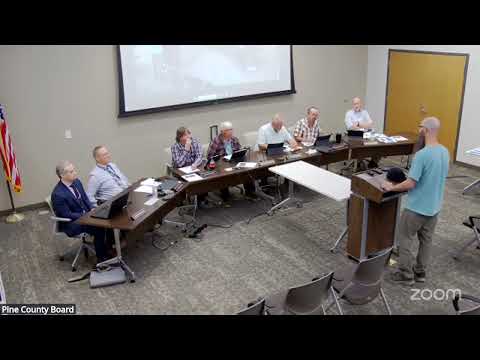
Public comment at a Pine County Board meeting on Monday focused on the county''s draft adult‑use cannabis ordinance, with residents warning the rules as written could allow cannabis businesses near homes and a local applicant urging the board to adopt clear, workable zoning.
Those opposing broader siting options urged the county to treat cannabis operations like other potentially disruptive land uses and to preserve residential neighborhoods. "Not that we're banning it, but they don't necessarily belong in residential communities," a resident said during the public forum, arguing that industrial or commercially zoned areas are more appropriate.
Supporters of permitting local businesses said the zoning work already done by county staff and the zoning board balances state regulation and reasonable restrictions. "They have worked very diligently ... making sure everything is within reasonable restrictions," said Trent Canenberg, who said he has preapproval for a microbusiness and is seeking a retail license. "They made it so small businesses like myself can operate, and I'm very appreciative of that."
Several commenters cited specific concerns they said are missing or inconsistent in the draft ordinance: nuisance definitions, odor and environmental review processes, and how conditional or interim permits would be applied. One speaker referred to a separate, countywide building ordinance "last amended March 18" and asked which ordinance should take precedence. "Which ordinance overrides the other, and why does the ordinance 2024‑50 regulating cannabis begin with the purpose of this ordinance is to protect the public health, safety, and general welfare of its residents?" the speaker asked.
Residents also raised practical complaints about potential odors and scale. One commenter said published material links cannabis production odors to the same degree of nuisance associated with some agricultural operations and questioned water use and plant counts referenced in articles. Another asked whether cannabis is an agricultural product or remains a Schedule I substance under federal law and whether interim use permits or building permits would be required in agricultural zones.
Board members did not take formal action during the public‑comment segment. Multiple speakers asked that questions about cross‑references, environmental assessment requirements and conditional‑use criteria be clarified in the ordinance and in related county zoning materials.
The public comments combined testimony from opponents worried about siting and nuisances and from at least one potential operator asking the county to finalize zoning that would allow small, locally owned cannabis businesses to operate under state rules. The county will consider the public input as staff and the zoning board finalize the ordinance language for future action.