Get Full Government Meeting Transcripts, Videos, & Alerts Forever!
Get email alerts on the Rural Fire Funding topic
No spam. Unsubscribe anytime.
Committee hears bill to create advisory committee on rural fire protection district funding
Summary
Senate Bill 454 would direct the State Fire Marshal to convene an advisory committee to study funding options and report to the Legislature by Dec. 31, 2026; supporters said the study is intended to inform future funding decisions for rural fire protection districts.
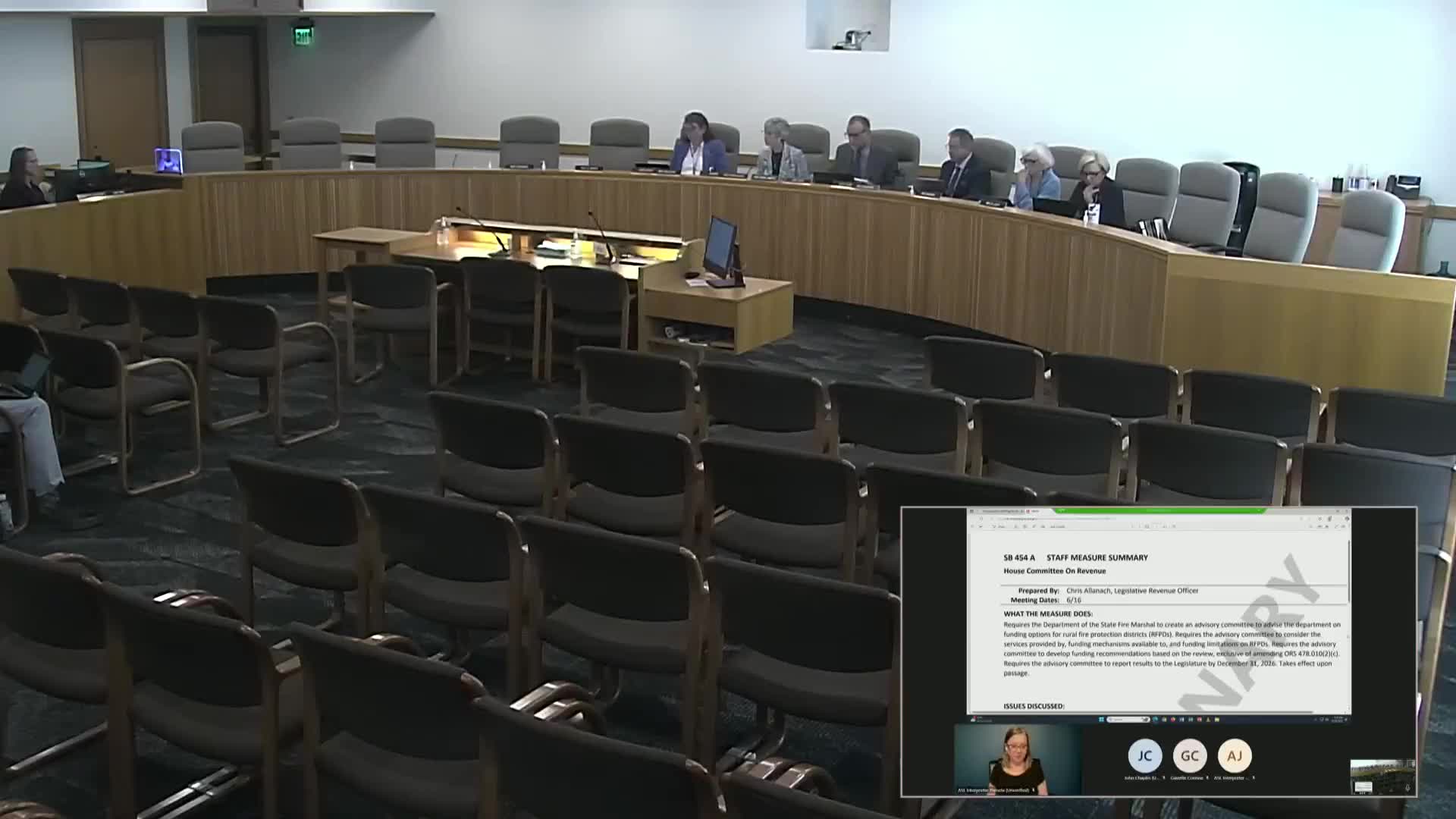
The House Committee on Revenue heard testimony Monday on Senate Bill 454, which would require the State Fire Marshal to convene an advisory committee to evaluate funding options for rural fire protection districts (RFPDs) and report recommendations to the Legislature by Dec. 31, 2026.
Chief Ben Stangi of Polk County Fire District No. 1, testifying on behalf of the Oregon Fire Chiefs Association and the Fire and EMS chapter of the Special Districts Association of Oregon, said the measure would create a data-informed pathway to address funding shortfalls in rural districts. “This bill represents an essential step toward addressing one of the most critical issues facing the Oregon Fire Service today, sustainable funding for our rural fire protection districts,” Stangi told the committee.
Stangi said about 250 of the more than 300 fire agencies in Oregon are rural fire protection districts and described growing service demands — including structure fires, special rescue, opioid overdoses and behavioral-health calls — that rely on funding models created in a different era. He said a 2024 summit of 30 fire-service leaders made it clear that inadequate and outdated funding mechanisms are central to challenges in recruitment, equipment maintenance and response capacity.
The bill does not impose any new taxes or fees, Stangi said: “Senate bill 454 dash 2 does not impose any taxes or fees. It simply creates a pathway for us to step back and analyze the system.” He also said the bill passed unanimously out of the Senate.
Representative Marsh asked whether the State Fire Marshal had signaled support; Stangi replied that the fire marshal had hosted a 2024 summit and had been engaged in follow-up conversations. “She is very aware and has been engaged with us throughout this process and very supportive,” Stangi said.
The committee closed the public hearing after questions. The transcript records no committee action on SB 454 during this meeting.
Why this matters: committee discussion framed the bill as a fact-finding step intended to produce recommendations to inform future policy choices about how to sustainably fund rural fire districts.
Next steps: if the committee schedules a work session it may consider amendments and a recommendation before sending the measure to the chamber floor.