Get Full Government Meeting Transcripts, Videos, & Alerts Forever!
Get email alerts on the Unemployment Tax Credit topic
No spam. Unsubscribe anytime.
House committee approves tax credit to partly offset COVID-era unemployment tax increases
Summary
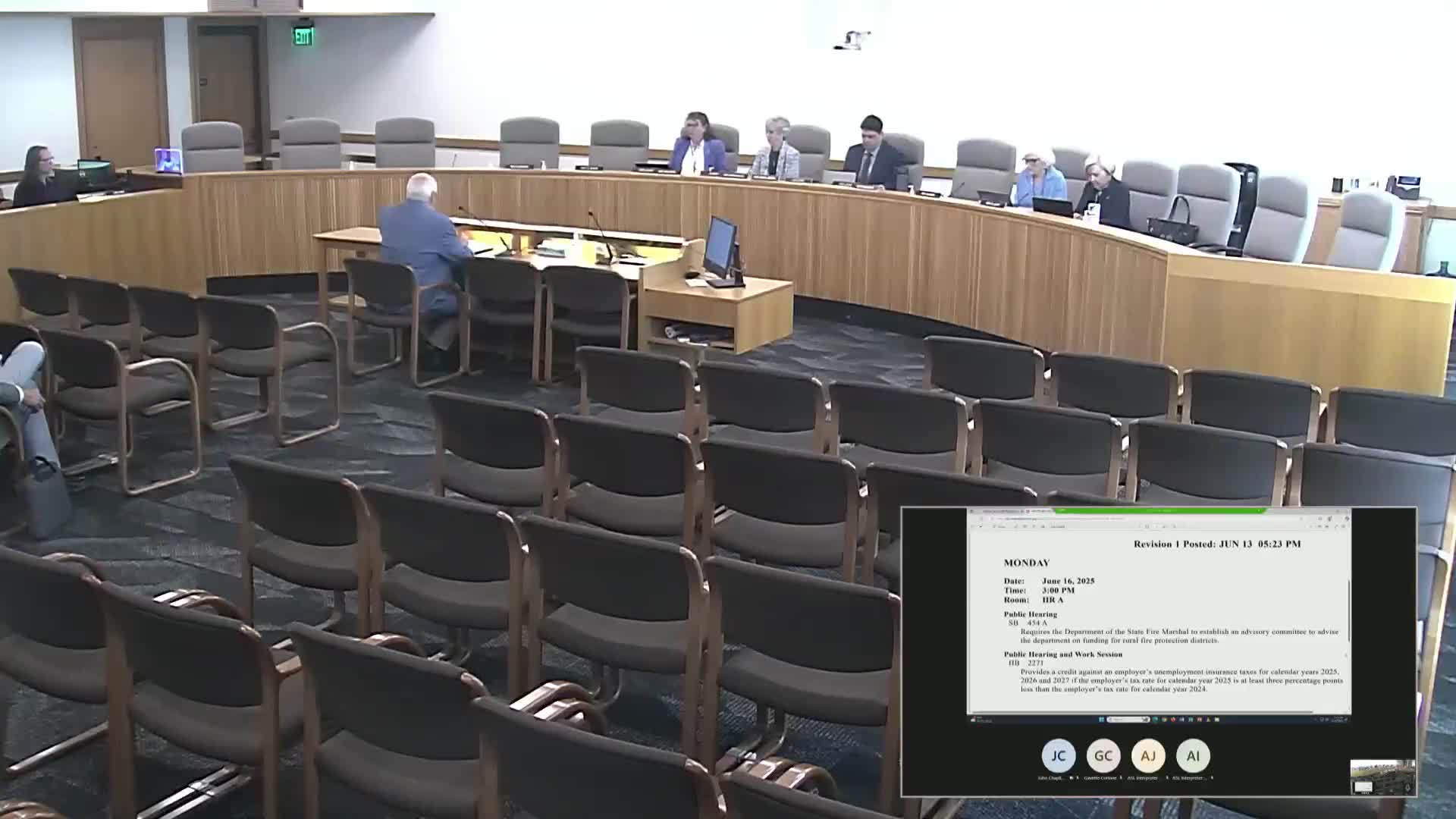
House Committee on Revenue Chair Nathanson on Monday moved House Bill 2,271 as amended out of committee after adopting a dash 2 amendment that reduces the eligibility threshold and narrows the credit.
House Committee on Revenue Chair Nathanson on Monday moved House Bill 2,271 as amended out of committee after adopting a dash 2 amendment that reduces the eligibility threshold and narrows the credit.
The bill creates a nonrefundable tax credit against employers’ unemployment insurance payroll taxes for employers whose tax rate in 2025 is lower than in 2024 by a specified margin. The dash 2 amendment lowers the required reduction from 3 percentage points to 2.5 percentage points and limits the 2025 credit to the lesser of the employer’s 2025 taxes or $5,000; under the bill’s original language the credit could extend into the subsequent years with different limits.
Supporters said the credit is aimed at employers who were affected by changes to unemployment insurance rate calculations enacted during the COVID-19 pandemic. Representative Wright, a sponsor and testifier at the hearing, said the proposal was narrowed to avoid harming the unemployment insurance system while providing relief to small firms: “The concept was that when COVID hit, businesses were closed and, they were stuck with the rate,” Representative Wright said. She described the dash 2 change as an effort to “give small businesses the opportunity to recoup at least something.”
Business testimony came from John Chaplin, who told the committee he had paid “in excess of $25,000 in unemployment premiums that I wouldn't have paid otherwise.” Chaplin said the bill will return only a portion of what affected employers paid but asked lawmakers to “do something to make it right.”
Agency officials told the committee the estimated revenue impact is modest and would not threaten the fund’s solvency. David Gens of the Oregon Employment Department said the department estimates about $1,200,000 in reduced receipts to the Unemployment Insurance trust fund in the 2025–27 biennium and roughly $440,000 in a following biennium. “The fund is solvent, and we don't anticipate that this amount of money will create any impact or risk the solvency of the fund,” Gens said.
Committee discussion included questions about the size and makeup of businesses that would benefit. Representative Wright said roughly 1,100 businesses would be eligible under the proposal and that about 80% of those employers have fewer than 25 employees.
In a work session following the hearing, Vice Chair Walters moved to adopt the dash 2 amendment dated 05/06/2025; the motion passed. Walters then moved HB 2,271 as amended to the floor with a due-pass recommendation; that motion also passed. The committee assigned Representative Wright to carry the bill to the floor.
No roll-call vote totals were recorded in the transcript; both procedural motions were recorded only as passing.
Why this matters: supporters said the bill addresses what they described as an unintended consequence of earlier COVID-era unemployment insurance legislation (House Bill 3389) that increased some employers’ rates. Opponents were not recorded in testimony, and the committee accepted the amendment and advanced the bill for further consideration on the House floor.
The bill text, amendment language, and fiscal estimates are posted on the legislative information site (OLIS).