Get Full Government Meeting Transcripts, Videos, & Alerts Forever!
Get email alerts on the Education Attainment topic
No spam. Unsubscribe anytime.
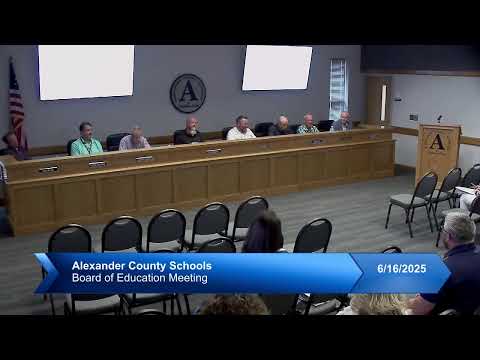
Alexander County Schools unanimously endorses My Future NC attainment goal
Summary
The Alexander County Board of Education voted unanimously Monday to endorse My Future NC’s statewide attainment goal of 2,000,000 credentialed North Carolinians by 2030 and to adopt a local stretch goal that 4,842 residents ages 25–44 in Alexander County hold a postsecondary degree or credential by 2030.
The Alexander County Board of Education voted unanimously Monday to adopt a resolution endorsing My Future NC’s statewide goal that 2,000,000 North Carolinians hold a “high quality credential or postsecondary degree” by 2030 and to adopt a local stretch goal that 4,842 residents ages 25 to 44 in Alexander County reach that level of attainment by 2030.
My Future NC regional impact manager Dr. Kim Case presented county and regional attainment data to the board and described the group’s origins and mission. “My Future NC is a statewide nonprofit. We were formed out of bipartisan legislation in 2019 with the specific purpose of lifting up an educational attainment goal for our state,” Case said, and she emphasized that the organization counts short-term credentials and trades certifications alongside degrees.
The presentation laid out why local leaders say the measure matters: local workforce projections from the Department of Commerce signal shifting employer demand, and My Future NC provides county and school-district attainment profiles and a legislative reporting mechanism to monitor progress. Case told the board Alexander County currently has 3,087 residents ages 25–44 with postsecondary degrees or credentials, and she described the district’s “leaky pipeline” — students persisting to year two of college but dropping off before completing degrees — as a focal point for local action.
Board members asked how the resolution would affect district priorities. Board member Rob Arguelles pressed the presenters about labor-market fit and the risk of producing “overqualified, underemployed personnel,” saying, “So I don't understand why this resolution is asking that we open up the floodgates and add even more education pedigree to our population when the need isn't quite there other than the bachelor's degree.” Case and other speakers clarified that My Future NC’s definition of attainment includes short-term, stackable credentials and trade certificates, and stressed collaboration with community colleges and economic-development partners to align training with local job openings.
Superintendent Dr. Griffin noted the district’s role in both graduating today’s students and engaging the parents and adults in the 25–44 cohort: “we've got to find a way to keep them here too,” he said, pointing to housing and childcare as factors that affect whether credentialed residents remain in the county.
Vice Chairman Degenhardt moved to approve a written resolution that endorses both the statewide target and the Alexander County stretch goal and directs the district to work with My Future NC and local partners on an action plan. Jesse Bowles seconded the motion; the board voted aye unanimously.
The resolution asks the district to adopt the local stretch goal, to partner with local business, higher-education and government leaders to develop measurable action steps, and to share successful practices with peer communities. Board members said the vote was an initial step and described further collaboration — including outreach with the county’s economic-development officials, community college partners and chambers of commerce — as the next phase.
The board agreed the resolution does not mandate a single education pathway for every student and that career and technical education, short-term credentials and apprenticeships are included in the attainment definition. The district will return to the board as partners flesh out an action plan and identify specific local steps to align education programming with regional workforce needs.