Get Full Government Meeting Transcripts, Videos, & Alerts Forever!
Get email alerts on the Short Term Rentals topic
No spam. Unsubscribe anytime.
Pacifica planning commission backs revised short‑term rental rules, recommends strict new limits and enforcement
Summary
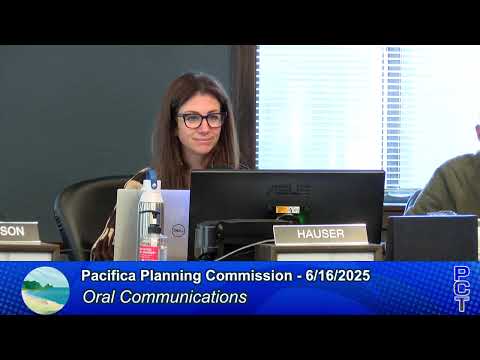
Pacifica planning commissioners voted unanimously June 16 to recommend that the City Council adopt a revised short‑term rental ordinance that imposes annual inspections, narrows who may run a hosted STR and reduces the allowed nights for unhosted rentals.
Pacifica planning commissioners voted unanimously June 16 to recommend that the City Council adopt a revised short‑term rental ordinance that imposes annual inspections, narrows who may run a hosted STR and reduces the allowed nights for unhosted rentals.
The commission’s action follows a staff presentation of Council‑directed changes and several hours of public comment on problems neighbors say STRs cause. Staff recommended the draft text amendment (File No. 2025‑001, TA‑157‑25) be found exempt from the California Environmental Quality Act and sent to Council with the edits Council requested. Community Development Director Samantha Updegrave presented the draft and the Council’s direction.
Why this matters: commissioners and multiple neighbors said persistent STR noise, trash and large gatherings have reduced livability in some Pacifica neighborhoods and may remove long‑term housing stock. The commission’s recommended changes aim to limit unhosted commercial operations, increase life‑safety oversight and create clearer enforcement paths for repeat violators.
The draft before the commission would repeal and replace Article 49 (Short Term Rentals) of Pacifica’s zoning regulations and includes several substantive changes the City Council directed. Staff said the city originally adopted STR rules in 2018, revised them in 2023 to cap permits at 150 citywide, and then asked the planning commission and council to consider additional changes in 2024–2025. Director Updegrave noted the council accepted most of the planning commission’s January recommendations but returned several policy items for further review.
Key provisions the commission reviewed and recommended (as amended by the commission): - Definitions and hosted/unhosted status: the ordinance removes accessory dwelling units (ADUs) from eligibility as a ‘‘hosted’’ STR and clarifies the operator definition to reference a natural person. The commission amended the draft to explicitly state that a primary residence does not include an ADU or a junior ADU (JADU). - Length and occupancy: Council directed staff to lower the annual allowed nights for unhosted STRs from 90 to 60. The ordinance also adjusts occupancy counting so children under age 6 are excluded from the headcount calculation (changed from under 12). - Insurance and inspections: the council added a requirement for proof of insurance and for life‑safety inspections for all STRs (hosted and unhosted). Staff said inspections are performed by city building inspectors at application and again at each annual renewal (permits are one year in duration; renewal occurs Oct. 1–31). - Responsible party and response time: the ordinance requires each STR to list a responsible party reachable 24/7; the council added a 30‑minute required response time for complaints. The planning commission also required that hosted STRs have a host present on‑site during overnight hours (the commission’s amendment specifies the host be on‑site between 11:00 p.m. and 6:00 a.m.). - Visitor and quiet hours: staff read into the record a Council direction that visitors be limited to one‑half of the maximum allowed guests and that visitor hours be limited to 8:00 a.m. to 10:00 p.m. The commission added a separate definition of “quiet hours,” setting quiet hours at 10:00 p.m. to 7:00 a.m., and directed staff to reference that definition in operational requirements. - Platform accountability and enforcement: the draft adds platform accountability language requiring advertising platforms to confirm permits when possible and a private right of action allowing an ‘‘aggrieved resident’’ to sue to enforce the article; staff said there is no commitment from platforms yet to comply with new language. The draft uses a fine tier structure (example figures in the packet: $1,500 initial; $3,000 second within one year; $5,000 subsequent) and includes revocation authority for repeat violations. Staff said the tier mirrors state code language and that each day a violation continues can be treated as a separate violation for enforcement purposes. - Other changes: the ordinance narrows eligibility for hosted STRs in ADUs/JADUs, adds required guest information (including composting and recycling instructions), requires operators to provide solid‑waste pickup date/time to guests, and contains a Coastal Commission certification clause for coastal‑zone implementation.
Public comment was extensive and overwhelmingly focused on neighborhood impacts. Dozens of residents told commissioners that specific properties near them were used as high‑occupancy party rentals, that trash and parking overflowed, and that repeated calls to law enforcement had not resolved the problems. Several commenters urged strict limits or near‑elimination of unhosted STRs. Pro‑host speakers asked for carve‑outs for responsible individual hosts and warned that overly broad restrictions could harm homeowners who host responsibly.
Commissioners asked staff for clarifications during deliberations: how building inspectors will conduct life‑safety checks (staff said inspectors will verify basic life‑safety elements at application and renewal), how fines and revocation would apply in practice, and whether there is data on police hours spent responding to STR complaints (staff said that information was not available at the hearing). Commissioners expressed concern about city enforcement capacity and platform cooperation.
Formal action: Commissioner Susan Davis moved (and Commissioner Ferguson seconded) that the Commission find the draft exempt from CEQA (citing CEQA Guidelines sections 15301 and 15061(b)(3)), adopt the proposed resolution initiating TA‑157‑25 and recommend approval to City Council ‘‘as amended’’ to incorporate the commission’s clarifications. The motion passed unanimously.
What happens next: the Planning Commission’s recommendation will go to the City Council for final consideration; staff and commissioners noted the ordinance will require Coastal Commission certification for parts of the coastal zone before those provisions take effect. Director Updegrave said outreach will continue after Council action; commissioners asked staff to return with clarified language and clean redlines reflecting the changes discussed on June 16.
"The city council directed the city manager to prepare a revised ordinance," Samantha Updegrave said during her presentation, describing the chain of review that produced the proposed draft.
Ending note: commissioners and dozens of residents described the effort as a compromise intended both to preserve neighborhood quality of life and to allow legitimate, responsible hosting. Several commissioners cautioned that enforcement and interagency cooperation (including with advertising platforms and the Coastal Commission) will determine whether the new rules reduce the problems neighbors described.