Get Full Government Meeting Transcripts, Videos, & Alerts Forever!
Get email alerts on the Municipal Finance Bonds topic
No spam. Unsubscribe anytime.
Council introduces amendment to allow surety instead of escrow for sewage revenue bond
Summary
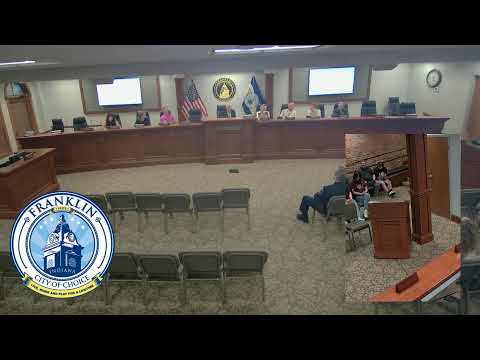
At its June 16 meeting, the Franklin City Council heard introduction of an ordinance that would let the city use a surety bond rather than escrowing about $3.9 million required under its existing sewage works revenue bond ordinance; the item was introduced for public hearing at a future meeting.
FRANKLIN — The Franklin City Council on June 16 introduced an ordinance to amend the city’s sewage works revenue bond rules to allow purchase of a surety bond in place of escrowing roughly $3,900,000 tied to the sewer plant improvements.
City Attorney Lynn Gray told the council the change would not alter the bond’s term or principal but would add an option to secure the debt with a surety policy rather than setting aside an escrowed account. "You have to escrow a certain percentage of that money throughout the entire 20 years of the bond to make sure that the city never misses any payments," Gray said. She added that the city’s financial adviser calculated a surety would be more cost‑effective: "The interest we're paying on the bond exceeds the money that we're going to be recovering. So we would be spending that over a period of 20 years."
Why it matters: The current ordinance (ordinance 2025‑0303) required the city to keep an escrow so payments would be guaranteed over the 20‑year term. Using a surety would free the escrowed funds for other uses while a surety company would step in only if the city defaulted, Gray said.
Gray said bond counsel and the city’s financial planner performed the analysis and determined the surety option would lower the city's overall financing cost; she referenced Jeff Peters, the city’s financial adviser, as having done the calculation. "The reason it's more cost effective is while we take the 3,900,000.0, approximately $4,000,000 and put it in an interest bearing account, we would draw interest. The interest we're paying on the bond exceeds the money that we're going to be recovering," Gray said.
Council members did not take action beyond introduction. The ordinance before the council was described as "introduction only," and Gray said a public hearing will be held at the next meeting before the council could adopt the change.
Details from the presentation: the amendment would not change the bond amount or its 20‑year term; it would simply allow either the escrow approach required in the original ordinance or purchase of a surety bond. Gray said the council had been "very...adamant" about a 20‑year term to pay the project as quickly as possible, and that preference remains unchanged.
Next steps: The item was introduced on June 16; the council will hold a public hearing at a subsequent meeting before considering final adoption.