Get Full Government Meeting Transcripts, Videos, & Alerts Forever!
Get email alerts on the Continuing Education topic
No spam. Unsubscribe anytime.
Michigan Realtors highlights continuing‑education platform, supports land‑division and zoning reforms and outlines response to NAR settlement
Summary
Sean Cecil, policy field director for Michigan Realtors, told the House subcommittee the association’s CE Marketplace and training programs are core to consumer protection and that the group supports targeted Land Division Act updates and local zoning reforms to increase housing supply.
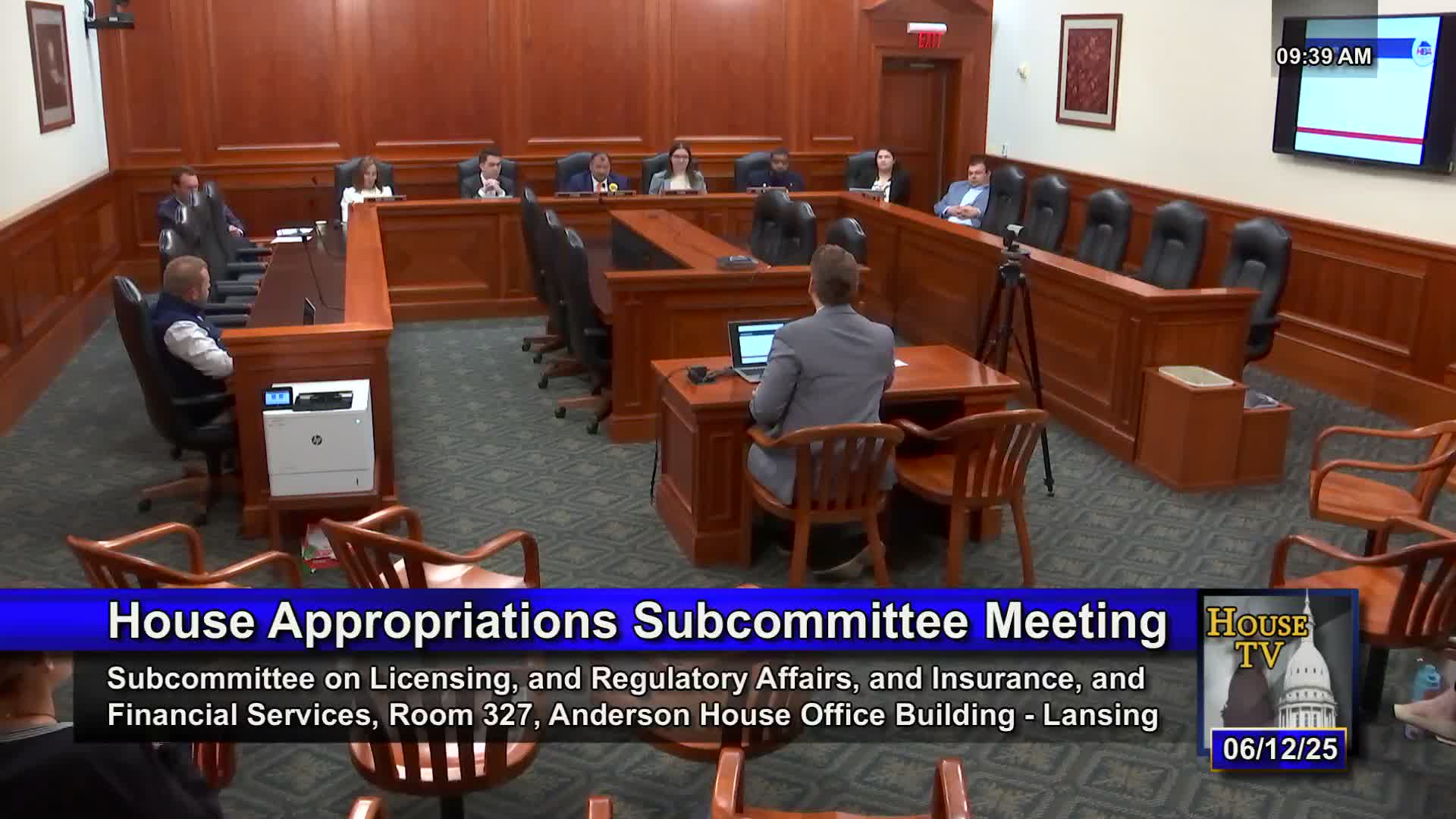
Sean Cecil, policy field director for Michigan Realtors, told the House Subcommittee on Licensing and Regulatory Affairs and Insurance and Financial Services that the association’s Continuing Education (CE) Marketplace and training programs are central to maintaining professional standards for licensed real‑estate practitioners and that the group supports specific statutory and local policy reforms to expand housing supply.
Cecil said the CE Marketplace, launched in 2014 and formalized as central to the association’s regulatory work in 2018, provides a centralized, accessible platform for licensees to find approved courses and maintain compliance. “The marketplace is more than just a compliance tool, it's a professional resource,” he said. Cecil noted Michigan requires 18 hours of continuing education over three years, including two hours of legal credit and one hour of fair‑housing credit each year.
On housing policy, Michigan Realtors told the committee it supports updating the Land Division Act to increase allowable parcel splits from four to ten, while preserving municipal authority to require surveys and apply planning standards. Cecil said relaxing some land‑division limits and modernizing local zoning—reducing minimum lot sizes, easing parking mandates and allowing more housing types—can facilitate modest infill and workforce housing without eliminating local planning discretion.
Cecil also described how recent national litigation and settlement affecting the National Association of Realtors (NAR) have changed business processes for agents. He said a 2019 antitrust class action settled for $418 million; as a result, MLS platforms no longer display buyer‑agent compensation and buyers must enter written agreements disclosing and negotiating agent compensation prior to touring property. Michigan Realtors has updated contracts, produced compliance guidance and offered training webinars and legal guidance to members, he said.
Cecil described partnership work with local boards and brokerages, a statewide training calendar, and an on‑call service to help licensees navigate compliance, reporting and approved course selection. He said Michigan Realtors will continue to work with LARA, the committee and local stakeholders to balance consumer protection and regulatory efficiency while advancing policies to increase housing supply.
Committee members asked about the role of local governments and municipal planning staffs, the consumer value of licensing and continuing education, and how the association supports licensees through market cycles. Cecil said the association provides both statewide and local programming and helps brokers and agents adapt to legal and regulatory changes.
The subcommittee took no formal action on Michigan Realtors’ recommendations during the hearing.