Get Full Government Meeting Transcripts, Videos, & Alerts Forever!
Get email alerts on the Building Codes topic
No spam. Unsubscribe anytime.
Home Builders Association warns 2021 Michigan Residential Code will raise new‑home costs and plans legal challenge
Summary
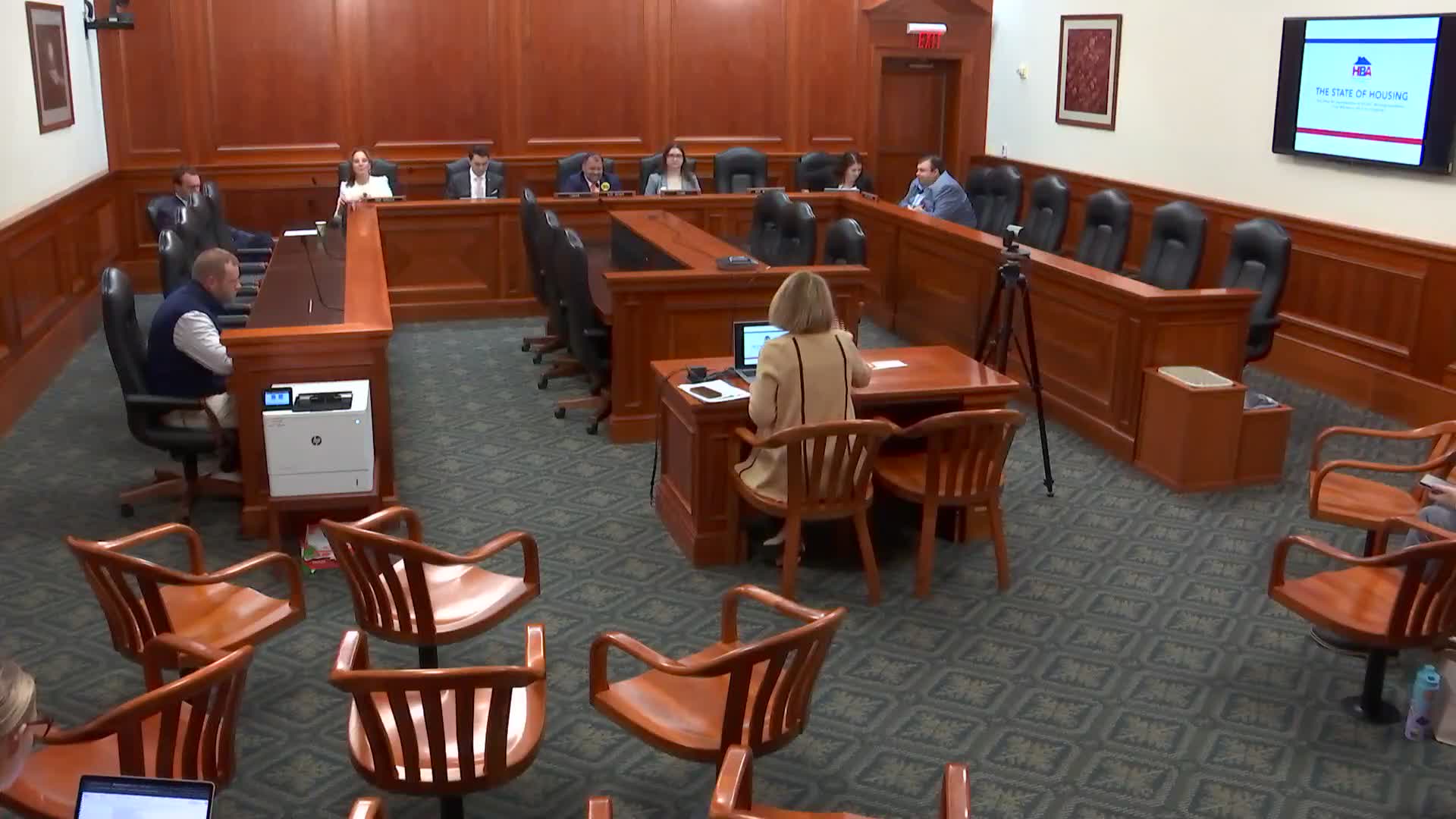
Dawn Crandall, executive vice president of government relations for the Home Builders Association of Michigan, told the Michigan House Subcommittee on Licensing and Regulatory Affairs and Insurance and Financial Services that implementation of the 2021 Michigan Residential Code will increase construction costs and could price thousands of households out of the new‑home market.
Dawn Crandall, executive vice president of government relations for the Home Builders Association of Michigan, told the Michigan House Subcommittee on Licensing and Regulatory Affairs and Insurance and Financial Services that implementation of the 2021 Michigan Residential Code will increase construction costs and could price thousands of households out of the new‑home market.
Crandall, testifying May 15 before the subcommittee, said the 2021 code includes mandatory items that she said will raise costs—two‑by‑six exterior framing instead of two‑by‑four, R‑60 ceiling insulation, insulated interior ductwork, one‑inch exterior insulated sheathing and new solar‑readiness requirements—and that the association has filed a notice of intent to sue the Department of Licensing and Regulatory Affairs (LARA) on May 1 and plans to seek an injunction if the code goes into effect.
The code change matters because, Crandall said, higher construction costs reduce affordability. “Every time you raise the cost of housing, you price out 3,393 households,” she said, summarizing research cited in her testimony. She also said national data show building material prices have risen 41.6% since the pandemic and cited a national regulation that raised air‑conditioner prices by roughly 25%.
Crandall outlined how the code promulgation process changed after LARA revised its rulemaking procedures. Under the prior process, advisory councils—made up of builders, inspectors, labor and fire officials—reviewed International Code Council model codes and recommended Michigan‑specific amendments before the director adopted rules. Crandall said the bureau’s revised process shortens timelines and removes the formal advisory committees, and she objected to adoption of the 2021 Michigan Residential Code through the new process.
She said the Joint Committee on Administrative Rules (JCAR) did not achieve a quorum to sustain an objection and that the rules were forwarded to the Office of the Great Seal; if adopted, Michigan builders “will be building to the 2021 code, which will go into effect on August 29,” she said. Crandall added, “Please let me be clear that our builders want to build energy efficient homes. This is not skating so that we don't have to build to a higher code.”
Crandall provided statistics on housing supply and labor: single‑family residential permits peaked in early 2005 at roughly 54,000 and fell to 6,900 in 2009; she said the state is projecting about 15,728 permits in 2025 and that year‑to‑date through April the state had pulled 4,542 permits. She said the Home Builders Association estimates about 58,011 licensed individuals in the construction trades in Michigan, with roughly 2,400 licensees aged 18–34 and about 24,000 aged 56–66 or older; the median builder age in her briefing was 58.
On statutory and administrative authorities, Crandall cited the State Construction Code Act, the Michigan Residential Code, the Michigan Uniform Energy Code (Part 10), the Bureau of Construction Codes and Public Act 504 of 2012 as the statutory framework governing code adoption. She said the 2015 Michigan Residential Code stood at about 847 pages, the 2021 edition at about 1,115 pages, and that LARA’s process is intended to bring new model code language into state rule more quickly.
Committee members asked questions about the rationale for specific code changes, the seven‑year payback requirement for energy upgrades, licensing prerequisites for builders, and whether the code changes had adequate stakeholder input. Crandall said LARA held hearings but that some sessions had only limited public testimony; she argued that stakeholder expertise is necessary to assess costs and payback timelines.
Crandall recommended restoring the advisory‑committee model to the code promulgation process, either by executive action or legislation, and said the association has draft bill language that would narrow a statutory exception allowing the residential code to skip a cycle only when no major health, safety or welfare issues are at stake. She said the HBA would pursue legal remedies if necessary to delay implementation.
The subcommittee received no formal action on the code itself; the only committee motion recorded in this hearing was approval of the subcommittee’s minutes from May 15, 2025.