Get Full Government Meeting Transcripts, Videos, & Alerts Forever!
Get email alerts on the Environmental Health topic
No spam. Unsubscribe anytime.
Baker County holds first readings of two ordinances to take over on‑site wastewater permitting and set administrative hearings procedures
Summary
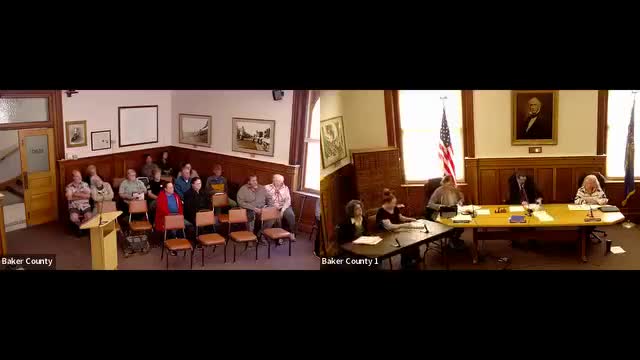
Baker County commissioners opened public hearings and approved first readings of two linked ordinances that would let the county administer on‑site wastewater permitting and adopt a countywide administrative hearings procedure for enforcement.
Baker County commissioners opened public hearings and approved first readings of two linked ordinances that would let the county administer on‑site wastewater permitting and adopt a countywide administrative hearings procedure for enforcement.
The county is implementing an intergovernmental agreement (IGA) that delegates Oregon Department of Environmental Quality (DEQ) permitting, inspection and enforcement authority for on‑site wastewater systems to Baker County; Ordinance 2025‑03 is written to implement that delegated management program. Commissioners also reviewed Ordinance 2025‑04, a separate administrative‑hearings ordinance counties can use to assess civil penalties and resolve code violations.
County staff said the ordinances are intended to work together. A staff presenter told commissioners the IGA with DEQ requires a local ordinance to “implement the authority delegated from DEQ to administer and enforce the management program in Baker County.” She also said the enforcement ordinance was drafted broadly so it could be used for enforcement of other county codes as well as septic issues.
Members of the public and county staff discussed enforcement approach and resources. Jesse Barnes, who identified herself as the Harney County on‑site services lead, said she emphasizes education and voluntary compliance: “I try to work with people to make the best effort to move forward” and that when enforcement has been necessary in Harney County she has sought less‑painful remedies and funding options for property owners.
Local contractor Bill (Bridal) Harvey, who said he works as a custom builder, urged the county to avoid the delays he has experienced with DEQ permitting and welcomed local administration, but also pressed for a local hearing or more clearly stated local options before court referral for noncompliance. “I'd rather see some ability to have a local, hearing process to at least give them the opportunity to come in,” he said, citing costs of repairs and the difficulty elderly homeowners face meeting DEQ requirements.
Commission actions: Commissioners voted to approve the first reading, by title only, of Ordinance 2025‑03 (implementing on‑site wastewater requirements) and of Ordinance 2025‑04 (establishing administrative hearings procedures). After public testimony they moved both hearings to continue on June 4, 2025, to take additional written and in‑person testimony. The public was told written testimony for the first ordinance can be submitted to Shem (Shim) Carlson by May 30, 2025.
Why it matters: The change shifts DEQ’s direct administrative permitting role to Baker County under the IGA, which county staff and some local builders say could speed turnaround on permits. At the same time residents and builders pressed county staff and the Harney County program lead on how the county will balance enforcement with financial and practical challenges faced by property owners.
Next steps: The county will continue both public hearings on June 4, 2025, and staff asked for written submissions to be filed before that date. Commissioners also discussed referral pathways for imminent public‑safety threats that could bypass the administrative hearing process and go directly to the courts.