Get Full Government Meeting Transcripts, Videos, & Alerts Forever!
Get email alerts on the Offender Residency Exemption topic
No spam. Unsubscribe anytime.
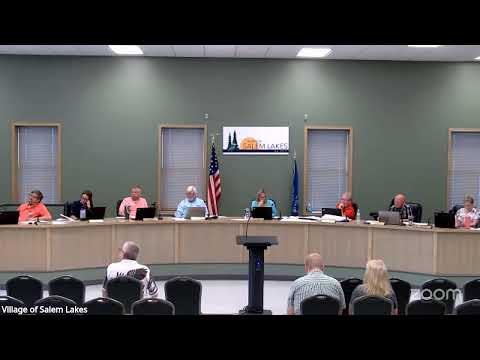
Salem Lakes trustees grant residency exemption to convicted offender after 4–3 vote
Summary
After a quasi-judicial hearing and deliberation on 11 factors in village code 439-5, the Salem Lakes Board of Trustees granted Joshua Cobalt an exemption to offender residency restrictions by a 4–3 vote.
The Village of Salem Lakes Board of Trustees voted 4–3 to grant a residency exemption under village code 439-5 to Joshua Cobalt, who had applied to live at 9416 270th Sixth Avenue following a conviction for an offense charged under Wisconsin child-enticing statutes.
The decision came after a continuation of a quasi-judicial hearing that began June 2. Village Attorney Ramsey instructed trustees that the ordinance requires balancing “the public interest in protecting children as well as the interest of the offender seeking the exemption,” and that the board may consider a nonexhaustive list of 11 factors during deliberations.
Ramsey summarized the statutory charge discussed at the hearing as child enticement and read from the statute and sentencing information. Trustees heard that Cobalt received a sentence including six months of house arrest, three years of probation and conditions including treatment and registry obligations. Cobalt told the board, “No new evidence or anything to provide other than any answers to questions you might have.”
Trustees reviewed the 11 factors listed in the village ordinance: the statutory provisions violated; the relationship between offender and potential victim; presence or use of force; presence of enticement; proximity and time between offense and exemption request; time out of incarceration; offender credibility; remorse; proximity of the proposed residence to a child-safety zone; the offender’s support network; and counseling and treatment history.
On several factors trustees were split. Multiple trustees said the criminal charge and the fact Cobalt pleaded guilty under the child-enticing statute established the presence of enticement. Several trustees also said they were concerned that his proposed residence lies well within the ordinance’s 1,500-foot restriction from designated child-safety areas: one trustee cited a measurement of about 391 feet to the nearby Salvation Army camp; another said roughly 440 feet to a park area. Trustees noted the park has playground equipment and the Salvation Army site is fenced; trustees debated how those details affect the public-safety calculation.
Trustees differed on whether the timing of Cobalt’s purchase and conviction weighed against granting an exemption. Some said the brief interval between the offense and his application was troubling; others said housing availability and a desire to live near family were plausible reasons he bought the house when he did. Several trustees described Cobalt as credible and remorseful, while at least two trustees said they were not convinced the record established genuine remorse.
Trustees also considered treatment and support. The record included references to VA-based counseling and a forensic-psychologist report authored by Deborah Collins; trustees said treatment history and professional opinions tended to lower the assessed risk of reoffense, though some expressed reservations about the sufficiency of evidence that supports would appear in person.
After deliberation, a motion to deny the exemption failed. A subsequent motion to grant the exemption under village code 439-5 passed on a 4–3 vote; President Buecher announced to Cobalt, “You've been granted your exemption, sir.” The board then adjourned.
The exemption allows Cobalt to reside at the addressed property despite the village’s residency restriction; the board did not specify additional conditions in the public record. The transcript records Cobalt’s registry obligation under state law will be 15 years (the transcript states that registry duration is either 15 years or life and that Cobalt received 15 years), and that his ankle-monitor house-arrest requirement runs until Sept. 17 (as stated in the hearing).