Get Full Government Meeting Transcripts, Videos, & Alerts Forever!
Get email alerts on the Online Prescription Renewal topic
No spam. Unsubscribe anytime.
Lawmakers weigh online prescription renewals for contacts; optometrists urge verification, retailers promote safety system
Summary
House Bill 45‑58 would let patients renew contact lens prescriptions online if they had an in-person prescription within the past two years; witnesses split between expanding access and urging verification and guardrails.
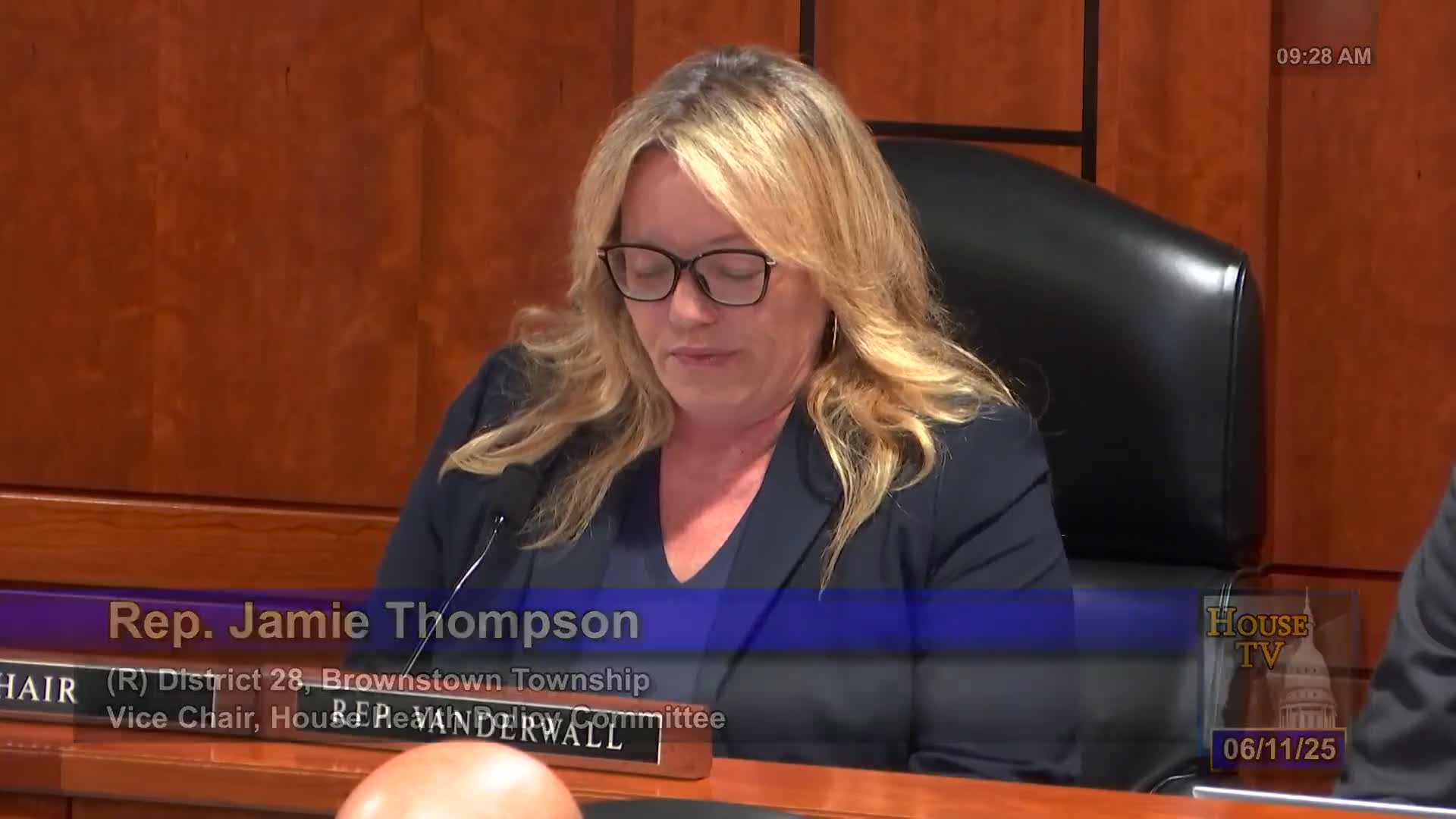
Representative VanderWaal introduced House Bill 45‑58 as legislation to allow online prescription renewals for contact lenses provided the patient had received a valid in-person prescription within the prior two years. "This means that every other year, they would be able to renew their prescription and restock on contact lenses online through a telemedicine process without having to go into the eye doctor," the chair said.
Supporters told the committee the bill expands access and competition. Jack Baum of Americans for Tax Reform said the bill "modernizes outdated restrictions" and noted 42 states allow similar renewals. David Gunther of the Mackinac Center emphasized consumer convenience and rural access, arguing routine renewals can free clinicians to focus on more complex cases.
The Michigan Optometric Association (MOA) — represented by Dr. Whitney Genrich, Dr. Erica Johnson Carter and Dr. Jennifer Shadd — urged revisions. They said the bill’s current language would create two classes of prescriptions by allowing online renewals that could change aspects of a contact-lens prescription other than power (for example base curve, diameter or brand). They warned that changing those parameters without an in-person fitting could risk corneal injury or other complications. "This would not be a renewal, but instead result in a whole new prescription of the contact lens," Dr. Genrich said.
Optometrists recommended requiring online providers to obtain or verify the patient’s prior in-person prescription rather than relying on patients to self-report the prior date or prescription details. They flagged a known commercial practice: online sellers may proceed if a prescriber does not deny a transmission within an eight‑hour window, which can allow a sale to complete outside office hours.
Physicians and industry witnesses described how online renewal platforms operate. Eric Castaneda of 1‑800 Contacts described the Express Exam process: patients complete a health questionnaire, submit images, perform a visual acuity check and then a licensed physician in the patient’s state reviews the data. He said about 30% of patients are screened out by the platform and referred to in-person care, and that physicians, not companies, make the final prescribing decision.
Committee members asked about reported harms, the sufficiency of two‑year intervals for in-person exams, the accuracy of patient-entered prescription data and whether a statutory verification requirement would impede cross-state telemedicine practice tied to interstate licensure. The MOA said it would be neutral or potentially supportive if statutory language was amended to require verification and to ensure online renewals do not alter fitting parameters; the association offered to supply draft language.
No committee vote was taken on HB 45‑58 during this hearing; the record shows extensive pro and con testimony and follow-up requests for clarifying bill language.