Get Full Government Meeting Transcripts, Videos, & Alerts Forever!
Get email alerts on the Vegetation Management Rights Of Way topic
No spam. Unsubscribe anytime.
Michigan bill would codify 15-foot vegetation clearance for power lines, sponsors say
Summary
Representative Phil Green and Thumb Electric Cooperative urged the House Energy Committee to allow utilities to maintain vegetation up to 15 feet from lines to improve safety, reliability and cost efficiency; no committee vote was taken.
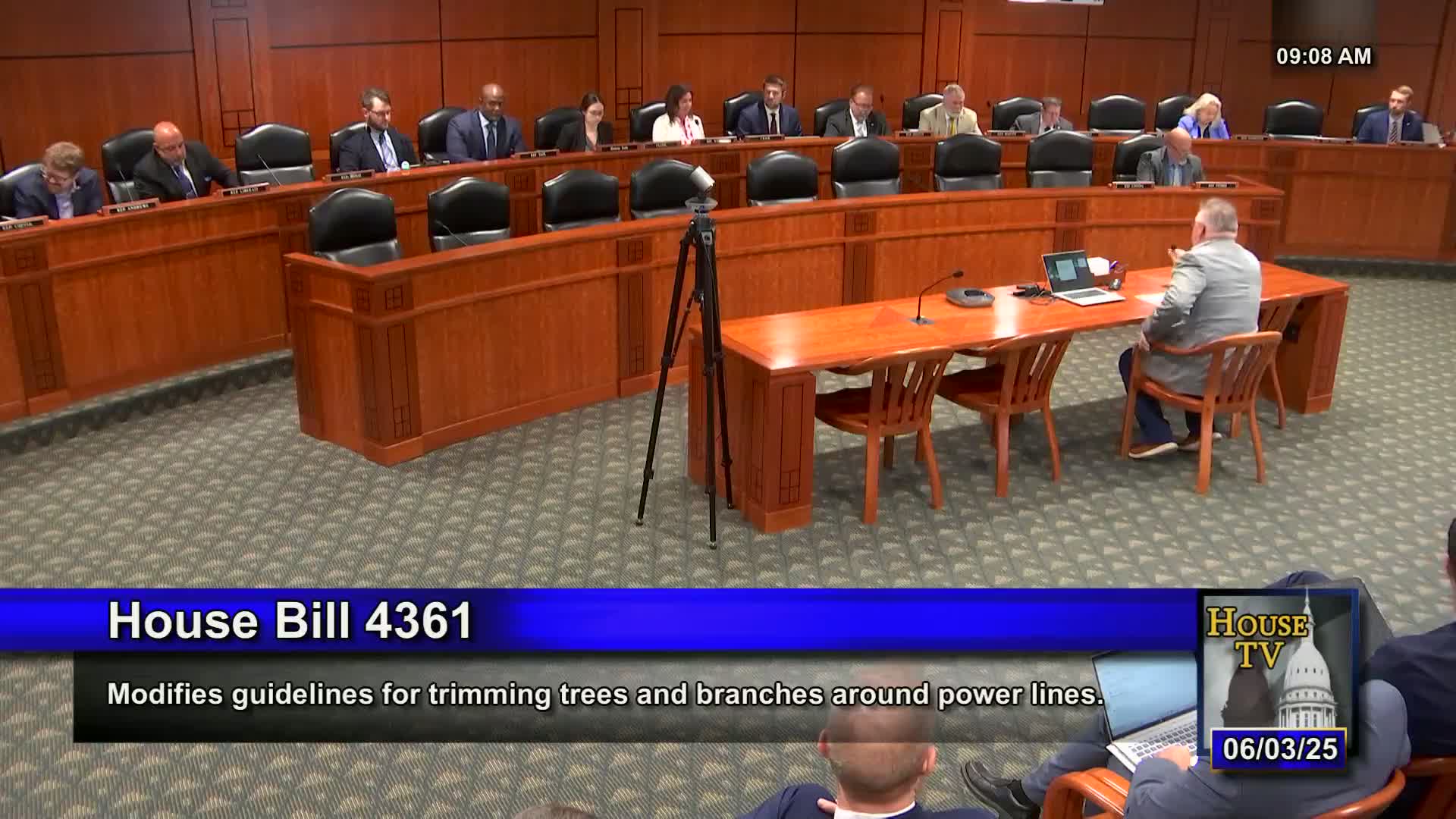
Representative Phil Green told the House Energy Committee that House Bill 4,361 would change the statute that established the Public Service Commission to allow utilities to maintain vegetation “from the ground to the sky … up to 15 feet from the outermost portion of the wire that conducts electricity.”
The bill’s sponsor said the measure targets tree-related outages after repeated storm damage in his district, and would clarify how far utilities may trim to reduce branches and trees falling on lines. “Growing up in the thumb, living in the thumb representing the thumb, we had a lot of issues with … reliability,” Green said, citing ice storms and insect-driven tree die-off.
Kevin Mazur, legal and compliance engineer for Thumb Electric Cooperative, told the committee the cooperative supports codifying a clear 15-foot standard to promote “safety, reliability, and affordability” and to reduce corrective actions cited under safety reviews. “When we do vegetation management, we spend a lot of time educating our members,” Mazur said. He described the co-op’s system as about 12,000 members served over “over 2,000 miles of power lines,” and said that vegetation work is their most-cited corrective action for worst-performing circuits.
Committee members asked about homeowner input and compensation. Mazur described a multi-step process in which the utility or contractor visits the property, marks trees and asks homeowners to sign an agreement; he said outcomes vary by homeowner. On compensation, he said, “Oftentimes, there is not. We’re a non profit cooperative. So every time we give compensation to 1 of our members, we’re essentially taking it from the pockets of their neighbors.”
Representative Bridal asked who has the ultimate authority to decide whether a tree is trimmed or removed; Mazur described legal easements and current standards as “a big gray area” and said many easements refer to vague standards such as “reliable, safe, practicable.” He added that some easements state a 30-foot width (15 feet on each side of the conductor).
Representatives on the committee sought clarity on whether codifying 15 feet would change existing practice; Mazur said he expected “not much change at all” and described the bill as an educational tool that would allow utilities to point to a statutory standard when explaining work to landowners. Representative Preston asked whether a vegetation-management cycle (for example, a five-year cycle) was being proposed; Mazur said enacting the 15-foot standard would make cycles more effective because problem areas would require less frequent visits.
No motion or vote on House Bill 4,361 was recorded during the hearing. The committee approved routine minutes earlier in the session, but the vegetation-management bill remained at the discussion stage at adjournment.
The testimony cited the National Electric Safety Code and Michigan Public Service Commission oversight as regulatory drivers that already require utilities to meet vegetation standards; the bill’s supporters said a clear statutory number would reduce disputes with landowners and improve outage prevention.