
House committee hears bill to disqualify unemployment claimants who 'ghost' employers
Get AI-powered insights, summaries, and transcripts
Subscribe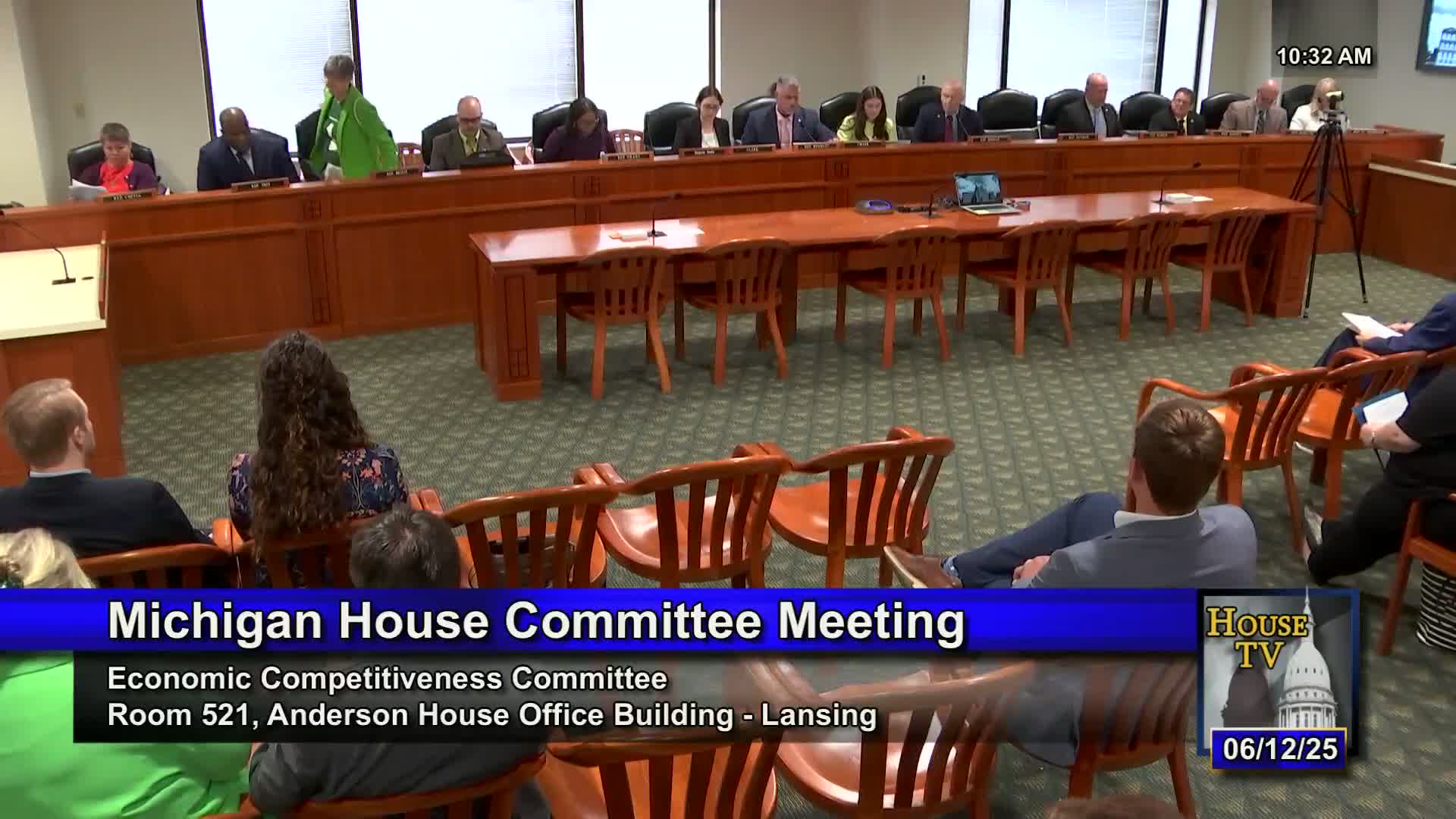
Summary
Lawmakers and business groups told the House Committee on Economic Competiveness that House Bill 4516 would let employers report applicants who skip interviews or fail to show for a first day of work; labor advocates said the measure would add administrative burdens and risk cutting off benefits for workers with legitimate barriers.
The House Committee on Economic Competitiveness heard testimony Thursday on House Bill 4516, a bill from Representative Jason Wolford that would amend the Michigan Employment Security Act to create a rebuttable presumption that claimants are ineligible for unemployment insurance if they "ghost" a scheduled job interview or fail to show for work after accepting an offer.
The bill would direct the Unemployment Insurance Agency (UIA) to modify employer-facing systems (identified in testimony as MiWAM and its successor MyUI) to allow employers to report missed interviews or missed first days of work, and to give the agency authority to investigate and determine eligibility. Representative Wolford told the committee the measure includes a rebuttable presumption to let claimants present evidence — for example, childcare breakdowns or car problems — to defend against a disqualification.
Supporters told the committee the change is needed to protect the employer-funded UI trust fund and to strengthen accountability for claimants who they say use interviews to meet weekly work-search requirements while not intending to accept work. Opponents said the bill would create new administrative work for an agency already struggling with timeliness, risk cutting off benefits for workers with legitimate reasons for missing interviews, and is not clearly tied to the documented large-scale fraud identified in pandemic-era reviews.
Representative Jason Wolford, the bill sponsor, opened by saying the UI program is "100% employer funded" and should "be focused on helping people get back to employment." He described what he and employers call "ghosting": scheduling an interview or accepting a job and then failing to show up without notice. "House Bill 4516 addresses this by making the act clear that if a person ghosts an employer, they will be disqualified from receiving UI benefits and allows the employer to report ghosting so that you and UIA can investigate the situation if necessary," Wolford said.
Business groups told the committee they back the bill. David Worthams, director of employment policy for the Michigan Manufacturers Association, said employers have been frustrated for years by what they described as weak enforcement of eligibility criteria and by trust-fund depletion during the pandemic. Worthams told the committee the trust fund fell from "over 4 and a half billion dollars" before the pandemic to "less than $797,000,000" and has since recovered to about $3 billion, and he said employers want a way to notify UIA when applicants or new hires fail to show.
Kelly Saunders, vice president of policy and engagement at the Small Business Association of Michigan, said a 2023 task force formed by the association identified ghosting as a leading challenge for small employers and recommended a mechanism for employers to report no-shows. "The number one recommendation back then and still to this day is that the UIA create the ability to share when applicants no show or refuse offers to ensure accountability related to work search and work availability requirements," Saunders said.
Amanda Fisher, Michigan state director for the National Federation of Independent Business, also supported the bill and stressed the system's employer funding and the downstream effect on employers' payroll-tax rates. "When the trust fund was decimated, it was up to employers to make that up," Fisher said, adding that many small employers report applicants who accepted work or scheduled interviews and then did not show.
Committee members and witnesses debated technical details the bill would impose. Wolford said an employer could notify the agency through a secure internet portal established under the statute; the bill would create a rebuttable presumption that a claimant is ineligible if the claimant (1) fails to appear for a scheduled interview or (2) fails to report for work for two consecutive days during the first 90 days of employment without notifying the employer. The sponsor said the bill allows claimants to rebut the presumption with evidence (for example, a childcare emergency or vehicle breakdown).
Several representatives pressed for detail and cautioned about unintended consequences. Representative Kofia noted that a change passed last session (Public Act 238) increased claimant work-search requirements from one to three activities per week; she said that requirement and access barriers (broadband, transportation, childcare) are important context when considering additional disqualification rules. Representative Bridal and others asked what verification employers would need to submit; witnesses said employers would provide date, time and identifying information in MiWAM/MyUI and that UIA would investigate but acknowledged gaps in connecting the employer who schedules an interview with the employer who is charged on the claimant's experience rating.
Labor and legal advocates testified in opposition. Alexa Tapia, unemployment insurance campaign coordinator at the National Employment Law Project, said the state agency already struggles to meet federal timeliness standards and that adding time-consuming fact-finding could delay payments for claimants. "Adding another layer of red tape would risk increasing the delay for payments and pool agency staff for more mission critical efforts," Tapia said.
Jacob Fahlman of the Sugar Law Center for Economic and Social Justice said the measure would be among the strictest anti-ghosting laws in the country if enacted, and that other states that have limited disqualifications typically only bar benefits for the week tied to the missed interview rather than applying a retroactive, blanket disqualification. Fahlman also said the bill would expand presumptions applied after hire to earlier than the existing three-day no-call/no-show standard.
Witnesses and lawmakers cited differing estimates of fraud and improper payments. Some business witnesses described "hundreds of millions" in improper payments and cited larger figures attributed to pandemic-era fraud; the precise amounts varied in testimony. Opponents said international cyber-fraud was a major driver of pandemic-era losses and that the connection between that fraud and routine applicant ghosting is not direct.
Representative Wolford asked the committee to report House Bill 4516 favorably to the full House. The committee took testimony from employer groups and worker-advocacy organizations but did not vote on the bill during the hearing.
The committee record shows continued disagreement: supporters said the bill would help protect employer-funded UI resources and hold applicants accountable, while opponents said it risked deterring benefit access, would add administrative burden to UIA and might penalize people with legitimate hardships. The committee did not take a vote on the bill during the hearing; the sponsor requested a favorable report to the full House.