Get Full Government Meeting Transcripts, Videos, & Alerts Forever!
Get email alerts on the Harbor Docks topic
No spam. Unsubscribe anytime.
Destin council denies Perry Enterprises’ request to reclassify slips at 288 and 302 Harbor Boulevard
Summary
After a lengthy quasi‑judicial hearing with public comment and competing legal arguments about prior approvals and public‑use promises, the Destin City Council voted unanimously to deny an applicant request to reclassify slips at two adjacent harbor properties.
The Destin City Council on Monday denied a request from Perry Enterprises to change how boat slips at 288 and 302 Harbor Boulevard are designated, saying the original approval and the public benefit promised in 2019 supported keeping more transient slips open to the public.
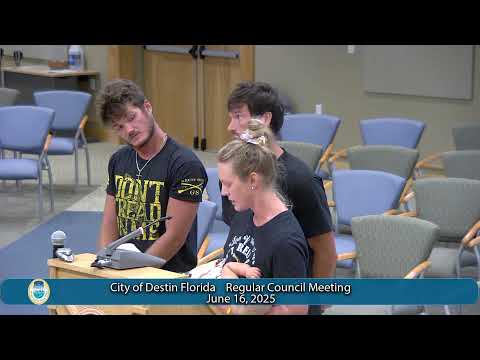
Council members voted 7‑0 to deny the amendment after several hours of staff presentations, testimony from the applicant and a long public comment period that included boat‑owners, condominium representatives and residents who said the harbor’s public access should be preserved.
The application sought to reassign the existing slip mix approved in 2019 — then described by staff as 18 commercial slips, 21 transient slips and 1 water‑taxi slip — into a configuration the applicant said would include 29 commercial slips, six transient slips, one water‑taxi slip and six fueling slips. City planning staff told council the change would reduce the number of transient slips the council originally relied on when it approved the docks in January 2019.
“Tonight the applicant is proposing to adjust these designations to accommodate 29 commercial slips, six transient slips, one water taxi and six fueling slips,” said Planning staffer Kyle Butler during his presentation. He also explained the land‑development code provisions used for the 2019 approval and noted the particular criteria related to “fare‑carrying” and transient slips that the applicant had relied on at that time.
Applicant representatives said they were offering more public benefit than required under the current code and described the proposal as a managed approach to keep parts of the dock available to transient users without undermining the property’s commercial tenants.
“[We] are proposing nearly 20 public waterfront slips that will be available on his two properties,” Taylor Engineering’s Matt Trammell told council, arguing the project would add access and support the Harbor Boardwalk and harbor businesses.
Several residents and harbor businesses urged council to preserve the earlier understanding that many slips would remain available to the public. “Should this matter proceed to go to litigation, arbitration, or negotiation … I strongly urge the council to consider requesting easements to the boardwalk of 288 and 302 Harbor Boulevard,” John Stevens, chairman of the Harbor CRA, told council.
Other speakers objected to changing the slip mix, saying the public had been promised transient access when the docks were approved and that the city and applicant had not clearly documented the arrangement as a binding long‑term obligation. Multiple commenters also raised concerns about parking capacity downtown if more slips were designated for commercial or fare‑carrying use.
Council discussion repeatedly returned to what had been promised in 2019. Council member Guile moved to deny the application “as presented,” a motion that drew a second and ultimately a unanimous vote in favor of denial.
City staff advised that continuing code‑compliance proceedings related to current slip use would proceed to the magistrate as scheduled; council’s denial means the requested reclassification will not be approved and the earlier permit conditions remain in force.
The applicant indicated it would work with staff on next steps; city staff said the council’s action and the pending magistrate hearing could be part of a broader process including easements, signage and clearer definitions of transient use on future inquiries.
Ending: The council’s denial preserves the slip designations tied to the 2019 approval and leaves unresolved questions about long‑term public access, parking and whether the applicant and city will negotiate a recorded development agreement or easements to clarify future use. A magistrate hearing on current code enforcement remains scheduled and may address uses that city staff say are inconsistent with the earlier permit conditions.