Get Full Government Meeting Transcripts, Videos, & Alerts Forever!
Get email alerts on the Census Geography Programs topic
No spam. Unsubscribe anytime.
Census Bureau tells Massachusetts to begin decade-long work on LUCA, BAS, PSAP and redistricting data now
Summary
At a Massachusetts legislative hearing, U.S. Census Bureau officials urged state and local governments to begin decade-long preparations now to protect address and boundary data ahead of the 2030 census.
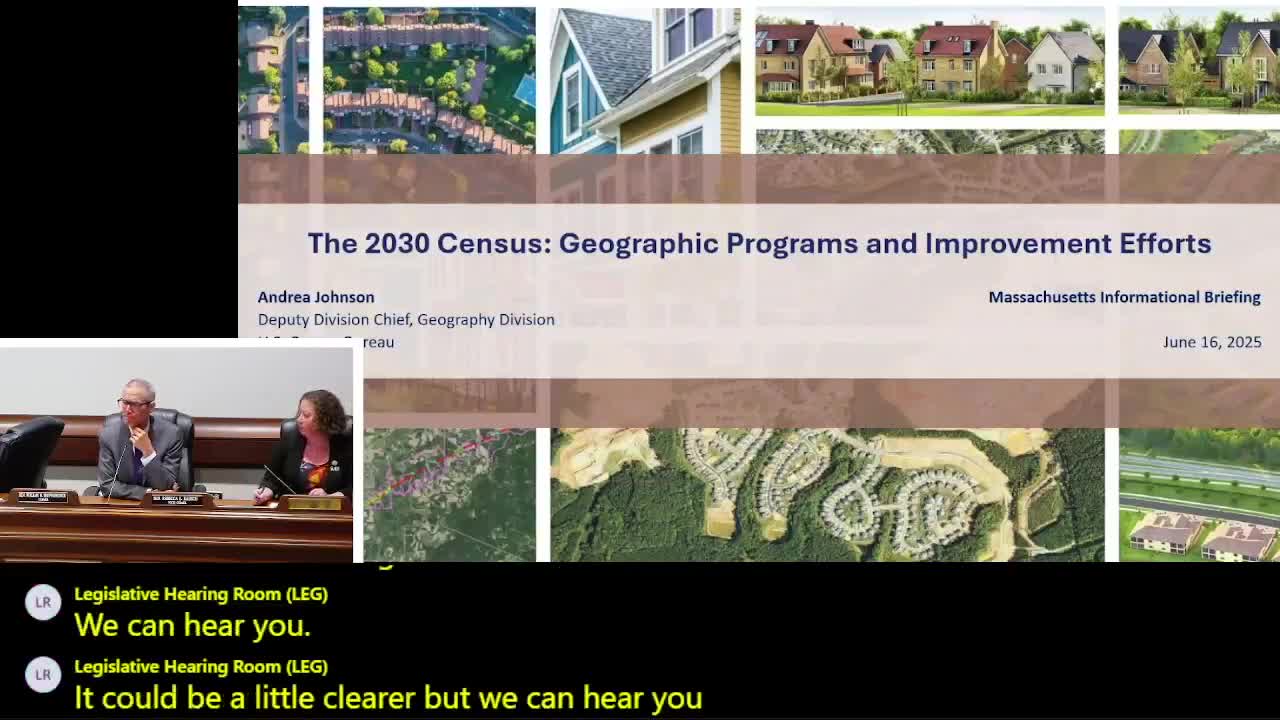
At a Massachusetts legislative hearing, U.S. Census Bureau officials urged state and local governments to begin decade-long preparations now to protect address and boundary data ahead of the 2030 census. Andrea Grace Johnson, deputy division chief of the Geography Division at the U.S. Census Bureau, and James Whitehorn, chief of the Redistricting and Voting Rights Data Office, outlined the bureau’s geography programs, timelines and technical tools during the session.
Johnson said geography is “the foundation for both censuses and surveys” and described four recurring programs states can use to keep federal address and boundary lists current: the Boundary and Annexation Survey (BAS), the School District Review Program, the Participant Statistical Area Program (PSAP) and the Local Update of Census Addresses (LUCA). She told the committee BAS opens in January each year and that March 1 is the target date for updates to appear in American Community Survey tabulations, with a longer submission window through May 31. “It’s never hurt to plan ahead,” Johnson said, noting LUCA is a once-a-decade program that will begin preparations in early 2027 and will give participants months to submit address feedback.
James Whitehorn described the Redistricting and Voting Rights Data Office’s five-phase program that produces block-level geography and the redistricting data used by state legislatures and commissions. He said the bureau will begin collecting voting-district (precinct/ward) information in 2028 and follow that with two rounds of verification in 2029 and a shorter verification round in 2030. He emphasized that census blocks are the foundational unit of all other published geographies and that states can use the bureau’s block boundary suggestion tools to propose changes.
Officials also described new technical approaches the geography division is using to keep address registers current. Johnson explained the bureau’s “automated change detection” workflow: detecting cleared land or new construction through imagery, integrating building footprint data (commercial sources supplemented by bureau-created footprints) and applying machine learning to identify likely housing units. She showed an example near Worcester where detected housing units rose from 568 to 817 between years in the bureau’s internal files.
Whitehorn said the bureau will continue to adapt the content of redistricting data to federal policy and technical changes. He noted a major Office of Management and Budget (OMB) change (Statistical Policy Directive No. 15) that directs federal agencies to use a single combined race-and-ethnicity question and to add a Middle Eastern and North African (MENA) category; he said the Census Bureau is coordinating with state liaisons to ensure those changes will meet states’ redistricting needs.
Wendy Underhill and Helen Brewer of the National Conference of State Legislatures (NCSL) told the committee state legislatures can support accuracy by appointing nonpartisan liaisons, convening local partners and, where appropriate, funding complete-count outreach and LUCA participation. NCSL noted many states provided grants and created state-level complete-count committees for 2020; Massachusetts’ 2020 committee awarded grants and received $6.65 million that cycle.
Discussion at the hearing repeatedly stressed that these programs are cooperative: the bureau compiles an initial address and block list and invites states, municipalities and qualified partners to review and propose corrections. Officials urged Massachusetts cities and towns to begin mapping, staffing and community outreach now so that when program windows open — LUCA preparation in early 2027, PSAP in 2028 and voting-district collection beginning 2028 — municipalities can make timely, documented submissions.
Proponents said early state engagement reduces reliance on door-to-door follow-up and statistical imputation, and produces the more accurate self-response rates the bureau prefers. The Census Bureau said it will provide materials and contacts, and presenters offered to share the presentation deck and further resources with the committee.
For administrative clarity: these remarks described ongoing programs and recommended state and local actions. No formal votes or policy changes were taken at the hearing.