Get Full Government Meeting Transcripts, Videos, & Alerts Forever!
Get email alerts on the Parks And Recreation topic
No spam. Unsubscribe anytime.
McHenry staff present five-year Parks and Recreation master plan; no formal action taken
Summary
Consultant Bill Hobson presented a Parks and Recreation Master Plan that inventories roughly 40 parks and recommends six concurrent goals — including indoor aquatics, improved connectivity and maintenance — based on community surveys. The committee heard the presentation but took no formal vote on the plan; the meeting was adjourned.
Bill Hobson presented the City of McHenry Parks and Recreation Master Plan to the Committee of the Whole, summarizing an inventory of about 40 parks and roughly 592 acres of parkland and recommending six concurrent goals for the next five years.
Hobson, the presentation’s lead presenter, said the plan was compiled with Hitchcock Design Group beginning in summer 2023 and that it “has 5 different parts” to assess existing facilities, gauge community sentiment, identify needs, define measurable goals and provide an action plan. He told the committee the city’s previous master plan dated to 2005 (adopted in 2007) and that the new plan is intended to guide investments and priorities for the next five years.
The report’s six goal areas are: complete indoor facility and outdoor-aquatic improvements; improve and maintain existing parks; evaluate and activate underutilized parks; provide amenities aligned with trends and demographics; address underserved areas and improve connectivity; and improve department operations and identify additional funding opportunities. Hobson said the plan is a “living document” and that many recommendations would return to the council for decisions.
Hobson presented key findings from the plan’s connect and analyze phases: an online survey with more than 750 participants and lower in‑person turnout (nine attendees at the community meeting), staff input from six full‑time Parks and Recreation staff, and a separate city council workshop. He said common priorities across those inputs included indoor aquatics and improved trail connectivity. Hobson summarized usage and condition findings: the Merkle Aquatic Center (a 1982 pool) is “in good shape, it’s outdated, it’s small,” and the McHenry Recreation Center is roughly 10 years old and approaching its usable programming limits in its current footprint.
The plan lists facility and program shortfalls and user preferences. Hobson cited survey results and operational details: playgrounds are typically replaced every 20–25 years; the plan identified walking and hiking trails and indoor aquatics as top missing amenities; department satisfaction rated about 62% satisfied, 31% neutral and 6% unsatisfied; and the inventory breaks parkland down by type (mini, neighborhood, community) with example acreages shown in the plan. He also gave sample repair costs reported in the presentation — a recent furnace replacement at the aquatic center for about $40,000 and a pump repair in the $25,000–$28,000 range.
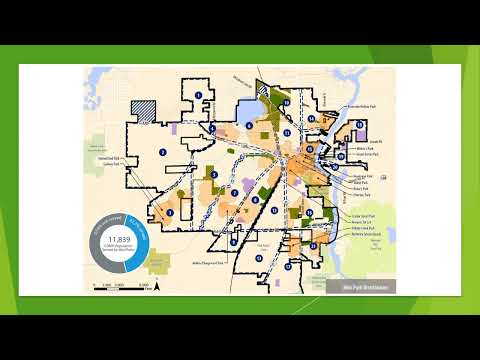
Hobson identified specific park issues and opportunities: East Beach, McHenry Shores, Althoff and Knox Park have received or are slated for playground or parking improvements; Lakeland Park and the Petersen Historic Farm were described as underutilized despite being in generally good condition; Millstream Subdivision Beach was described as a small, minimally developed site; and Miller Riverfront Park was noted for boat‑launch improvements and possible future trail connections. He said initial mapping of 21 planning areas was used to locate gaps in service and that “over 5,500 residents are not served by McHenry Parks,” according to the analysis.
On several topics Hobson gave clear, attributable statements from the presentation. For example he emphasized that one proposed use has been explicitly excluded: “Disc golf is not going in Cold Springs Park.” He outlined next steps the plan recommends: feasibility and business analyses for an indoor aquatics expansion, evaluating use of underutilized buildings (Knox Park Barn, Petersen Historic Farm, Lakeland Park), and pursuing capital improvements and funding strategies (donations, sponsorships, TIF and other sources) while noting funding and operational feasibility would require further study and council decisions.
Committee members did not take substantive votes on the master plan at the meeting. The presentation ran long and the Committee chose to adjourn the session to resume or continue the matter at a later meeting. The formal action recorded at the end of the transcript was a motion to adjourn moved by Alderman Cook and seconded by Alderman Glenn; roll call recorded affirmative votes from Aldermen Glenn, Vaney, Nordy, Vassy, Davis and Miller. Staff indicated the Parks master plan item will return for further council consideration in a subsequent meeting.
The presentation included numerous specific recommendations and supporting data that Hobson said would guide capital and operating work over the next five years; the City Council will need to review the plan’s feasibility analyses and funding strategies before adopting or directing implementation.