Get Full Government Meeting Transcripts, Videos, & Alerts Forever!
Get email alerts on the Police Response Protests topic
No spam. Unsubscribe anytime.
Residents criticize police 'sniper' deployment at protest; council adopts three-year video retention policy
Summary
Dozens of Las Cruces residents told the City Council on June 16 they felt intimidated when armed officers occupied elevated positions and used scoped rifles while monitoring a June 13 protest in Albert Johnson Park, and they asked city leaders for answers and accountability.
Dozens of Las Cruces residents told the City Council on June 16 they felt intimidated when armed officers occupied elevated positions and used scoped rifles while monitoring a June 13 protest in Albert Johnson Park, and they asked city leaders for answers and accountability.
The council voted to adopt a resolution setting a three‑year retention period and an automatic destruction process for non‑evidentiary Las Cruces Police Department (LCPD) video; officials said video tied to open or adjudicated cases will be preserved beyond that period.
The protest and the police response drew sustained public comment at the council meeting. "During our protest ... law enforcement deployed snipers and pointed rifles and tactical crossbows at us for the entire duration of the event," said Dylan Davis, who identified himself as a participant and resident. "There were children at this event. There were children with guns pointed at them for 3 hours."
Library staffer Catherine Quitello said an officer set up a scoped rifle inside an upper floor of Branigan Memorial Library and watched demonstrators through the scope. "Standing there in the grass watching a 3‑year‑old girl play with a puppy ... I felt only the violence of their presence," she said.
Other speakers, including Quentin Quitello, Lindley Hornsby and Giovanni (Yovanni) Hernandez, described fear and confusion at the protest and contrasted the LCPD response at a separately permitted Saturday event. Several public commenters asked why officers armed and positioned on roofs were visible during the Friday gathering but not during the Saturday demonstration. "On Friday, there were officers in plain clothes, hidden in shadows, holding guns," Quentin Quitello said. "Saturday, the police presence was notably different."
Police and city officials defended the department's decision while acknowledging concerns about optics. Las Cruces Police Chief Story told the council that elevated positions and overwatch were intended to protect the public and that some social‑media posts and other comments suggested threats to Saturday's planned events. "When I said that officers should not have been visible with their rifles, I didn't mean they shouldn't have been visible. I mean they shouldn't have been visible with their rifles," Story said, adding that prior contact with event organizers for Saturday had enabled different operational coordination.
City Clerk Christine Rivera and Chief Story described how the city's records management and evidence systems interact with video retention. Rivera said the city follows the state retention schedule and asked the council to adopt a uniform policy for LCPD video. Chief Story said the department had been retaining all video indefinitely and that setting a finite retention period for non‑evidentiary footage had become necessary because of the volume of data and staff workload. "We keep every video we've ever recorded going back almost 15 years ... that's created a storage issue," Story said. He and staff proposed retaining evidentiary video tied to open investigations or adjudicated cases, with non‑evidentiary material kept three years after case closure and then automatically purged under records‑management controls.
Council members and the mayor acknowledged the tension between preservation of potentially relevant evidence and concerns about data volume, privacy and community trust. Legal staff noted the city faces statutory timelines for tort and civil rights filings and said the three‑year period aligns with typical civil‑claims timeframes; the city attorney's office said evidence for open cases or appeals would be retained until legal processes conclude.
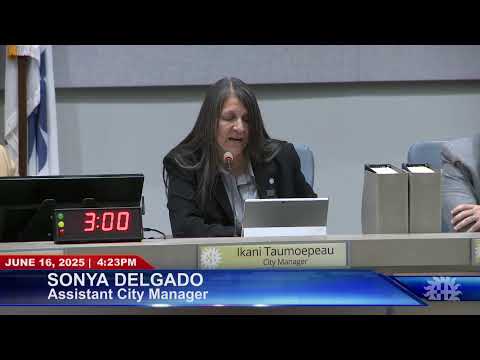
Several council members said they intend to pursue clearer protest protocols and communication between organizers and police. Mayor Eric Enriquez said he had met with Chief Story and city staff; Assistant City Manager Sonia Delgado and others said they would work with the police department on improved protocols and on ways to reduce the likelihood of misunderstood intent and harmful optics at future demonstrations.
Votes at a glance
- Resolution 25‑150 (uniforms/contract utilization): Approved. Motion to approve was seconded; vote recorded as yes from Councilors Matisse, Graham, Kran, Flores and Mayor Enriquez; Councilors McClure and Bencomo were recorded absent for that vote.
- Resolution 25‑151 (amendment to professional services agreement for lobbying services): Approved. Council recorded two no votes (Councilor Matisse and Councilor Flores) and four yes votes (Councilors Graham, Kran, Bencomo and Mayor Enriquez). The resolution increases the city's not‑to‑exceed annual amount for the lobbyist to $120,000 to cover longer legislative sessions through the current contract term.
- Resolution 25‑152 (write‑off of uncollectible utility and other receivables): Approved. Council voted unanimously in favor with absences noted.
- Resolution 25‑153 (LCPD video retention and destruction policy): Approved. Council adopted a policy establishing a three‑year automatic destruction period for non‑evidentiary video after case closure while retaining evidentiary material tied to open or adjudicated cases.
- Ordinance 3,092 / Council Bill 25‑021 (Sonoma Ranch North master plan zone changes): Approved. Council approved zone changes and master‑plan modifications for a 5.75‑acre undeveloped portion of Sonoma Ranch North consistent with planning staff recommendations.
What the record shows
Many speakers said the visible presence of officers with rifles produced fear and deterred some people — including families with children — from attending or remaining at the Friday event. Several speakers asked why law enforcement had not made any explicit on‑site notifications of perceived threats to attendees. Chief Story and other staff said the department had received intelligence about possible threats associated with the weekend of demonstrations and that communication with event organizers was stronger for the Saturday, permitted event.
On the retention policy, staff said the department currently stores large volumes of non‑evidentiary footage and that retention that effectively preserves everything indefinitely consumes storage and staff time for records requests. The adopted resolution sets a retention and automatic destruction workflow tied to the city's records‑management procedures; the city attorney's office told council this approach is intended to preserve footage for the periods required by the New Mexico Tort Claims Act and other statutes while reducing indefinite archival of routine footage.
What's next
Council members asked staff and the police department to develop clearer protest‑planning protocols, improve pre‑event communication when organizers are known, and to review how equipment and deployments affect community trust and perceptions of safety. The city will implement the retention schedule and the automatic destruction workflow under its records‑management procedures. Officials said evidentiary material and video for open cases will remain accessible and preserved until legal processes are complete.
Ending
The meeting’s public comment record shows continuing community concern about police tactics and transparency; council members said they would pursue follow‑up work with police and city staff to balance public safety, legal requirements and trust. The council also approved several unrelated administrative resolutions and an ordinance related to the Sonoma Ranch North master plan during the same session.