Get Full Government Meeting Transcripts, Videos, & Alerts Forever!
Get email alerts on the District Budget topic
No spam. Unsubscribe anytime.
Bear Valley Unified projects $2.9 million planned deficit for 2025-26, shifts one-time grants forward
Summary
District staff told the board that temporary federal and state grants drove year-to-year swings in revenues and expenditures and that a planned recurring deficit from recent negotiations will take multiple years to recover in the districts multi-year projection.
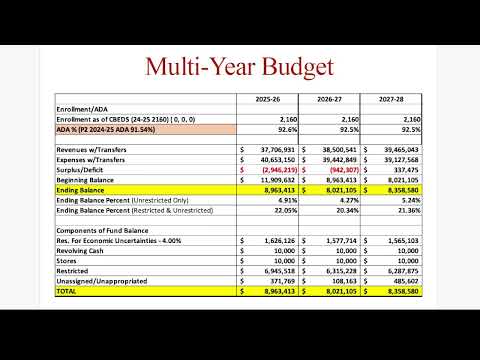
Bear Valley Unified staff presented the district—s proposed 2025-26 budget to the Board of Education, showing an expected operating deficit of $2.9 million and a larger estimated actual deficit of about $1.2 million for the year just ending.
The presentation explained that one-time and timing differences in grant revenuesnotably a spike in Comprehensive Support and Improvement (CSI) apportionments and other restricted grantsare being pushed into future years because the district can only record those revenues when it spends them. That accounting led to a $506,000 year-over-year decrease in recorded revenues at estimated actuals and to shifting hundreds of thousands of dollars of related expenditures into 2025-26 and later years.
Why it matters: District officials said the combination of recurring labor costs from recent contract negotiations and the timing of nonrecurring grant spending makes the 2025-26 budget tight. Staff also showed a multiyear projection (MYP) that narrows the deficit in 2026-27 and returns to a modest surplus in 2027-28 if enrollment and the districtfs funding assumptions hold.
Key details from the presentation included: certificated and classified salaries rose modestly as budget figures became final; supplies declined by about $860,000 largely because CSI and other grant expenditures were moved forward; and services decreased about $288,000. At second interim staff projected a $534,000 deficit; estimated actuals rose to about $1.2 million. The districtfs recurring deficit for the year of negotiations was shown elsewhere on the slides at roughly $4.5 million, which staff said is being managed by planned deficit spending and by using one-time grant resources where allowable.
Staff said enrollment slid slightly from the second-interim projection (about 2,193) to 2,160 at period 2 and that average daily attendance (ADA) declined in absolute numbers but rose slightly as a percentage of enrollment. Local revenues showed a net increase driven in part by fair-market-value adjustments, while state revenues rose about $155,000 (including an equity-multiplier allocation focused on one campus). Federal revenue recognition declined by about $538,000 at estimated actuals because large CSI and Title I allocations are being carried forward until spent.
The budget presentation also detailed fund and capital activity: playground surfacing and field maintenance work increased capital outlays in 2024-25; the Redevelopment Agency (RDA) fund contributed roughly $2.4 million toward science classroom renovations; developer fee revenue for the year was projected around $160,000; and the district captured higher indirect-cost recoveries that slightly improved unrestricted balances. Staff said some capital projects were reallocated between fiscal years after an audit adjustment that moved invoices to the proper prior year.
Board directions and next steps: staff said the LCAP (Local Control and Accountability Plan) adoption meeting is scheduled for June 18 and that unaudited actuals will be presented after year-end closing. The presenter also confirmed ongoing work to plan spending of expiring grants (arts and instructional-materials grants, educator-effectiveness funds and learning-recovery dollars) so the district does not return unspent monies.
Limitations: The figures above reflect stafffs slide presentation and interim accounting adjustments; unaudited actuals and the state budget process could change final numbers.
Ending: District staff told the board they will continue refining the 2025-26 budget and the multiyear projection and return to the board with unaudited actuals and follow-up analyses.