Get Full Government Meeting Transcripts, Videos, & Alerts Forever!
Get email alerts on the Transparency Events Branding topic
No spam. Unsubscribe anytime.
Warren council keeps disclosure rule, advances logo rules and launches work group on special-events policy
Summary
Council rejected a mayoral request to repeal a rule requiring disclosure when public funds pay for advertising, advanced a first reading revising city logo rules and directed staff to draft a special-events ordinance and a working group to tighten rental and sponsorship documentation for city-owned facilities.
The Warren City Council on June 10 approved a first reading of updates to city logo and seal use rules, rejected a mayoral-requested repeal of a disclosure rule for advertisements paid with public funds, and directed staff to draft a special-events ordinance and forms that will require more documentation for internal city events.
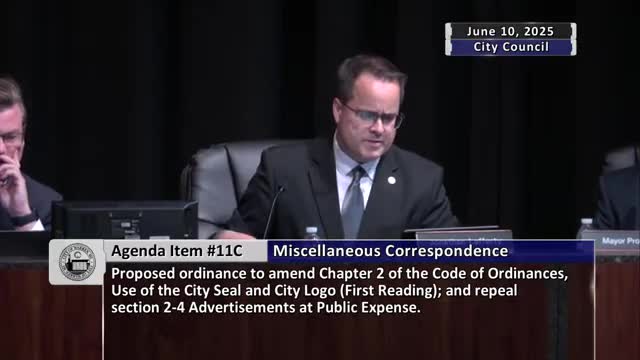
In a separate vote the council denied a motion to repeal section 2-4 of the ordinances, a rule that would require any television, radio, video or streaming announcement paid with tax dollars to carry a disclosure that taxpayers paid for the advertisement. Mr. Schroeder, the city attorney, said the provision was drafted to increase transparency after the council identified prior instances in which public money had purchased airtime that appeared as a talk show. “The idea was transparency,” Mr. Schroeder said. The motion to deny repeal carried.
Council also approved a first reading to amend chapter 2, regulating use of the city seal and logo, and asked staff to prepare clearer style rules for how the logo may be used or modified. Council member Jonathan Lafferty said the city must “protect” its brand and ensure consistent use.
A separate, extended discussion focused on event rentals, an ongoing moratorium the council placed on some Civic Center rentals, and a packet response the council received from the mayor’s office. Council member Lafferty said the administration’s response showed a lack of documentation for internal events and that the council should require the same written forms and approvals for internal events as third-party rentals: a designation for “internal government event,” sponsoring department, event description, budget and general-ledger number, and sign-off by the controller and department head. The council voted to receive and file the mayoral response and to require the administration to amend rental forms and policies accordingly.
Council member Janet Moore proposed a staff-drafted ordinance and formation of a working group to finalize rental policy and procedures; Moore, Lafferty and Council member McGee volunteered to serve on the working group. Members favored placing clear processes on a statutory footing rather than handling the matter only by internal policy.
Why it matters: Council’s action preserves a transparency disclosure for taxpayer-funded advertising and moves city branding and event-use rules toward formalized ordinance and process. Council members said the steps are intended to prevent inconsistent treatment of groups and to ensure that internal, city-sponsored events are documented with the same audit trail as third-party rentals.
Ending: Staff is directed to draft a special-events ordinance, to produce a logo/style guide, and to update rental forms; a working group of council members will review drafts before second readings.