Get Full Government Meeting Transcripts, Videos, & Alerts Forever!
Get email alerts on the Parks And Recreation topic
No spam. Unsubscribe anytime.
Clark County launches interjurisdictional parks task team to plan for rapid growth
Summary
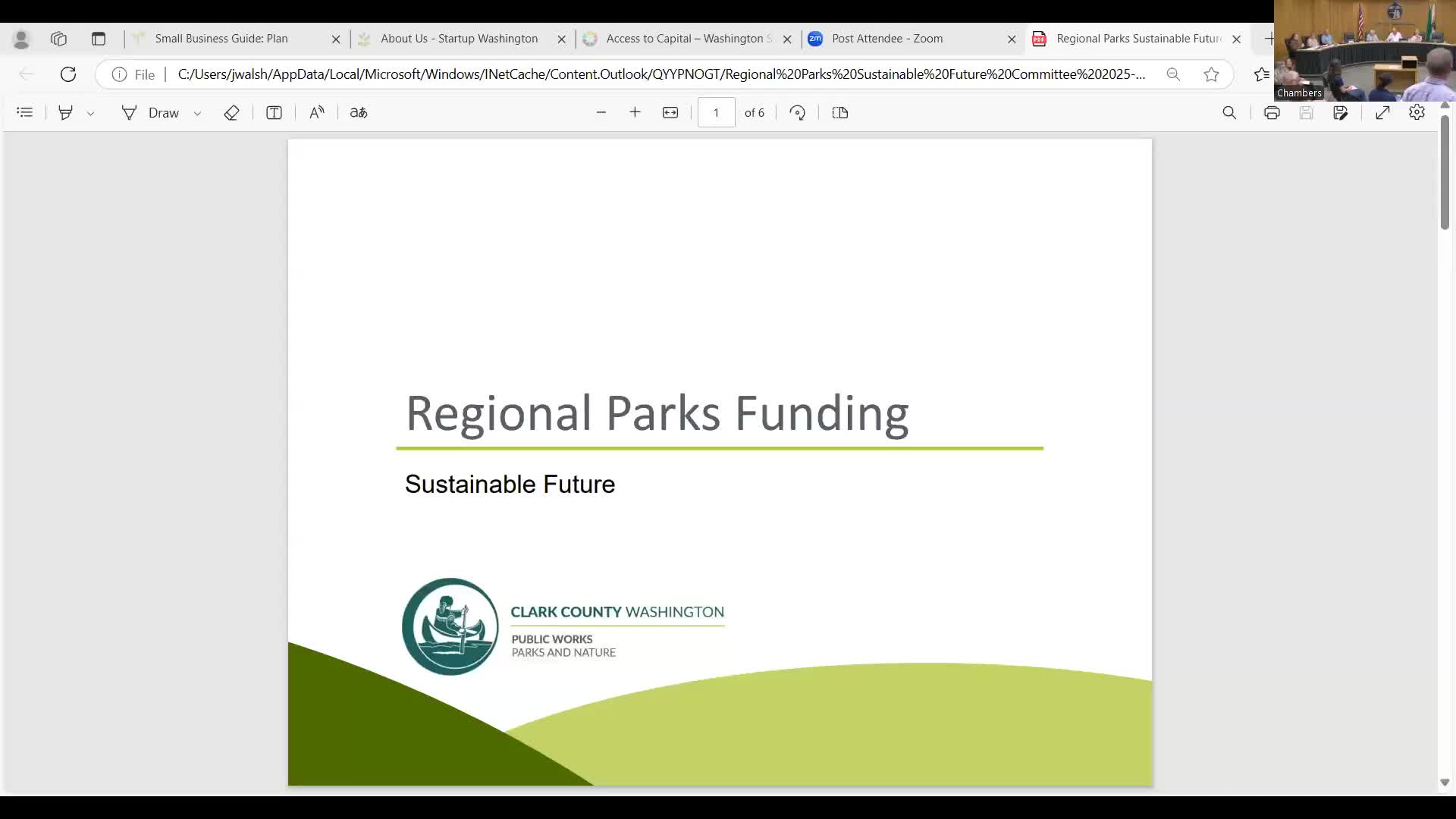
Clark County Regional Parks told the Washougal City Council it is forming a task team of county and city representatives to assess park funding, benchmark spending against national norms and present a menu of funding options after finding the county funded parks at roughly one-quarter of the national median.
Ross, a representative of Clark County Regional Parks, told the Washougal City Council on Monday that Clark County is forming a task team of county and municipal officials to develop short- and mid-term strategies for building and maintaining parks as the region grows.
The task team will gather data from each jurisdiction, benchmark local spending and staffing against national standards, review funding models and produce a concise report with recommended options and next steps, Ross said. He asked the council to designate an elected representative to participate in the group.
Ross said Clark County and its cities are in “an exciting phase” of rapid population growth and that the county’s current park funding and staffing levels lag national medians. “One of them, there’s some funding mechanisms to do that,” Ross said, listing impact fees, REET 2 and general fund capital allocations. He added the larger long-term challenge is maintaining parks once built.
Why it matters: as Washougal and neighboring jurisdictions add residents, city and county leaders must decide how to pay for new parkland and ongoing maintenance. Ross told the council Clark County staff will collect local data — for example, full-time staffing, capital replacement budgets and acres per population — then compare that data to the National Recreation and Park Association survey to identify gaps.
The task team’s work plan has three main steps, Ross said: 1) understand gaps and needs in each community; 2) benchmark systems against national data; and 3) explore alternative funding and governance models used elsewhere. Ross cited King County’s parks levy and the East Bay Regional Parks District as examples of different regional approaches. He also pointed to the Greater Clark Park District, a metropolitan park district formed north of Vancouver in 2013, as a nearby example.
Ross told the council the county’s review will probably take about six months to yield a report, followed by community outreach to user groups — youth sports, equestrians, boaters and others — to identify priorities. He invited an elected official from Washougal to serve on the county task team so the city’s interests can be represented in the review.
Council members and staff asked about local amenities such as pickleball courts and dog parks and about accessing the county’s benchmarking tool; Ross offered to share links and the county’s collected data. He told the council the county-wide per-capita park funding is “about a quarter of the national median,” a gap the task team intends to quantify and address with case studies and a menu of policy options.
Next steps: Clark County will convene the task team, collect jurisdictional data, produce a short report with options for regional and local funding models and follow with community outreach; Washougal was asked to nominate a council representative.
Ending: Ross said the county wants to “get ahead of this growth” so that parks can be planned and funded before land is no longer available. Council members thanked Ross for the presentation and indicated interest in participating.