Get Full Government Meeting Transcripts, Videos, & Alerts Forever!
Get email alerts on the Infrastructure Bridge Projects topic
No spam. Unsubscribe anytime.
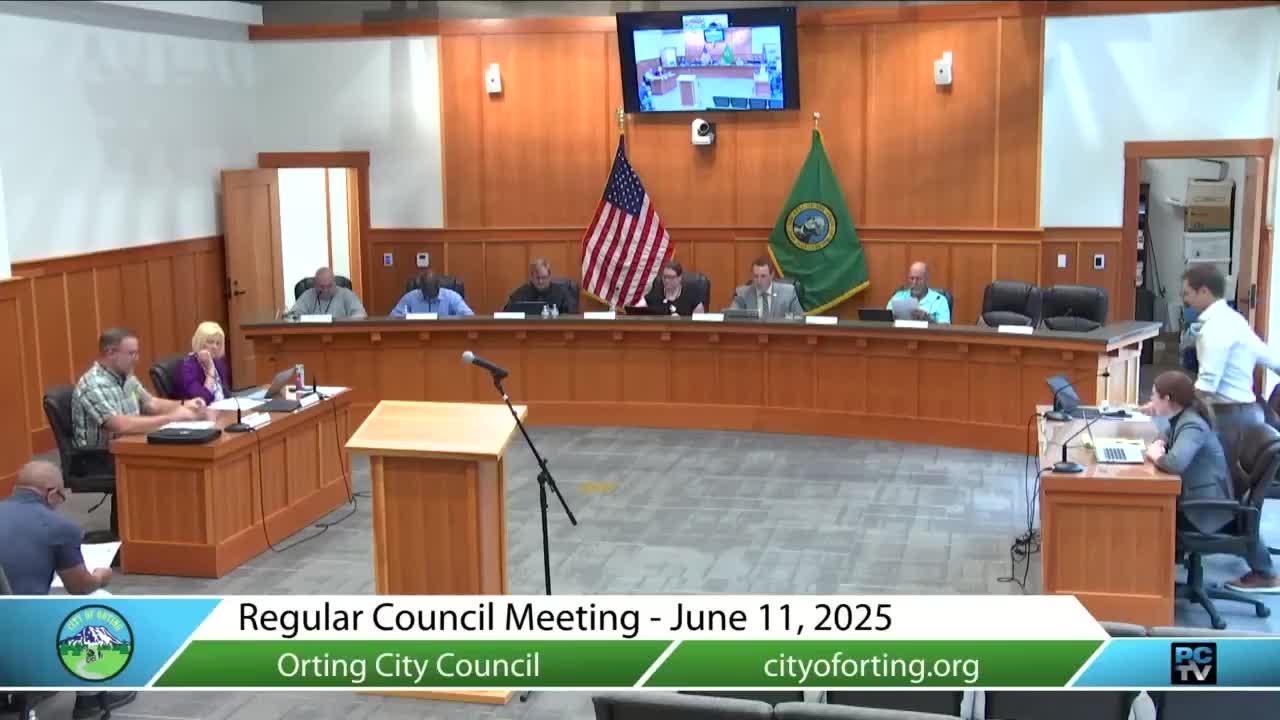
Orting council briefed on emergency-evacuation bridge repairs; change order expected next week
Summary
City staff told the Orting City Council the emergency-evacuation bridge project has required unplanned shaft repairs and a redesign of one deep foundation shaft; staff said it will present a change order for council approval next week with preliminary cost estimates.
Orting — City staff on Wednesday told the Orting City Council that construction on the emergency-evacuation bridge has progressed but requires additional work on deep foundation shafts and that the council will be asked to approve a contractor change order next week.
Scotty Ireland, construction manager for the project, said crews have "successfully completed the repairs to the substructure portion of the work" and that four of five deep foundation shafts have been repaired. "There is a single shaft ... that cannot be relied upon to provide the structural capacity necessary for the bridge," he said, and that shaft must be redesigned before replacement work proceeds.
The briefing explained three categories of near-term costs staff expect to bring to council: (1) a rough-order-of-magnitude engineer estimate of about $350,000 to redesign and rebuild the affected West Ramp 2 shaft; (2) the city's current estimate of approximately $75,000 for investigation work already performed; and (3) roughly $60,000 for grouting and the repairs that have been performed and that the city acknowledges are its responsibility. Scott Larson, city administrator, and project staff said final amounts will be based on negotiated change-order pricing with the prime contractor.
Why it matters: The shaft redesign is on the construction critical path, staff said, and the value of the pending work exceeds the project team’s delegated authority, so council approval will be required. The work ties directly to safety and to the schedule for turning the bridge over to the Washington State Department of Transportation (WSDOT) at project completion.
Council members asked about dispute resolution, oversight, and additional costs. Ireland said the disputed costs are being handled under the contract’s processes; if the parties cannot agree, arbitration is defined in the contract. "Both parties are diligently, collaboratively, and objectively evaluating each party's position," he said, adding that the project team is working to resolve issues on the critical path so construction can continue.
Council members also asked whether WSDOT review could slow approvals. Ireland said WSDOT is reviewing structural changes as they are developed and that the project team is coordinating approvals "hand in hand" to avoid later surprises. Several council members asked that future change-order agenda packets include the specific contract language showing why a particular cost is charged to the city or the contractor.
Other items discussed included a WSDOT-required pigmented sealer for concrete surfaces that staff said was not in the original contract documents but is part of WSDOT’s acceptance criteria. Staff told the council the pigmented sealer is a WSDOT standard for bridges and helps extend concrete life and reduce life-cycle maintenance, and that a separate discussion will be scheduled about its cost and scope.
The council did not vote on any bridge contract action at the briefing. Staff said they will present a formal change-order request for council consideration at the next council meeting.