Get Full Government Meeting Transcripts, Videos, & Alerts Forever!
Get email alerts on the Temporary Encampments topic
No spam. Unsubscribe anytime.
Burien adopts temporary‑encampment code with change to staffing requirement after council debate
Summary
Burien City Council voted May 19 to adopt Ordinance 861, a new temporary‑encampment code, and changed a proposed 24‑hour on‑site staffing requirement from “required” to “encouraged.”
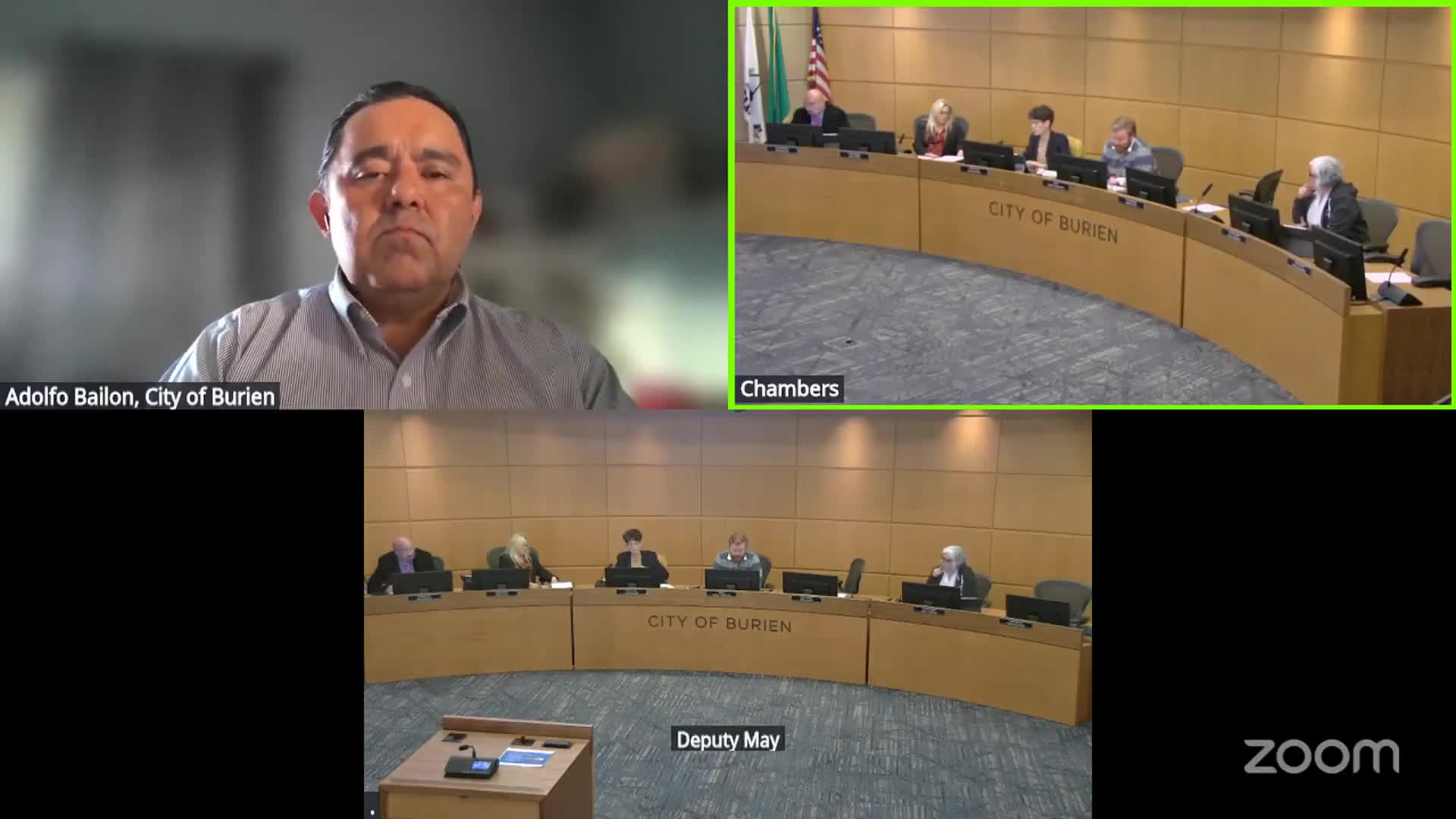
Burien City Council voted on May 19, 2025, to adopt Ordinance 861, a new municipal code provision governing temporary encampments and religious‑organization shelters, and revised a staffing provision so that 24‑hour on‑site staffing is “encouraged” rather than required.
The ordinance was taken from the table for discussion after Deputy Mayor Sarah Moore moved to “take from the table ordinance number 8 61 for the purpose of discussion and potential action.” Planning staff and council members then debated the rules that would govern permit timelines, staffing and how the city should implement recent state law changes.
The council debate focused on three main issues: time limits for temporary encampments, whether 24‑hour on‑site staffing should be mandated, and the extent to which the city should adopt a local code that mirrors state law. Deputy Mayor Moore proposed an amendment to extend the allowable duration for temporary encampments to one year — and three years for small temporary housing — citing concern that short windows create anxiety for service providers. That amendment failed. Councilmember Hugo Garcia proposed a two‑year compromise; that amendment also failed.
Planning staff explained that the draft city code is intended to mirror state law while filling gaps where the statute leaves alternatives open. Liz (planning staff) told council, “So, deputy mayor, we did speak with a few organizations,” and named the Low Income Housing Institute and a local pastor who runs severe‑weather shelters as participants in outreach to shape the draft. Staff said the local code provides a clearer administrative path for reviewing requests than relying on the city’s existing temporary‑use permit rules.
Public commenters raised operational concerns. Beatrice Van Holder, who identified herself in public comment as supporting Tiny Home Villages, said the one‑year cap under consideration is impractical: “This setup cost between 700, thousand and $1,000,000, and it is unrealistic and unwise for any organization to spend this amount of time, energy, and taxpayer, or grant money to set up a village that could stay in place for less than 2 years.” She added that the average length of stay for residents exiting homelessness is three to four months, and argued that short municipal time limits could deter providers from establishing villages.
Councilmembers also discussed legal and administrative risk. Planning staff said the city’s proposed code does more than repeat state law: it picks options where state law provides multiple approaches and supplies procedural details so planners and applicants have predictable requirements. A city official cautioned in general terms that any municipal action can prompt litigation, noting the city has faced lawsuits in recent years; that speaker emphasized the right to sue does not mean challengers will prevail.
After several failed amendments, the council approved the ordinance language change to make 24‑hour on‑site staffing encouraged rather than required. The council recorded the result as a successful vote; the transcript records the final outcome as adopted (the meeting recorded the final tally verbally as “a successful vote” with a small number of members not voting affirmatively). Councilmembers directed staff to return the ordinance materials and implementation steps to the June calendar for processing and permit guidance.
Why it matters: the ordinance creates the city’s local process for authorizing temporary shelters and encampments following state changes, and it affects faith‑based organizations and other community groups that may host emergency or temporary housing. The debate highlighted tension between predictable local rules and the operational realities and costs that nonprofits and religious institutions face when opening shelter sites.