Lifetime Citizen Portal Access — AI Briefings, Alerts & Unlimited Follows
Senate subcommittee hears bipartisan push to curb illegal, unreported and unregulated fishing; Fish Act touted as key tool
Loading...
Summary
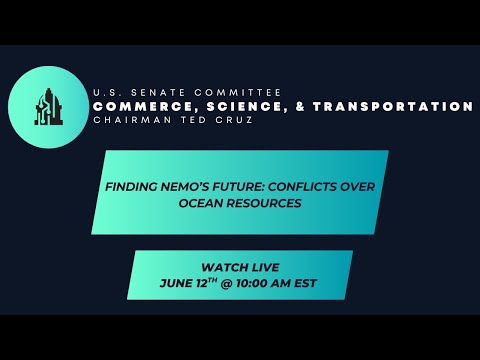
Chairman Dan Sullivan convened the inaugural hearing of the Senate Commerce Subcommittee on Coast Guard, Maritime, and Fisheries to focus on illegal, unreported and unregulated fishing, its links to transnational crime and forced labor, and possible U.S. responses, including pending legislation known as the Fish Act.
Chairman Dan Sullivan convened the inaugural hearing of the Senate Commerce Subcommittee on Coast Guard, Maritime, and Fisheries to focus on illegal, unreported and unregulated fishing, its links to transnational crime and forced labor, and possible U.S. responses, including pending legislation known as the Fish Act. "Today's hearing will focus on international conflict, criminal activity, and, yes, even slave labor, associated with the ocean," Sullivan said, adding that the committee recently passed the Fighting Foreign Illegal Seafood Harvest (Fish Act) unanimously in committee.
Why it matters: Witnesses and senators described IUU fishing as a cross-cutting threat — harming U.S. fishermen and coastal economies, degrading fish stocks and marine ecosystems, enabling human trafficking and forced labor, and posing national-security risks when foreign vessels operate near U.S. waters or allied infrastructure.
The hearing opened with senators from multiple coastal states describing local effects. Ranking Member Sen. Lisa Blunt Rochester said IUU fishing "destabilizes marine ecosystems and even has national security implications," and warned that cuts to NOAA could reduce enforcement and scientific capacity. Sen. Sheldon Whitehouse and Sen. Ted Cruz also framed IUU fishing as both an environmental and security problem; Cruz described seizures of illegally caught fish off the Texas coast and called for more surveillance and enforcement along the southern maritime border.
Expert testimony and evidence: Gregory Poling, director and senior fellow at the Center for Strategic and International Studies' Asia Maritime Transparency Initiative, said IUU fishing is often part of broader "fisheries crime" networks that can include trafficking, forced labor and smuggling. He urged stepped-up maritime domain awareness using low-earth-orbit satellites and uncrewed platforms and stronger coordination with allies to detect and deter bad actors.
Nathaniel Rickard, a lawyer who has worked on seafood trade issues, cited U.S. International Trade Commission estimates that removing IUU imports would raise U.S. commercial fishing operating income (the ITC estimated roughly $61 million in annual industry-wide operating income gains) and argued that supply-chain transparency and data sharing — both central to the Fish Act — would help domestic producers compete.
Gabriel Prout, president of the Alaska Bering Sea Crabbers Association, described steep harms to Alaska crabbers from Russian and other IUU imports and said the recent U.S. restrictions on Russian seafood helped lift dock prices for Alaska crab this season. He urged expanded import monitoring, mandatory country-of-origin labeling for cooked and processed crab, stronger sanctions and relief or financing to help small family-run vessels modernize.
Dr. Whitley Som Weber, director of the Stephenson Ocean Security Project at CSIS and a University of Rhode Island professor, outlined a four-part response: market access control (using U.S. and allied buying power), operational interdiction (patrols and partner patrol agreements), enhanced maritime domain awareness and sustained investment in the agencies that support those measures, especially NOAA, the U.S. Coast Guard and USAID.
Budget and capacity concerns: Witnesses and senators warned that recent staffing reductions and proposed budget cuts to NOAA would weaken science, enforcement and international engagement. Witnesses quoted figures from the hearing record: NOAA fisheries staffing reductions of about 18 percent and a stated risk that 30 percent of NOAA research vessels could remain docked this summer, which committee members said would reduce stock assessments and enforcement capacity. Sullivan also pointed to a pending budget reconciliation package that includes about $22 billion in proposed Coast Guard investment.
Policy tools discussed: Panelists and senators repeatedly recommended (1) passage and implementation of the Fish Act to blacklist IUU vessels and tighten import controls; (2) expansion and full implementation of NOAA's Seafood Import Monitoring Program and stronger country-of-origin labeling, including for cooked products; (3) increased maritime domain awareness through satellite and uncrewed systems and better international data sharing; (4) expanded port-state measures, and (5) targeted sanctions and market-access penalties to deprive IUU actors of markets.
International dimension: Witnesses highlighted the global scope of IUU fishing and its effect on Pacific Island nations, Africa and other regions. Poling and others emphasized that China operates a very large distant-water fleet and that Chinese and Russian vessels have been implicated repeatedly in IUU activity; committee members heard that China’s distant-water fleet was reported by Global Fishing Watch to have some 57,000 vessels and that IUU fishing may account for up to 20 percent of the global catch, figures cited in opening remarks.
Next steps: The committee requested written follow-up from the witnesses and indicated it would pursue legislation and oversight in coming weeks. Chairman Sullivan encouraged ongoing bipartisan work and said the committee would use the witnesses' expertise as it advances policy and funding priorities.
Votes and formal actions: Chairman Sullivan told the subcommittee that the Fighting Foreign Illegal Seafood Harvest (Fish Act) was recently approved unanimously in committee and described it as central to preventing IUU seafood from entering U.S. markets. The Fish Act was presented at the hearing as the principal legislative vehicle discussed by senators and witnesses.
The hearing record remains open for written testimony and follow-up answers to committee questions.