
Commerce Nominee for Export Enforcement Pledges Vigorous Enforcement as Senators Press on Chip Diversion and Resources
Get AI-powered insights, summaries, and transcripts
Subscribe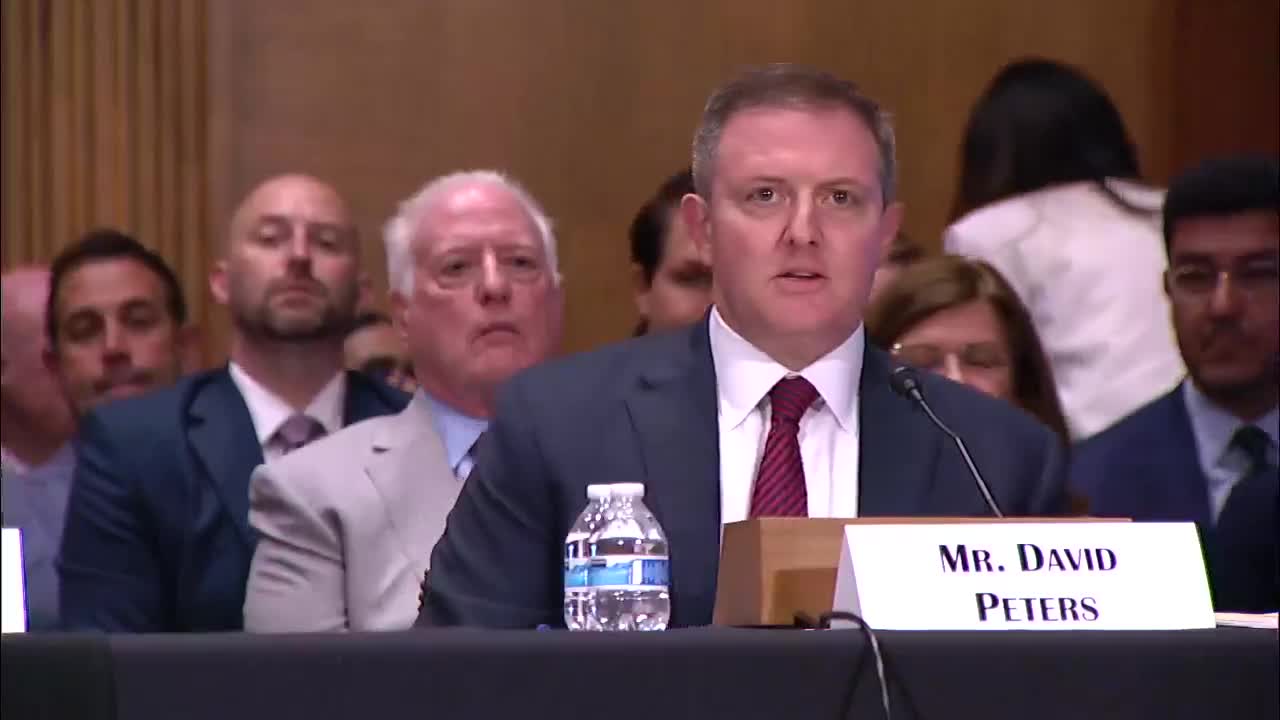
Summary
Commerce Department export enforcement nominee Mr. Peters told the Senate Banking Committee he will ‘‘vigorously enforce’’ U.S. export laws; senators pressed him on transshipment of advanced AI chips to China, potential transfers via third countries including the UAE, and whether the Bureau of Industry and Security has the resources it needs.
Mister Peters, President Trump’s nominee to be assistant secretary for export enforcement at the Commerce Department’s Bureau of Industry and Security, told the Senate Banking, Housing, and Urban Affairs Committee that he would be “vigorous” in enforcing export control laws and would “aggressively enforce the law.”
Senators from both parties pressed Peters on how the United States can prevent high‑end AI chips and other controlled technologies from reaching China through third countries. Senator Elizabeth Warren repeatedly asked whether Peters agreed that the U.S. needs “robust safeguards” to stop countries such as Saudi Arabia or the United Arab Emirates from taking U.S. chips and passing them to China; Peters repeatedly said he would commit to vigorous enforcement of export controls and cited existing criminal, civil and administrative tools.
Why this matters: advanced semiconductors and AI chips are central to national and economic security. Multiple senators described open interdiction and diversion routes and asked whether the Commerce Department and BIS currently have the investigative and enforcement tools and staffing to keep pace with smuggling networks.
Senator Mike Rounds cited congressional and open‑source reporting that identified “at least eight Chinese smuggling networks that have each trafficked over $100,000,000 worth of U.S.‑made AI chips into sanctioned Chinese military and research entities,” and urged Peters to work with senators on the bipartisan Stop Stealing Our Chips Act, which would add a whistleblower incentive program for BIS. Peters said he would be “happy to… work with you” and that it would be part of his charge to determine how any new resources should be allocated if Congress provides them.
Committee members also raised specific concerns about policy and administration actions. Senator Chris Van Hollen pressed Peters about a reported agreement between the U.S. and the UAE and noted public reporting that the administration planned to rescind an Obama‑era/Biden‑era “AI diffusion” rule intended to limit certain transfers of sensitive technologies; Peters said he was aware of the public reporting but not of specific details and reiterated that enforcement is BIS’s role.
On the entity list — a tool that imposes licensing requirements and a presumption of denial for listed foreign parties — senators asked whether Peters would restore a regular cadence of entity‑list actions. Peters said he would take his responsibilities seriously and work with colleagues across the department, while noting that rule‑making and policy are handled on the administrative side of BIS and enforcement focuses on investigations and prosecutions.
Peters repeatedly framed enforcement as a mix of criminal prosecutions, civil and administrative remedies under the Export Administration Regulations and the Export Control Reform Act. He told the committee that if a criminal prosecution cannot be achieved, BIS would pursue civil and administrative actions under available authorities.
The senator‑led exchanges make clear that the committee expects the nominee to engage with pending legislation, agency resource requests and international partners to limit diversion and transshipment of controlled goods. Senators pressed for commitments that BIS would be resourced and empowered to match the scale of illicit export activity; Peters said the White House budget proposal he had seen included “a significant increase for resources to BIS targeted primarily towards enforcement,” and that he would allocate additional appropriations to meet high‑priority threats if confirmed.
The committee left follow‑up questions for the record and asked nominees to answer by committee deadlines.