Get Full Government Meeting Transcripts, Videos, & Alerts Forever!
Get email alerts on the Budget topic
No spam. Unsubscribe anytime.
Livingston Parish School Board adopts final 2024–25 operating budget amid enrollment-driven revenue drop
Summary
The Livingston Parish Public Schools board approved its final 2024–25 operating budget after hearing staff outline a $12.9 million general-fund shortfall, planned transfers from restricted reserves and fund-by-fund summaries including sales-tax, maintenance, construction, sinking and federal/state program funds.
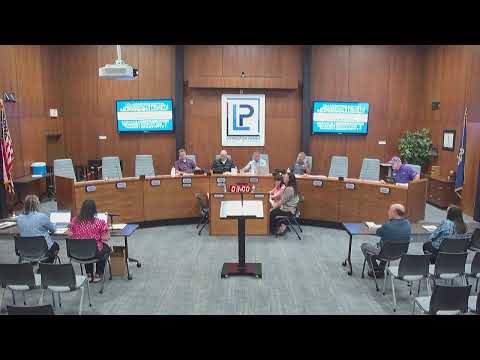
The Livingston Parish Public Schools Board voted to adopt the district's final operating budget for fiscal year 2024–25 after a staff presentation outlining a projected $12.9 million deficit in the general fund and planned use of restricted reserves to cover some shortfalls.
Assistant Business Manager Ashley Yang presented the budget to board members, saying the district projects $273,000,000 in general-fund revenues and $286,000,000 in expenditures for 2024–25, leaving a projected deficit of $12,900,000. Yang told the board that about $5,000,000 of restricted reserves will be transferred to partially cover that shortfall and that final, audited “actual figures for 24‑25 will be available after our annual audit.”
The presentation attributed the revenue reduction to a $1,600,000 decrease in MFP revenue tied to lower student enrollment. Yang described several restricted reserves and program-specific adjustments the budget relies on, including CDF-designated reserves, a $250,000 increase for E‑Rate expenditures, and a $600,000 increase for career-development spending funded from prior-year dedicated balances.
Yang walked the board through other major general-fund changes: roughly $400,000 in salary increases related to differentiated compensation stipends, higher health-insurance costs that increased benefits expenses, higher workers’ compensation and severance payouts tied to recent retirements, and an approximately $500,000 increase in materials and supplies primarily reflecting CDF-related career-development spending and technology costs including camera installation on new buses.
The board reviewed other restricted and enterprise funds. The district's second-sales-tax fund (parishwide 1¢ sales tax plus a share of a half-cent sales tax) shows projected 2024–25 revenues of $41,700,000 and expenditures of $39,900,000, leaving a current-year surplus of $1,800,000 and a net surplus of $63,300,000 after prior-year balances. The 7‑mill maintenance fund is projected to generate $13,400,000, including a $5,600,000 transfer from the second-sales-tax fund to cover expenditures. The sinking (debt-service) fund is projected to have $12,100,000 in revenue and $12,400,000 in expenditures, a current-year deficit of roughly $283,000 and a net surplus of about $5,000,000 after prior balances.
Construction fund projections list $13,900,000 in revenues with a prior-year balance that produces a current-year surplus of about $17,000,000. The school food service fund shows projected revenues of $17,800,000 and expenditures of $20,200,000 for a current-year deficit of $2,400,000 and a net surplus of about $8,000,000 after prior-year balances. Disaster fund, federal, and state program totals were also reviewed: the disaster fund projects $7,000,000 in revenues with minimal planned expenditures; IDEA is shown at $10,400,000; other federal programs at $1,500,000; NCLB funds at $3,800,000; ESSER at $3,200,000; state 8(g) funds at $277,000; and the LA 4 program at $2,900,000.
Board members asked clarifying questions about the MFP-related revenue decline, enrollment trends including homeschooling and virtual-program participation, and potential future impacts from state proposals the staff referenced. Yang and other staff emphasized the complexity of converting enrollment decreases into immediate expenditure reductions because students are distributed across schools, and they noted the district has seen increases in property-tax revenue that partially offset enrollment-driven losses.
A brief exchange during public discussion confirmed that summer meals will again be provided free to students; the transcript records approximate figures discussed for what charged lunches might cost if reinstated, which speakers described as rough estimates rather than firm policy changes.
After questions, a motion to adopt the final 2024–25 budget was made by Mister Seals and seconded (second not named in the transcript). The board approved the budget by voice vote. A later motion to adjourn, moved by Mister Seals and seconded by Mister Frizzell, carried by voice vote.
The board presentation noted that audited, final numbers for 2024–25 will be available after the annual audit and will be reflected in the revised 2025–26 budget documents.