
North Brookfield approves $15 million general operating budget; stabilization and long-term debt discussed
Get AI-powered insights, summaries, and transcripts
Subscribe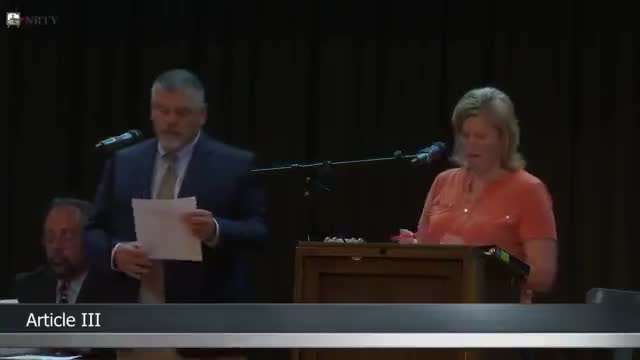
Summary
Voters at the Town of North Brookfield annual meeting approved the fiscal 2026 general operating budget totaling $15,000,004.63 and raised questions about the town's stabilization balance and long-term debt schedule.
North Brookfield voters approved the town's fiscal 2026 general operating budget, voting to raise and appropriate a total of $15,000,004.63 for the 12-month period beginning July 1, 2025.
The approval came after Finance Committee members and town officials reviewed line items, explained the town's stabilization balance and answered residents' questions about debt maturing on multiple town projects. "The finance committee has reviewed all the articles, as well as the budget for fiscal 26. And we are in agreement with the budget that is being presented tonight by the Board of Selectmen," a finance committee representative told the meeting.
The budget was presented in four separate motions covering (1) administrative and central charges; (2) public safety and inspectors; (3) the school department; and (4) highway and other municipal departments. The first motion included transfers from Stabilization ($298,995.47) and Free Cash ($90,000) for group insurance and set the combined total for the general fund operating budget at $15,000,004.63.
Town Accountant Sheila LeBlanc provided the current Stabilization balance in response to resident questions, saying the balance was approximately $1,000,003.64 (figure read at the meeting). Residents asked whether the town should maintain a target balance; LeBlanc said the town's financial advisor recommends maintaining about $1 million in Stabilization to preserve borrowing ratings for future capital projects.
Several residents asked about the schedule for outstanding debt tied to school, wastewater and other projects. The town accountant described which borrowings are paid from the tax base and which are sewer-user obligations, and said the town had used a USDA final borrowing for the wastewater treatment plant upgrade. Officials identified a mix of bond anticipation notes that require annual re-borrowing until final borrowing is completed. Town officials responded that the schedule of final maturities and some line-item dates were available in meeting materials but were read aloud with numeric transcription artifacts during the meeting.
The meeting recorded votes approving each motion (majority or two-thirds as required by the specific motion). No specific roll-call tallies were provided in the public read-aloud; the moderator called the voice/hand votes and announced each motion passed.
Budget watchers pressed officials on long-term affordability and the practice of using Stabilization and Free Cash for operating costs; officials reiterated that some transfers were planned and that longer-term borrowing will be used for capital projects as appropriate.