
Design team recommends 'Option 1' for Drew Middle School site; board and neighbors press safety, parking and buffering details
Get AI-powered insights, summaries, and transcripts
Subscribe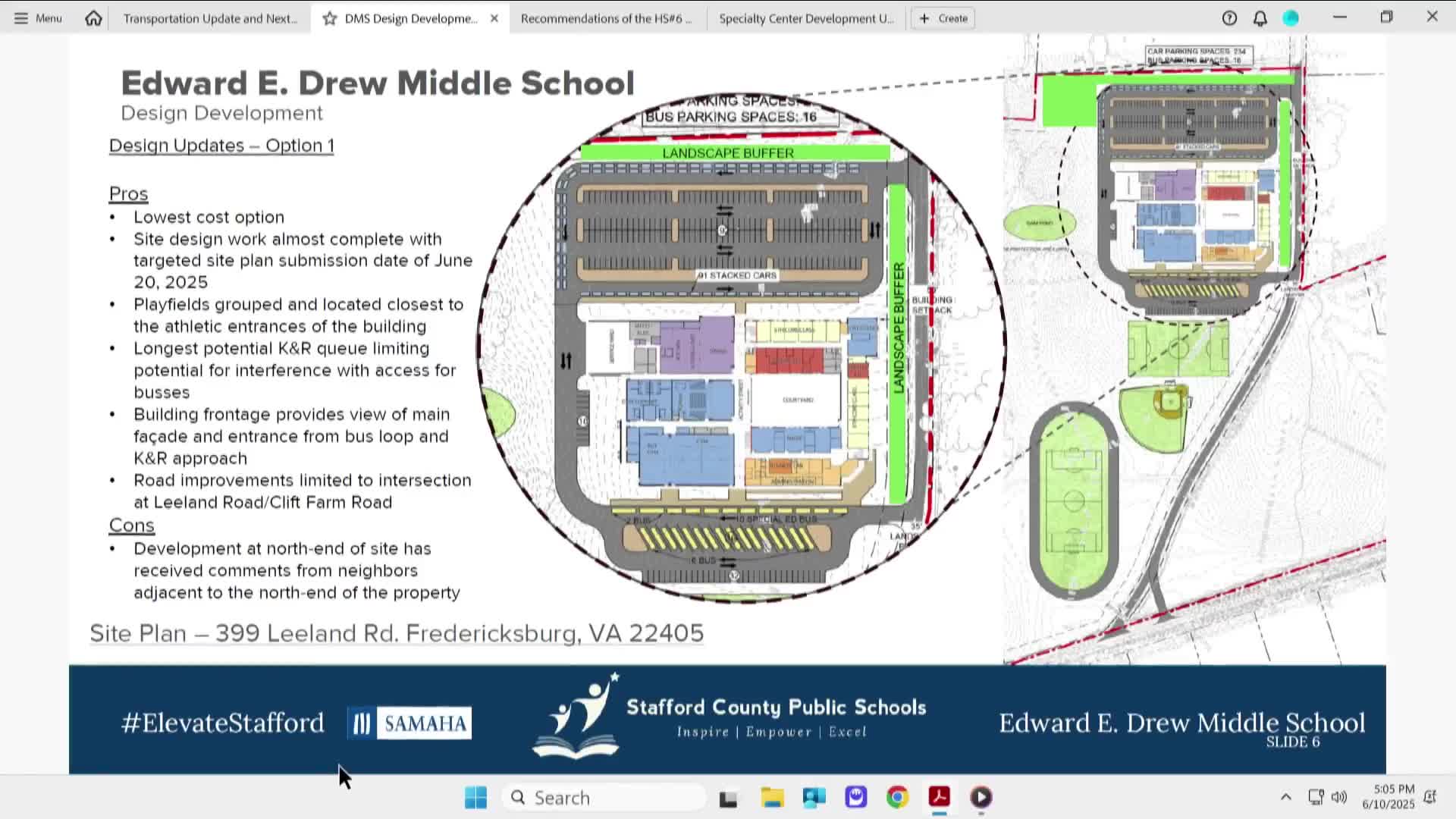
Summary
Architects presented a design‑development update for the Drew Middle School rebuild and recommended the lowest‑cost site orientation, while neighbors and board members pressed for changes to visitor parking, pedestrian access, mechanical screening and landscape buffers before civil submission.
Architects and school staff presented a design‑development update on the Drew Middle School rebuild and said they plan to move forward with the lowest‑cost site orientation — called “Option 1” — and submit site plans in about two weeks.
The update, given at the June 10 meeting of the Stafford County School Board, walked the board through changes made since schematic design, including stacked locker pods that can later convert to labs or classrooms, relocated drama space, simplified fire‑wall geometry and a designated rooftop mechanical area between the auditorium and gymnasium. The design team also said it had developed cost estimates with two consultants and that the project remains on schedule for the next permitting milestone.
Neighbors and several board members raised operational and safety concerns tied to the recommended orientation. Community commenters said the proposed arrangement places visitor parking and parent drop‑off in locations that would require pedestrians to cross active bus movements; they urged either flipping the plan or creating stronger, separated pedestrian connections so parents and visitors do not walk through bus queuing areas. School staff and the design team said they had studied a mirrored layout and two alternate site options but found operational or schedule impacts: Option 2 would split play fields and require a third access on Cliff Farm Road; moving the building far south (Option 3) would require relocating part of Cliff Farm Road and add an estimated $3 million–$5 million in site cost and a significant schedule delay.
The design team and staff also responded to questions about safety systems and materials. The presenters said “simplifying the firewalls” referred to straightening structural walls to reduce construction complexity and cost and that the change did not reduce safety or code compliance. The team noted a planned precast panelized facade on the three‑story portions as a value‑engineering step intended to speed construction and lower cost.
Board members pressed for additional design clarifications before final site‑plan submission. Topics the designers agreed to study further included: wider and more continuous visitor walkways from parking to the secure vestibule; whether a satellite check‑in table or SRO‑adjacent workspace could be added to better manage large‑event visitor screening; the number and distribution of accessible parking spaces; and options to increase the initial maturity and density of the landscape buffer to reduce early‑stage light and sightline impacts for adjacent homeowners. The design team said the site plan scheduled for submission in roughly two weeks reflects the option used for the current cost estimates but that staff could refine buffer planting sizes and lighting types as part of permit‑level drawings.
Why it matters: The board and public framed the decision as a trade‑off between preserving schedule and addressing neighborhood impacts. Moving the building or reworking the bus/parent loop could add millions of dollars to site costs and delay delivery; conversely, residents want stronger initial screening, quieter lighting, and safer pedestrian routing, not only longer‑term plant growth.
The presentation closed with the design team’s recommendation to proceed with Option 1 and submit the site plan on schedule, and staff said they would return with cost projections for upgraded buffer plantings and additional pedestrian/safety details if the board requests them.