Get Full Government Meeting Transcripts, Videos, & Alerts Forever!
Get email alerts on the Personnel And Executive Session topic
No spam. Unsubscribe anytime.
Baker council moves into executive session on city‑attorney personnel matter citing Louisiana open‑meetings law
Summary
The City Council of Baker voted unanimously to enter executive session to discuss a personnel matter involving the city attorney, citing La. R.S. 42:17(a)(1), (a)(4) and (a)(10) and Louisiana Code of Evidence Article 506; special counsel said 24‑hour notice was given to the city attorney, who elected an executive session.
The City Council of Baker voted unanimously to enter executive session to discuss a personnel matter involving the city attorney, invoking Louisiana’s open‑meetings exceptions for discussions of competence, investigations and privileged attorney‑client communications.
Special counsel Henry Olin told the council he provided 24‑hour notice to the city attorney, identified in the meeting as "Mr. Fogg," and relayed that the attorney elects to have the discussion in executive session. Olin said he would place the attorney’s written reply into the record. The motion to enter executive session cited La. R.S. 42:17(a)(1) (discussion of competence), La. R.S. 42:17(a)(4) (investigation) and La. R.S. 42:17(a)(10) (to facilitate privileged attorney‑client communications), along with Louisiana Code of Evidence Article 506.
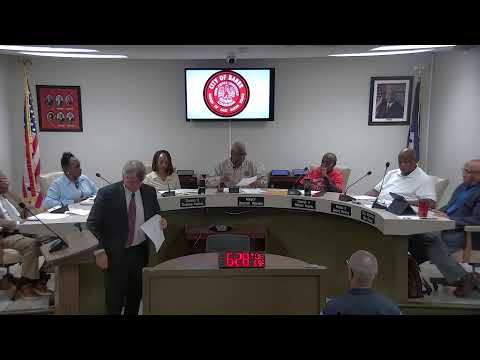
Council Member Desiree Collins made the motion to enter executive session, and Council Member Cedric Murphy seconded it; the presiding officer called the roll by district. Districts 5, 4, 3, 2 and 1 each answered "Yes," and the chair announced, "Motion carries. We are now in executive session." No substantive personnel details were discussed on the public record before the council recessed into executive session.
The agenda item described the personnel matter as concerning Section 406 of the Baker Charter and noted the city attorney had continued to serve after a change in voter registration in September 2024. The council recorded the statutory bases for closing the session on the meeting agenda before the vote. The meeting record includes special counsel's statement that he provided the city attorney the notice required under the open‑meetings law and that the attorney chose executive session rather than a public discussion.
Following the unanimous vote, the council moved into executive session; no public decisions beyond the vote to enter closed session were disclosed at that time.