Get Full Government Meeting Transcripts, Videos, & Alerts Forever!
Get email alerts on the County Compensation topic
No spam. Unsubscribe anytime.
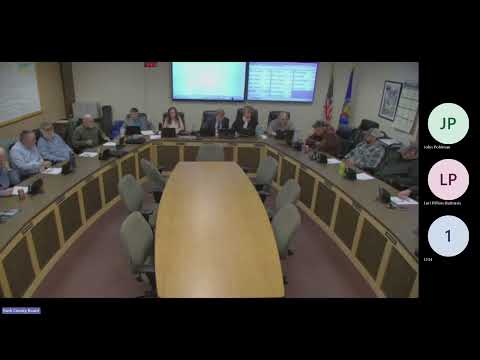
Rusk County board hears wage-study warning, adopts written hiring rules limiting new hires to step 7
Summary
County staff told supervisors Rusk County wage scales have fallen behind regional markets and recommended a market rebenchmark; the board adopted a personnel handbook compensation policy that limits routine hiring to step 7 on the county pay scale and requires department-head consultation for higher starts.
Rusk County officials heard a presentation on county wages and voted to adopt a written compensation policy that narrows administratively allowable new-hire starting pay and formalizes how promotions and step or structure adjustments are handled.
County staff presented comparative data showing the county's wage scale — implemented in early 2023 using 2021 market data — has not kept pace with regional employers. The presentation, given to the full board after a prior personnel-committee briefing, showed 62 benchmarked positions and said many are more than 10% below the average minimum, control-point and maximum pay found in seven comparison counties (Barron, Chippewa, Price, Sawyer, Taylor and Washburn). The board then debated and approved several amendments to a draft compensation policy and adopted the policy as amended.
The wage study matters because 44% of the county's budgeted expenditures are wages and benefits, staff said. Relying on reserves to cover recurring pay costs is not sustainable, they said, and the state's levy limit (cited as Wisconsin Stat. 66.0602) constrains property-tax revenue growth. “Without regular updates, we are going to be losing talent, falling further behind, and risking long-term damage,” one presenter told supervisors.
Key findings presented by staff included: - The county evaluated 62 positions against the seven neighboring counties' pay grids at three points (minimum, control point, maximum). Many positions were more than 10% behind at each point; the largest gaps grew for higher-graded positions. - About 23% of current employees were at or above the control point (step 11 under the existing scale from the 2022 benchmark). Roughly 51% of employees were at step 5 or lower as of April 2025. - The county has given periodic step increases since implementation, but has not applied annual structure (COLA) adjustments that would keep ranges aligned with market changes.
Staff proposed options including re‑benchmarking the market with a consultant (Cottingham & Butler, formerly Carlson Dettman), conducting a market wage study (estimated at just under $23,000), implementing annual structure reviews, and targeted retention steps. The presentation also outlined fiscal constraints: average allowable levy growth in recent years and a one-time use of roughly $1.24 million from general reserves to balance the 2025 budget.
Supervisors debated how much administrative discretion to allow when setting starting wages for new hires. An amendment to replace the draft policy's language allowing new hires “up to the control point” with a numeric limit — “step 7” — passed on a 12–6 vote. Another amendment to require that any starting-step decision be made in consultation with the department head (added to the approval chain of the human-resources manager and administrative coordinator) passed by a 17–1 margin. The board then approved the personnel handbook compensation changes as amended by a 17–yes majority vote.
During discussion supervisors and staff repeatedly emphasized that compensation alone will not solve retention problems and urged that compensation changes accompany workplace-culture, management and career-development efforts. Several supervisors asked staff to provide more exit-interview summaries and to consider strategic workforce planning before approving any further one-off fixes.
The personnel-policy changes now add written guidance on new-hire placement, promotions, demotions, temporary appointments and reclassifications. Staff told the board the written policy will reduce inconsistent decision-making and help protect both employees and the county from perceived favoritism.
Supervisors did not commit new recurring dollars at the meeting; staff said the next steps would include whether to engage a market consultant, how to fund any recommended restructuring, and whether the personnel and finance committees should develop a strategic workforce plan.