
Friendswood DEDC discusses burying communication lines, sidewalks, lighting and public-safety cameras; staff directed to seek engineering plan
Get AI-powered insights, summaries, and transcripts
Sign Up Free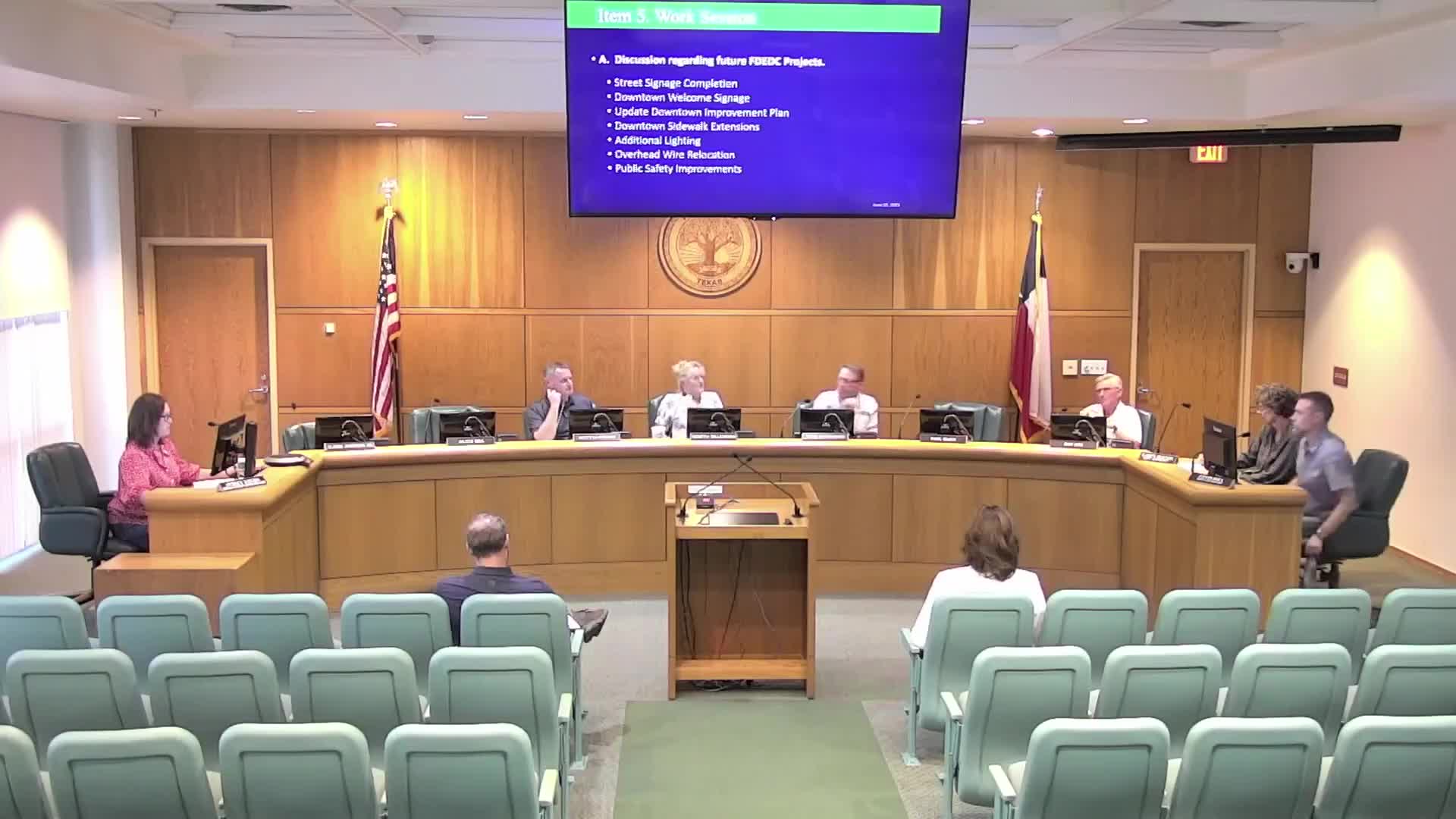
Summary
The Friendswood Downtown Economic Development Corporation directed staff to seek an engineered plan and cost estimates for burying downtown communication lines, to inventory sidewalks and lighting gaps, and to study public-safety camera options as part of ongoing downtown improvement planning.
Members of the Friendswood Downtown Economic Development Corporation discussed multiple downtown-improvement items tied to the downtown improvement plan and directed staff to research costs and next steps for design and implementation.
Steven, city staff, told the board staff has asked engineering to inventory sidewalk gaps and impediments so the city can estimate costs to extend sidewalks off FM 518, and to examine additional street lighting on side streets that were not included in the initial illumination project. He said staff has also begun seeking consultants who could prepare an engineered plan and a turnkey estimate for burying communication lines — a single duct-bank approach intended to let Comcast, AT&T and other providers place lines underground in a coordinated way.
On the question of carriers’ commitments, Steven told the board that AT&T and Comcast would not commit to “never putting anything back” overhead after an undergrounding project; carriers indicated they would replace underground lines “wherever we found it” if a repair were needed but would not promise to forgo overhead placement in perpetuity. Steven said Comcast provided a figure in recent discussions (described in the meeting as roughly $865,000), and that staff wants consultant estimates to produce a firm engineer’s cost estimate before the board considers funding.
The board also discussed public-safety technology. Chief Rogers (police chief) and Steven described two options: “Flock” license-plate-reader cameras and intersection monitoring cameras. Steven said Flock cameras were estimated at about $2,500 per camera per year (turnkey) and that intersection monitoring camera installations were in the range of $8,000 to $12,000 per intersection as a one-time cost. The board discussed potential benefits; one board member cited a recent arrest that staff said was aided by license-plate data across municipalities.
Staff were given direction to pursue: (1) an engineering/consultant proposal and cost estimate for an overall duct-bank strategy to bury communications lines, (2) an inventory and exhibit of sidewalk and lighting impediments, and (3) follow-up pricing and stakeholder outreach on public-safety camera options. No formal board motions or financial approvals were recorded during this discussion; the items were presented as work-session updates and are expected to return to the board with more specific cost information and a recommended path forward.