
Pacific Council approves modest sablefish trip-limit increases and readies rollback of quillback depth restrictions
Get AI-powered insights, summaries, and transcripts
Subscribe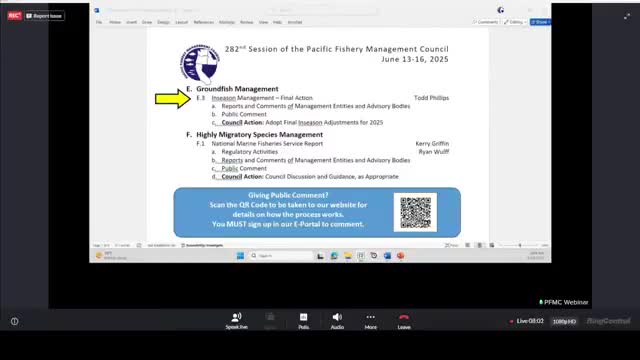
Summary
The Pacific Fishery Management Council approved modest increases to sablefish trip limits for several sectors and directed staff to prepare rollback measures for quillback-related depth restrictions in California if the forthcoming stock assessment review supports that change. Both council votes passed unanimously.
The Pacific Fishery Management Council on day two of its June meeting approved two in-season measures aimed at easing economic pressure on West Coast fixed-gear and open-access sablefish fishers and adopted a package of preparatory steps to scale back quillback-related restrictions in California if scientific review validates a revised assessment.
Under an agenda item on groundfish in-season adjustments (E3), the council approved a staff-and-advisory-team recommended, precautionary increase to sablefish trip limits for limited entry fixed gear (LEFG) and open access (OA) sectors north and south of 36° N latitude. The increases, described by the Groundfish Management Team (GMT) and supported by the Groundfish Advisory Subpanel (GAP), were modeled to expand opportunity while keeping projected impacts to shortspine thornyhead within the non-trawl allocation. The council enacted the recommendation by voice vote; the motion was made by Marcy (Marci) Remco, seconded by Mark Guralnick, and passed unanimously.
GMT staff told the council that some vessels in both the limited-entry and open-access sectors have already hit more than 90% of their status-quo sablefish trip limits in recent bimonthly periods, and that 2025 landings and prices show mixed signals. The GMT used a range of price scenarios based on 2023–24 price patterns and found option 1 — the conservative increase requested by industry in several areas — to be the best balance between increased utilization and a precautionary approach to shortspine thornyhead mortality.
GAP members and industry representatives who testified during the E3 presentation told the council that quota trading and bycatch constraints from recent ACL reductions for canary, shortspine thornyhead and petrale sole have pinched shore-based trawl and non-trawl processors and that higher sablefish trip limits would help some vessels access markets more reliably. The GAP recommended option 1 across the L EFG and OA sectors north and south of 36°.
In a second, separate but related action, the council approved a motion to direct National Marine Fisheries Service (NMFS) and agency staff to prepare in-season management changes to restore deeper fishing opportunities off central and northern California — a package the mover described as a “quillback rollback on the fast track.” That motion lays out a sequence of federal in-season and state regulatory steps that would be triggered if the forthcoming California quillback (Sebastes maliger) benchmark assessment and the review process yield “substantially similar” abundance and annual catch limits to those in the draft assessment. The rollback package the council approved would, if implemented, restore shoreward non-trawl rockfish conservation area (RCA) boundaries and day/season/depth structures that had been constrained by quillback-related conservation measures implemented in late 2023; it also specifies revised trip limits for nearshore, shelf and other complexes in the affected groundfish management areas.
Council staff and NMFS noted that the quillback work is contingent on the stock assessment review (STAR panel) and subsequent scientific-subcommittee findings. NMFS counsel and staff emphasized they could not enact emergency in-season regulatory changes until the STAR review and SSC determinations were complete; the council’s action was therefore intended to stage and prioritize rulemaking and state coordination (California Department of Fish and Wildlife and the California Fish and Game Commission) so that, if the assessment review confirms the draft’s conclusions, the administrative steps would already be in motion and relief could be implemented as quickly as possible. The motion to prepare the suite of rollback actions was made by Marcy (Marci) Remco, seconded by Mark Guralnick, and passed unanimously.
What the council decided and why - Sablefish trip-limit increases: GMT modeling (multiple price scenarios) found modest increases would provide greater landing opportunities for some vessels while producing only small projected increases in shortspine thornyhead mortality; GAP and industry requested those increases for logistical and market reasons. Council approved option 1 increases for LEFG and OA north and south of 36° (motion passed unanimously). - Quillback rollback: Council approved a staging motion directing NMFS, staff and (as appropriate) the state of California to prepare in‑season and state regulatory changes that would restore deeper fishing opportunities and nearshore trip limits if the STAR panel and SSC designate the draft quillback assessment as the best available science (substantially similar to the draft). Motion passed unanimously.
Who said what (selected attributions) - Todd Phillips, Council staff: overviewed the GMT/GAP materials and reminded the council that the GMT and GAP would present recommendations and that the council’s actions would be limited to adopting in-season, precautionary measures for 2025. - Thompson (Groundfish Management Team presenter): presented detailed GMT modeling of sablefish trip-limit options and sea‑son/pricing scenarios and summarized projected impacts to shortspine thornyhead under the modeled options. - Gary Richter (GAP): summarized GAP support for a conservative trip‑limit increase (option 1) and explained the commercial and recreational hardships driven by the 2023–24 harvest specification declines and the resulting effects on quota markets, processors and the shore-based industry. - Industry and public commenters: Multiple commercial and recreational stakeholders testified in person and online about economic hardship tied to ACL declines for canary, shortspine and petrale sole; charter operators and private recreational anglers urged restoration of deeper seasonal access to reduce pressure on nearshore reefs and port economies.
Legal and policy authorities cited - Magnuson‑Stevens Fishery Conservation and Management Act (MSA), including National Standard guidance on “stocks in need of conservation and management” and the council’s in‑season authority (as articulated in the groundfish FMP and council operating procedures). - California Fish and Game Commission / California Department of Fish and Wildlife (CDFW) state rulemaking authority (cited by staff as necessary to conform state waters with any federal in‑season depth changes affecting state jurisdiction).
Decisions and next steps - NMFS will finalize rulemaking steps for sablefish trip limit increases and process state/federal coordination materials for the quillback rollback pathways if the STAR review and SSC determinations support the draft assessment conclusions. - Council staff will explore whether the SSC meeting for quillback could occur sooner than September; NMFS and council staff will report back under “workload planning.”
Why it matters - The sablefish increase provides immediate, modest economic relief to limited-entry and open-access fixed-gear fleets while GMT modeling attempts to limit bycatch consequences. - The quillback motion demonstrates the council’s intent to move quickly — contingent on scientific review — to restore recreational and commercial access that was constrained by precautionary measures implemented after the 2023 assessment. The approach balances potential socio‑economic relief for coastal communities with the requirement that restoration be grounded in peer review and SSC findings.
What to watch for next - The STAR panel review and SSC determination on the California quillback benchmark assessment (dates now scheduled and described in GMT/NMFS briefings) and NMFS determination about administrative pathways for in‑season implementation. - September follow-up on potential SSC timing and any finalized emergency or in‑season rules that would follow an SSC determination supporting the draft assessment.