
Pacific Whiting cooperative seeks an exempted fishing permit to process at sea off California; proposes genetic testing and a 1,500‑salmon cap within existing B
Get AI-powered insights, summaries, and transcripts
Subscribe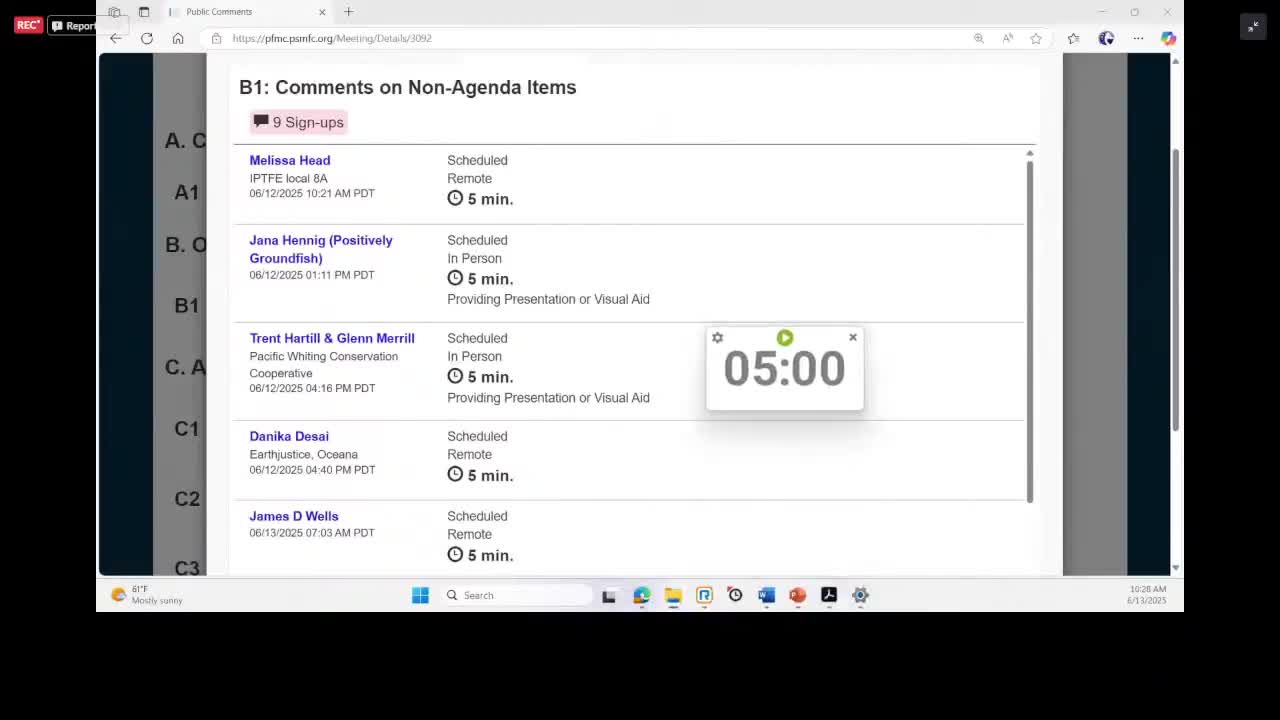
Summary
The Pacific Whiting Conservation Cooperative told the Pacific Fishery Management Council it intends to apply for an exempted fishing permit to allow at‑sea processing of Pacific whiting between the California–Oregon border and 42°10' north latitude, and proposed full genetic sampling of any salmon encountered.
Representatives of the Pacific Whiting Conservation Cooperative told the council they intend to submit an application for an exempted fishing permit that would allow at‑sea processing of Pacific whiting in waters between the California–Oregon border and 42°10' north latitude.
Trent Hartnell, president of the cooperative, said the request responds to an ongoing southward shift of whiting biomass that has in some years left substantial portions of the stock in California waters and limited the ability of the at‑sea sectors to harvest without moving into the new area. Hartnell said the fishery today has much higher coordination, observer coverage and a cooperative management system than when California processing was previously prohibited decades ago, and he argued that the cooperative’s tools could be used to minimize salmon bycatch.
Glenn Merrill, vice president, told the council the cooperative would propose full genetic sampling of all salmon encountered in the EFP area — not just subsamples — so managers could identify stock composition from any encounters. In response to questions from council members and NMFS staff, cooperative representatives said they expect the EFP application to include a sub‑cap for salmon encounters that would remain within the existing biological opinion’s hard cap. If the entire at‑sea sector participated, the cooperative said the proposed initial sub‑cap would be up to 1,500 Chinook salmon; they said the number would scale down if fewer vessels participated.
Council members and NMFS staff pressed the cooperative on coordination with other sectors, how the EFP would interact with state waters and tribal interests, and the practicalities and costs of full genetic testing. The cooperative said it had begun outreach with the mothership sector and that vessel operations are typically outside state waters because of depth, but that they could, and would, clarify any intent not to fish shoreward of state waters in their application. On genetic testing, the cooperative said it would likely pay the incremental cost for the additional analyses beyond routine subsampling.
NMFS representatives said initial agency review suggests an EFP is a plausible mechanism and that the application would be subject to the agency’s review processes, public comment and possible terms and conditions to be appended to any permit. NMFS staff also said that they had not yet had detailed conversations with the Protected Resources Division but that the Biological Opinion recognizes EFPs as an information‑gathering tool and that early coordination with PRD would be necessary because of ESA considerations.
The cooperative said it was pursuing the EFP to test whether the fleet could fish in the proposed area in a way that reduces overall salmon bycatch by creating additional mobility and operational flexibility, and to gather scientific information about stock composition and bycatch in an area closed to at‑sea processing for more than three decades. The cooperative did not submit an application at the meeting; instead, members informed the council of their intent and asked for early transparency and coordination.