
Student Health advisory panel urges sleep campaigns, phone‑free days and tighter in‑school device rules
Get AI-powered insights, summaries, and transcripts
Subscribe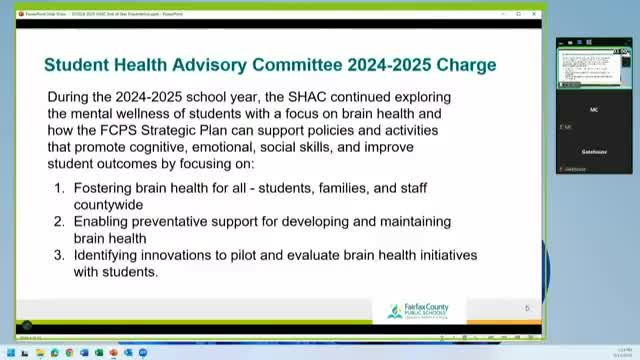
Summary
The Student Health Advisory Committee recommended new sleep awareness measures, an intentional technology‑use framework and a bell‑to‑bell phone‑free school day; the committee also urged replacing some digital citizenship curricula and strengthening social‑emotional learning implementation.
The Student Health Advisory Committee (SHAC) told the school board the county should treat sleep and technology as central components of student brain health and adopt concrete, division‑level measures to protect students’ attention and well‑being.
“Kina McEvoy and I began with a charge this year of fostering brain health for all,” co‑chair Kina McEvoy said. SHAC’s two priorities were sleep and technology; presenters cited national mind‑health research and local youth‑survey data as the basis for recommendations.
Why it matters: SHAC said inadequate sleep is strongly associated with higher reports of hopelessness, stress and suicidal ideation in local survey data and that persuasive digital‑design elements in modern apps amplify attention‑capture and displace developmentally important in‑person experiences. The committee recommended that the division add sleep questions to appropriate student surveys to create a baseline and track change over time.
Technology recommendations included a divisionwide, age‑appropriate technology‑use framework emphasizing targeted, intentional device use in classrooms (for specific instructional tasks) and discouraging school‑issued devices being used as rewards or for unstructured screen time. The committee stated that current research provides little robust, independent evidence that ubiquitous EdTech adds learning value compared with practices grounded in relationships and direct instruction.
SHAC also recommended pilot programs to train peers to reduce tech‑related harms, and urged the board to implement a bell‑to‑bell phone‑free school day; the committee said it had submitted a position letter in March supporting such a day with no exceptions. “Student health and wellness should be a priority,” the SHAC presentation said.
The committee recommended reviewing the division’s reliance on specific digital citizenship curricula, noting that some widely used materials (the presenters said) now receive industry funding and, in their view, emphasize inevitability and normalized use of commercial social platforms. SHAC suggested replacing or supplementing those materials with independent curricula that teach brain‑science informed practices (examples cited included Screen Strong and materials from the American Academy of Sleep Medicine).
Several board members asked about implementation details: adding sleep items to county youth surveys (staff said this revision is doable) and whether more social‑emotional learning and advisory‑period fidelity could be improved (SHAC and staff said advisory practice fidelity is below target and should be a priority). Members asked staff to bring examples of alternative digital‑citizenship curricula and to outline options for a bell‑to‑bell phone‑free pilot.
Next steps: SHAC asked the board to (1) approve adding sleep questions to surveys, (2) pilot an intentional‑use framework and a peer‑led tech education program, (3) review digital‑citizenship curriculum options, and (4) consider a pilot bell‑to‑bell phone‑free day accompanied by communication changes to support families and staff.