Get Full Government Meeting Transcripts, Videos, & Alerts Forever!
Get email alerts on the Cargo Screening Customs topic
No spam. Unsubscribe anytime.
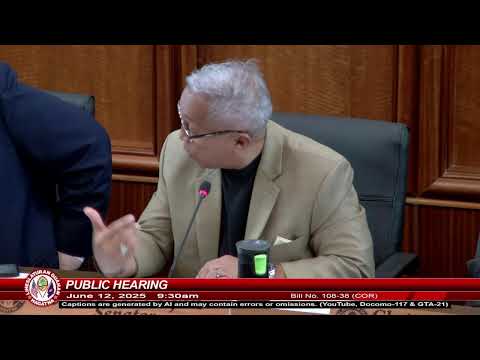
Committee debates Bill 108-38 to authorize public‑private partnerships for cargo screening; Customs urges statutory and language changes
Summary
The Committee on Transportation, Tourism, Customs, Utilities, Federal and Foreign Affairs took public testimony June 25 on Bill 108‑38, which would authorize the Customs and Quarantine Agency to enter public‑private partnerships to screen all cargo entering Guam.
The Committee on Transportation, Tourism, Customs, Utilities, Federal and Foreign Affairs took public testimony June 25 on Bill 108‑38 (COR), a measure that would authorize the Customs and Quarantine Agency (CQA) to enter into public‑private partnerships to screen cargo entering Guam at ports of entry.
Author Senator William A. Parkinson told the committee the bill was intended to allow CQA to scale screening to approach 100% of incoming containers by leveraging private capital, technology (for example high‑rate x‑ray systems and mobile scanners) and private logistics expertise. Parkinson cited law‑enforcement and medical data he said showed a sharp rise in methamphetamine‑related deaths and arrests in recent years and argued unchecked cargo is a major route for illicit drugs and invasive species. He listed examples of PPPs at mainland ports and said PPPs could reduce upfront public cost and accelerate deployment of scanning facilities and equipment.
CQA Director Sykes Perreido testified the agency supports modernizing screening and acquiring equipment, but raised substantive concerns with the draft bill’s current language and placement. Director Perreido stated that customs’ border search authority is a narrow, legally codified exception to probable‑cause/warrant requirements and that allowing private non‑sworn personnel to perform customs searches or physical inspections would conflict with those legal protections. He recommended the bill’s amendments be placed in CQA’s statutory chapter (Title 5, suggested by the director) rather than in the Port Authority of Guam statutes (Article 4, Chapter 10, Title 12), and suggested funding authority language would be more appropriate in the Tax Code (11 GCA Chapter 28) if the measure contemplates use‑tax or fee funding.
Perreido and other witnesses recommended the bill define “screening” and delineate exactly which functions may be performed by private partners (for example, equipment procurement, facility construction, maintenance, or operating scanning equipment under CQA supervision) versus which authorities must remain with sworn customs officers (document review, sworn border searches, law enforcement questioning, seizures). The director said CQA could use PPPs for infrastructure and equipment maintenance but advised against authorizing private persons to exercise customs search powers.
CQA and other witnesses described related modernization work already under way: implementation of a harmonized coding system and an automated customs platform intended to enable electronic manifests, risk assessment and improved targeting of suspicious shipments. Agency witnesses said rules and regulations for that work are being drafted and that staff training and stakeholder engagement will be required before automated systems are turned on. CQA described efforts to procure stationary x‑ray portals and mobile scanning systems and said $2,000,000 (approx.) in A&E and early project costs had been estimated for a container inspection facility; the agency said it had identified a portion of port property for such a facility and that a larger federal funding award (described in committee testimony related to transit as about $34,000,000 for a separate agency) was confirmed for other projects.
Committee members raised multiple issues during questioning: whether the Ports or CQA statute is the correct location for the authority; how the draft defines “screening”; the legal limits on delegating customs search authority to private parties; the effects on trade and port throughput of expanded physical inspection; and the need to consult port users, importers and logistics companies. Witnesses agreed that careful drafting and operational design are required to avoid criminal‑law and privacy problems, to preserve customs’ sworn‑officer authorities, and to ensure trade is not unduly delayed.
Committee actions and next steps recorded in the hearing: the chair said the committee will continue to accept written testimony for seven days following the hearing and will work with the bill author and legal staff to determine whether the existing draft can be amended in markup or whether the measure needs to be recrafted and presented in a subsequent public hearing. No vote was taken during the hearing.
Why it matters: advocates and law enforcement told the committee that improved cargo screening can reduce the flow of illicit drugs and invasive species and improve tax collection; agency witnesses said modern scanning equipment and automated manifest systems are necessary tools but stressed legal boundaries and operational logistics must be preserved.
The committee closed the hearing and invited additional written testimony; it did not make a final determination on the bill’s statutory placement or on the exact scope of authorities to be granted to private partners.