Get Full Government Meeting Transcripts, Videos, & Alerts Forever!
Get email alerts on the Guam Regional Transit Authority topic
No spam. Unsubscribe anytime.
Senate committee hears nomination of Jeffrey D. Kasaka to Guam Regional Transit Authority board
Summary
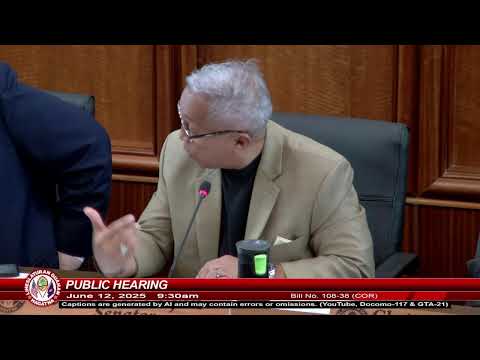
Jeffrey D. Kasaka appeared by video and answered senators' questions June 25 during a confirmation hearing before the Committee on Transportation, Tourism, Customs, Utilities, Federal and Foreign Affairs at the Calvo Arriola Building in Hagatna.
Jeffrey D. Kasaka appeared by video and answered senators' questions June 25 during a confirmation hearing before the Committee on Transportation, Tourism, Customs, Utilities, Federal and Foreign Affairs at the Calvo Arriola Building in Hagatna.
Kasaka told the committee he is a U.S. veteran and former federal employee who has worked on logistics, mobile delivery services and veterans’ transition programs. He said his priorities as a GRTA board member would be improving accessibility and equity across transit services, strengthening partnerships with village mayors and nonprofit and private partners, supporting economic opportunity through transit connectivity, promoting environmentally sustainable equipment and ensuring fiscal responsibility and transparency.
The nominee described particular concern for southern villages and for veterans, seniors and residents with disabilities. He told the committee he would press the board and management to pursue routes and services that reach underserved communities and to coordinate with village mayors and veterans’ service providers.
The committee heard supporting testimony from GRTA interim managers and community members. Pierre Tim Ogan, who identified himself as interim CEO/executive manager for Guam Regional Transit Authority, described a master plan through 2050 and said GRTA is procuring buses and expanding operations. Ogan said 23 buses and vans were in procurement at the time of the hearing, with a goal of reaching 60 vehicles and establishing four transfer terminals (one north, one central, two south) to create express-service hubs and improve on-time performance. Ogan also told senators the agency had federal awards he described as about $34,000,000 and that those funds had been confirmed and would not be retracted, while noting GRTA still needs general fund support to hire employees and operate new services.
GRTA staff described the agency’s current workforce as roughly 52 employees, of which about 15–17 were classified positions; leadership said increased staffing would be required to expand services and that autonomy for the agency would speed hiring and operations.
Committee members asked Kasaka and GRTA staff several operational questions. Senators pressed Kasaka on how the board would measure whether transit reaches underserved populations; he answered that the board should work with management and community partners to develop performance measures and to prioritize service to southern villages, veterans and people with disabilities. Senators also asked about accountability, website updates and whether the nominee would support performance‑based decision making; Kasaka pledged transparency and cooperation with GRTA management.
Several senators on the panel gave verbal endorsements. Senator William A. Parkinson said he knows Kasaka and would support the nomination. Other senators who spoke in favor emphasized Kasaka’s military background, fleet and maintenance experience, and community work; one senator cited the importance of not abandoning the agency but fully boarding GRTA so it can operate effectively.
Committee directions and next steps: the chair said the committee will prepare its committee report and work to transmit the nomination packet to the full legislature; the chair indicated the intent to get the nomination on the July session calendar. Committee staff also were asked to coordinate with the nominee and GRTA management to transmit any outstanding material for floor consideration.
Why it matters: GRTA provides scheduled and paratransit services relied upon by residents who lack private vehicles, veterans, seniors and people with mobility needs; testimony at the hearing stressed that improved reliability, expanded routes and better transparency would affect daily commutes, access to health care and economic activity for island residents.
The confirmation hearing concluded with the committee thanking witnesses and noting it would follow up on outstanding paperwork and scheduling. No confirmation vote took place during the hearing.