
Students, parents and staff say Northampton High schedule gaps stem from teacher cuts; committee authorizes temporary staffing
Get AI-powered insights, summaries, and transcripts
Subscribe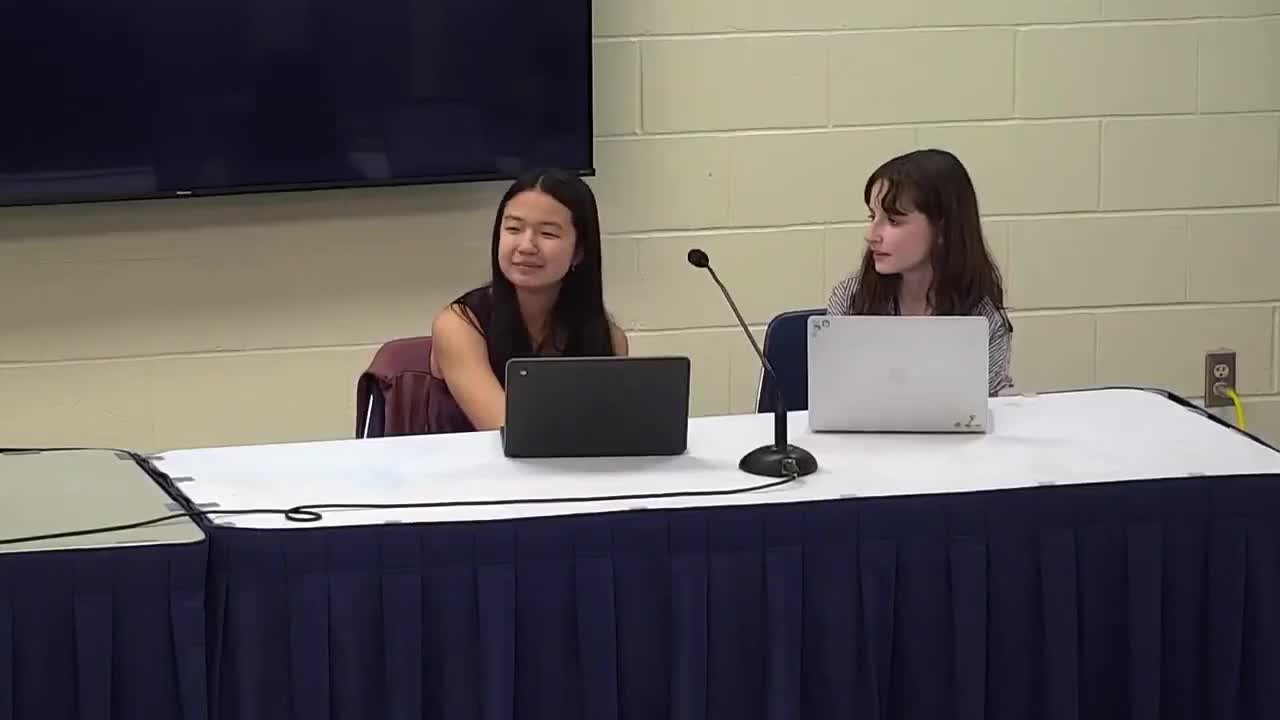
Summary
Students, parents and school staff told the Northampton School Committee on June 12 that budget-driven teacher shortages have left more than 75 rising NHS seniors with “holes” in their schedules. The committee authorized the superintendent to move quickly to restore positions and agreed to seek additional one-time funding for related needs.
Students, parents and staff told the Northampton School Committee on June 12 that recent staffing cuts have left rising Northampton High School seniors and other students unable to take desired classes, damaging college competitiveness and school community cohesion.
At the meeting, the two student representatives reported a “scheduling crisis” at Northampton High School (NHS): many seniors face an empty slot in period 3 because the school cannot run enough class sections. Student speakers described being offered asynchronous college classes or reduced course loads, being placed in classes not on their alternate lists, or being told to take multiple courses off-site at Smith College for the semester.
Artis Mann, introduced himself as “the newly elected president of the student union,” and said he was removed from Honors Spanish 5 because the school could not run two sections. “Most colleges I’m looking at require four years of a foreign language,” Mann said. “Being unable to take it would harm my admissions process.”
Students and parents said the problem disproportionately affects juniors and seniors and also harms students on Individualized Education Programs (IEPs). Andrea Bertini, a parent, said the district’s approach risks violating the least-restrictive-environment standard (LRE) for special education by forcing students into partial inclusion or off-campus instruction. “This is educational neglect,” Bertini told the committee.
Several students and speakers urged immediate hires. Anna Lucia Ohm, a student, said counselors and teachers had tried to rework schedules without success: “We tried AP calculus, AP statistics, AP world, AP lang, AP chemistry… none of them fit into my schedule.” Scarlett Bowman, another student, said the lack of NHS sections had eroded school morale and warned that families with means would leave the district.
Paraeducators and staff echoed the students’ concerns. Paula Ragano, a paraeducator at NHS, said: “It is our responsibility to educate these children. It is not Smith College’s job.” Other speakers noted that offering multiple Smith College classes to students effectively removes them from the school community for much of the day and creates equity problems for families without transportation or flexible schedules.
Committee members acknowledged the urgency. The superintendent and business administrator discussed available budget lines and possible one-time funding sources during the meeting. The committee voted to authorize the superintendent to act quickly to address immediate staffing needs at NHS, including posting to fill two prioritized positions and restoring funding for the district garden program; the superintendent said she would return to the committee with use of any remaining funds at the next special meeting.
Why it matters: Students described concrete harms to college planning and classroom continuity. Committee members and speakers framed the scheduling gaps as the downstream effect of prior budget cuts and staffing shortfalls, and they urged rapid action to prevent further disruption to rising seniors’ academic plans.
What the committee directed: The School Committee authorized the superintendent to proceed with steps to restore prioritized high-school positions and to allocate funds for the garden program, and it requested that the superintendent or administration return to the committee at the June 25 special meeting with details on remaining funds and proposed next steps. The committee also asked staff to continue analyzing one-time funding options and to coordinate with Budget & Property subcommittee work.
Ongoing questions: Speakers asked how the district will prevent similar scheduling gaps in future years, how families without transportation will be accommodated if students take off-campus college courses, and how the district will track the number of students affected. Parents and students requested clearer public timelines for any hires and for scheduling changes so families can plan for the fall.
Ending: Committee members said they expected updates before the start of school and reiterated that solutions would likely include both short-term hires and longer-term budget decisions. Several students thanked the committee for hearing them and urged follow-through so rising seniors do not lose educational opportunities.