
ISO advances targeted change to congestion‑revenue allocation to protect transmission customers
Get AI-powered insights, summaries, and transcripts
Subscribe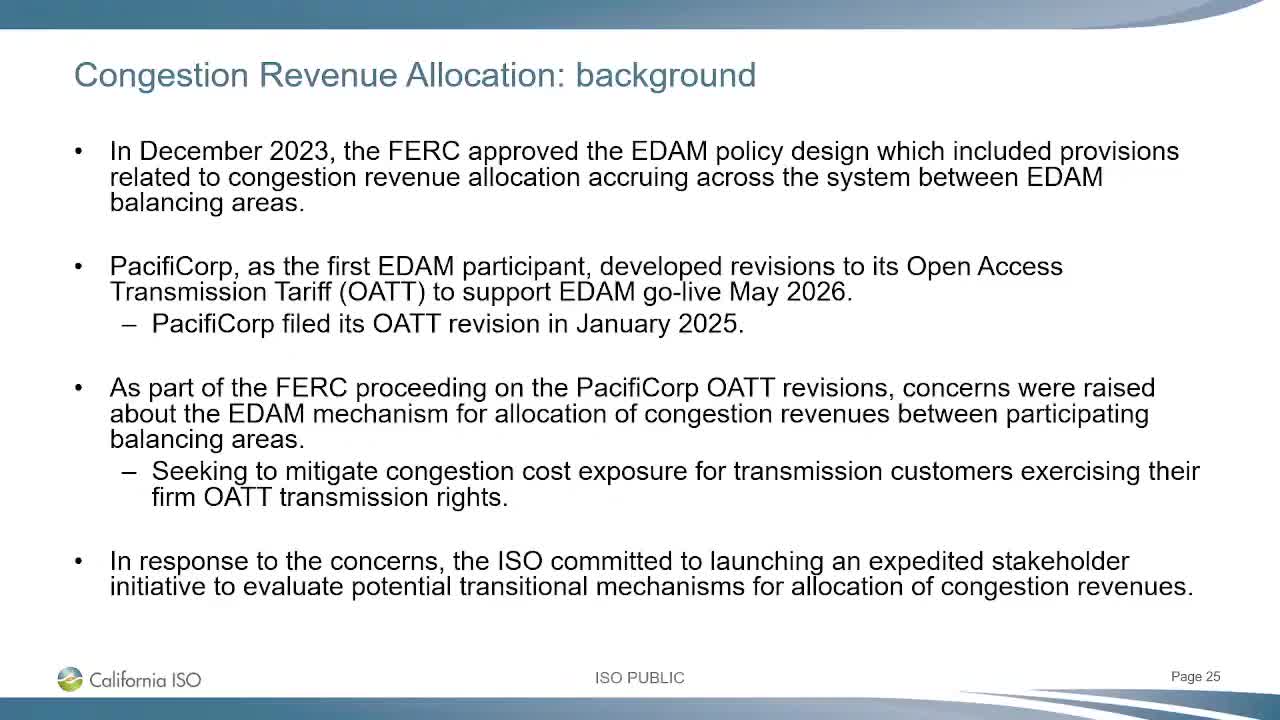
Summary
The California ISO proposed a targeted allocation change to ensure that congestion revenues tied to parallel flows are allocated to the balancing area where transmission customers exercise firm rights, a move officials said would preserve congestion‑cost protection for customers who use point‑to‑point transmission rights under EDAM.
Milos Kosanec, regional market sector manager at the California ISO, told Utah regulators the ISO has developed a targeted change to congestion‑revenue allocation intended to address stakeholder concerns about parallel‑flow congestion in the EDAM design.
The ISO explained that locational marginal prices (LMPs) have three components: energy, congestion and losses. The difference between the LMP paid to a generator and the LMP charged to load — the congestion component — produces congestion revenues that the market collects and must allocate back to participants through settlement.
Under the EDAM design that FERC approved earlier, congestion revenue associated with a particular transmission constraint was allocated to the balancing area where that constraint is located. Protesters in the Pacificorp tariff filing argued that, when a constraint in a neighboring balancing area drives parallel flows and creates congestion exposure for transmission customers exercising firm point‑to‑point rights, the EDAM entity (for example, Pacificorp) might not receive sufficient congestion revenues to provide the congestion‑cost protection the tariffed rights are intended to provide.
"We can determine how much of that was due to parallel flow versus an internal constraint," Milos Kosanec said, describing the ISO’s ability to disaggregate settlement impacts and the rationale for the proposal.
The targeted change proposed by ISO staff would leave the basic allocation rule in place (congestion revenues generally go to the balancing area where the constraint is located) but would reassign parallel‑flow congestion revenues — that is, congestion revenue tied to impacts of a constraint in another balancing area that affects prices in the EDAM entity’s footprint — back to the EDAM balancing area where the transmission customer exercised its rights. The ISO said the change is intended to ensure that transmission customers who exercise firm rights are not left undercompensated when cross‑area loop flows cause price separation.
ISO staff said they published a final proposal following workshops and written comments, plan to seek approval from the ISO’s governing bodies on June 19 (the Western Energy Markets governing body and the ISO board), and — if approved — would file the change at FERC by the end of June to support EDAM implementation timelines. The ISO said settlement systems are capable of tracking and apportioning congestion revenue disaggregation for settlement purposes, although that accounting is performed in settlement rather than shown in near‑real time.
Utah commissioners and staff asked technical questions about how congestion revenues are measured, how transfer revenue between balancing areas is shared (the ISO said transfer revenue from an inter‑BA scheduling limit is split 50/50), and whether the proposal reduces overall congestion revenue available to other balancing areas. ISO staff said the proposal reallocates only the portion tied to parallel‑flow impacts and will be monitored after implementation; staff also committed to reengage stakeholders and to evaluate additional enhancements as the footprint grows.
The ISO presenters on this topic were Milos Kosanec and Anna McKenna. Utah participants included staff from the Division of Public Utilities and members of the Utah Public Service Commission.