
ISO explains greenhouse‑gas bid framework: GHG compliance costs borne by state load
Get AI-powered insights, summaries, and transcripts
Subscribe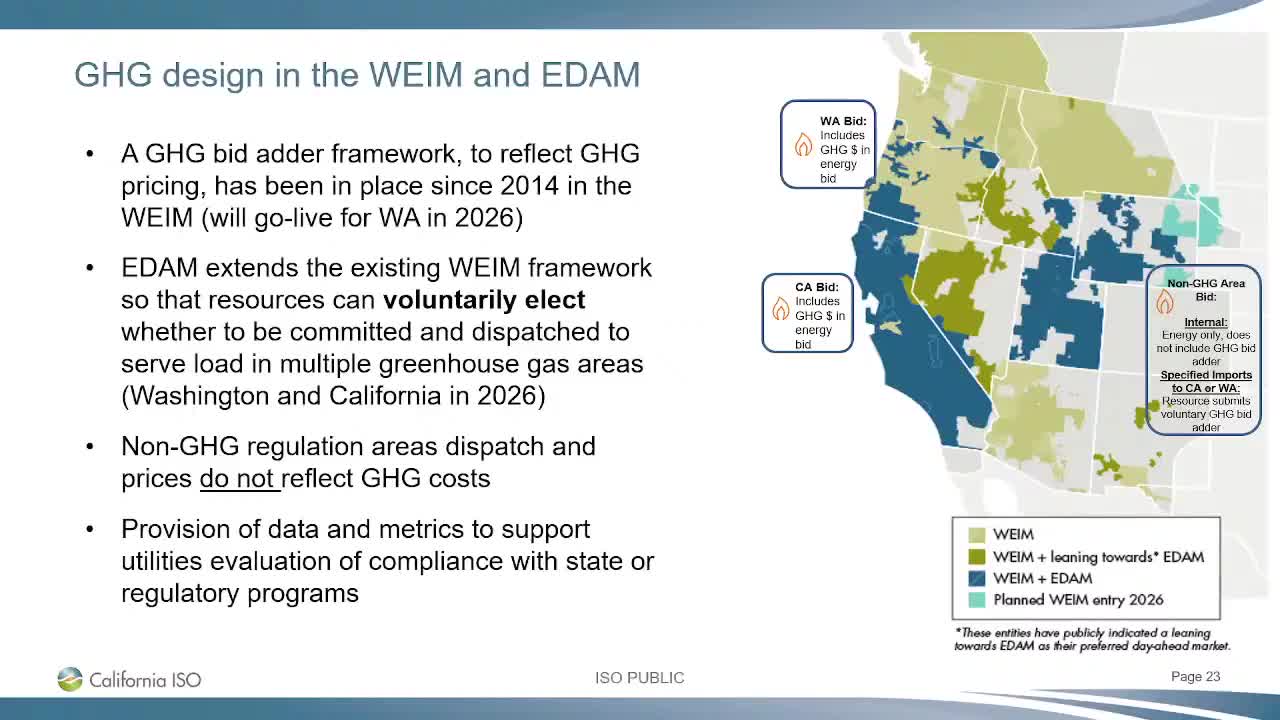
Summary
The California ISO told Utah regulators that its greenhouse‑gas bid framework lets resources reflect state GHG compliance costs and that marginal GHG costs, when dispatched, are paid by load in the GHG jurisdiction — not by the broader market.
Anya Gilbert, lead policy developer for the California ISO, told the Utah Public Service Commission that the ISO’s greenhouse‑gas bid framework lets generators voluntarily include state GHG compliance costs when they offer into California or Washington and that any marginal GHG cost paid to resources is borne by load in the affected GHG area.
“At its core, our GHG design allows states to reflect their preferences and policies without impacting other states,” Gilbert said, summarizing the ISO approach and noting the design has been in use in the Western imbalance market since 2014 to reflect California’s cap‑and‑trade program.
Gilbert explained that resources located inside a GHG jurisdiction embed compliance costs in their energy bids, while resources outside that jurisdiction may elect hourly to offer into GHG areas and, if dispatched to serve those areas, receive an explicit marginal GHG payment. The ISO said it also provides data to support state compliance programs and regulators’ monitoring needs.
Utah staff raised concerns that GHG pricing and related reporting requirements could create leakage or disadvantages for non‑GHG balancing areas. Gilbert and other ISO staff said the market design limits price impacts to the GHG area’s bid stack and noted that states have post‑hoc methods to calculate leakage; California’s system operator and regulators have previously described settlement processes intended to quantify and address leakage in certain circumstances.
Commission staff and ISO presenters also discussed recent state‑level legislative and regulatory inquiries. Anya Gilbert and Stacy Crowley said the ISO had communicated with state regulators — including the California Air Resources Board — about whether wholesale market participation would trigger statutorily required emissions reporting, and ISO staff said they would follow up with regulators to clarify obligations under state laws and pending rules.
The GHG framework, the ISO said, is voluntary for resources; it is designed to let states impose their own compliance cost signals while maintaining price formation that keeps impacts geographically contained to the state or jurisdiction that adopted the policy.