
California ISO officials brief Utah regulators on WEIM benefits and EDAM go‑live plan
Get AI-powered insights, summaries, and transcripts
Subscribe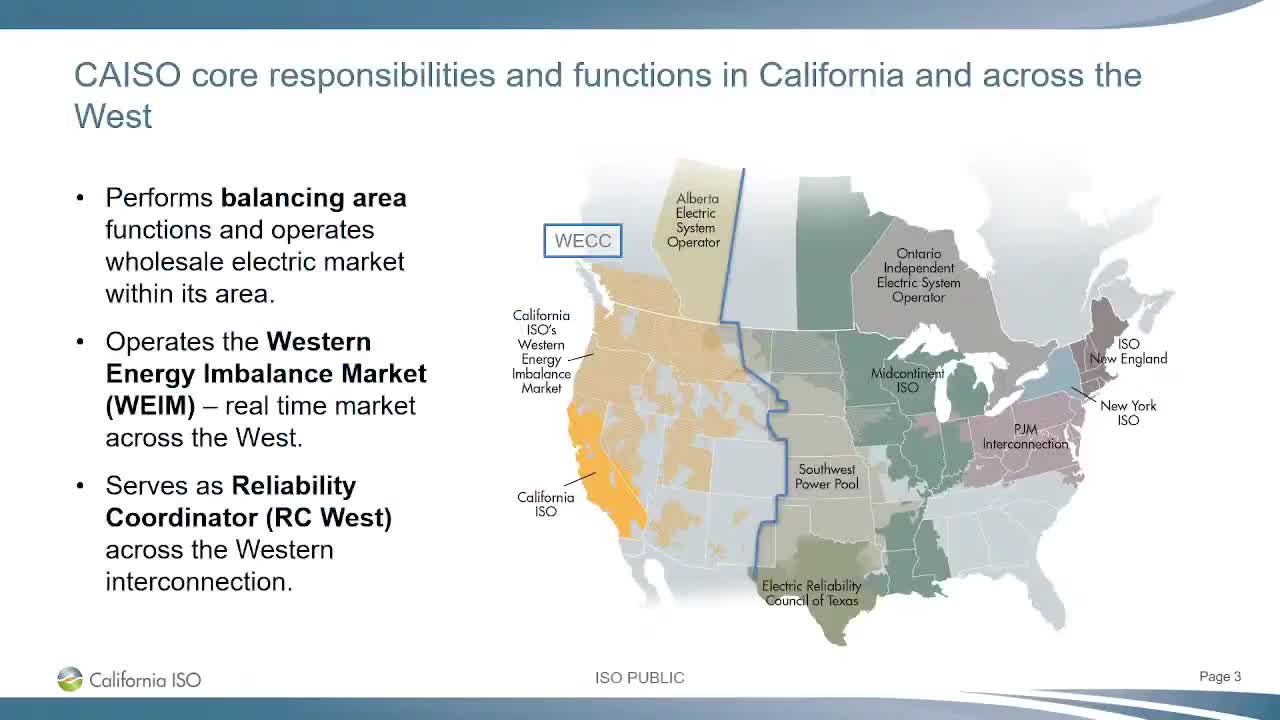
Summary
California ISO officials told the Utah Public Service Commission that the Western Energy Imbalance Market has produced multibillion‑dollar benefits and that the ISO is on track to bring an Extended Day‑Ahead Market into operation in May 2026.
California ISO officials told the Utah Public Service Commission on the record that the Western Energy Imbalance Market (WEIM) has produced multibillion‑dollar economic benefits and that the ISO is on track to launch its Extended Day‑Ahead Market (EDAM) with Pacific‑core participants in May 2026.
“We facilitate market trades, but we do not act as a market participant,” said Anna McKenna, vice president of market design analysis for the California ISO, describing the ISO’s role as neutral operator of the grid and markets.
The briefing covered three operational items that the ISO said drive WEIM benefits: a large, geographically diverse pool of resources that reduces production costs; real‑time optimization every 15 and 5 minutes that helps manage changing weather and renewables; and procedures that test participant readiness so the market produces feasible dispatches. Anna McKenna said WEIM has produced more than $7 billion in estimated economic benefits since 2014 and cited improved reliability and lower emissions as additional outcomes.
Anya Gilbert, lead policy developer at the ISO, and Milos Kosanec, regional market sector manager, described EDAM as a voluntary day‑ahead market that would extend least‑cost, portfolio‑level optimization across a larger Western footprint. The ISO’s planned EDAM functions include an integrated forward market (financial clearing), a residual unit commitment that ensures reliability if the market alone does not produce feasible schedules, and separate pricing for uncertainty. The ISO confirmed Pacific‑core entities are the initial set for EDAM go‑live in May 2026 and listed other expected implementation dates for later participants.
The ISO explained procedures intended to limit operational risk if an entity cannot show sufficient forward resources. The day‑ahead “resource efficiency evaluation” tests whether each participant can meet its forecasted load and uncertainty; ISO staff said the test is run before day‑ahead clearing and uses a high percentile forecast to capture uncertainty. If an entity fails, staff said there is a tiered set of consequences, opportunities to “cure” the deficiency, and a fallback to real‑time WEIM testing if the problem persists.
The ISO also described the assistance energy transfer product that lets entities opt in to pay a defined surcharge when they exceed prior transfer levels during tight conditions. Holly Taylor of the ISO said the surcharge is calculated after market clearing and is tied to a cap price (roughly in the thousands of dollars per unit in the emergency pricing example the ISO described); entities opt in by day for standard use and the product has been used by roughly 10–11 balancing areas at times.
Utah Division of Public Utilities staff asked about detailed benefit calculations and the ISO said it publishes a methodology and quarterly reports and performs counterfactual analysis comparing market outcomes to a no‑market base schedule case. The ISO agreed to provide links and quarterly detail to commission staff.
The ISO asked stakeholders to weigh operational and design choices as EDAM is implemented and said it will continue stakeholder engagement and monitor effects after go‑live. Officials invited regulators and staff to follow‑up technical workshops and training sessions planned before implementation.
The ISO’s presenters at the briefing were Anna McKenna (California ISO, vice president, market design analysis), Anya Gilbert (California ISO, lead policy developer), Milos Kosanec (California ISO, regional market sector manager), Holly Taylor (California ISO), and Stacy Crowley (California ISO, vice president of external affairs). Utah participants included staff from the Utah Division of Public Utilities and commissioners of the Utah Public Service Commission.