
Wichita County hears risk-pool review showing high vehicle damage costs, strong workers'‑comp performance
Get AI-powered insights, summaries, and transcripts
Subscribe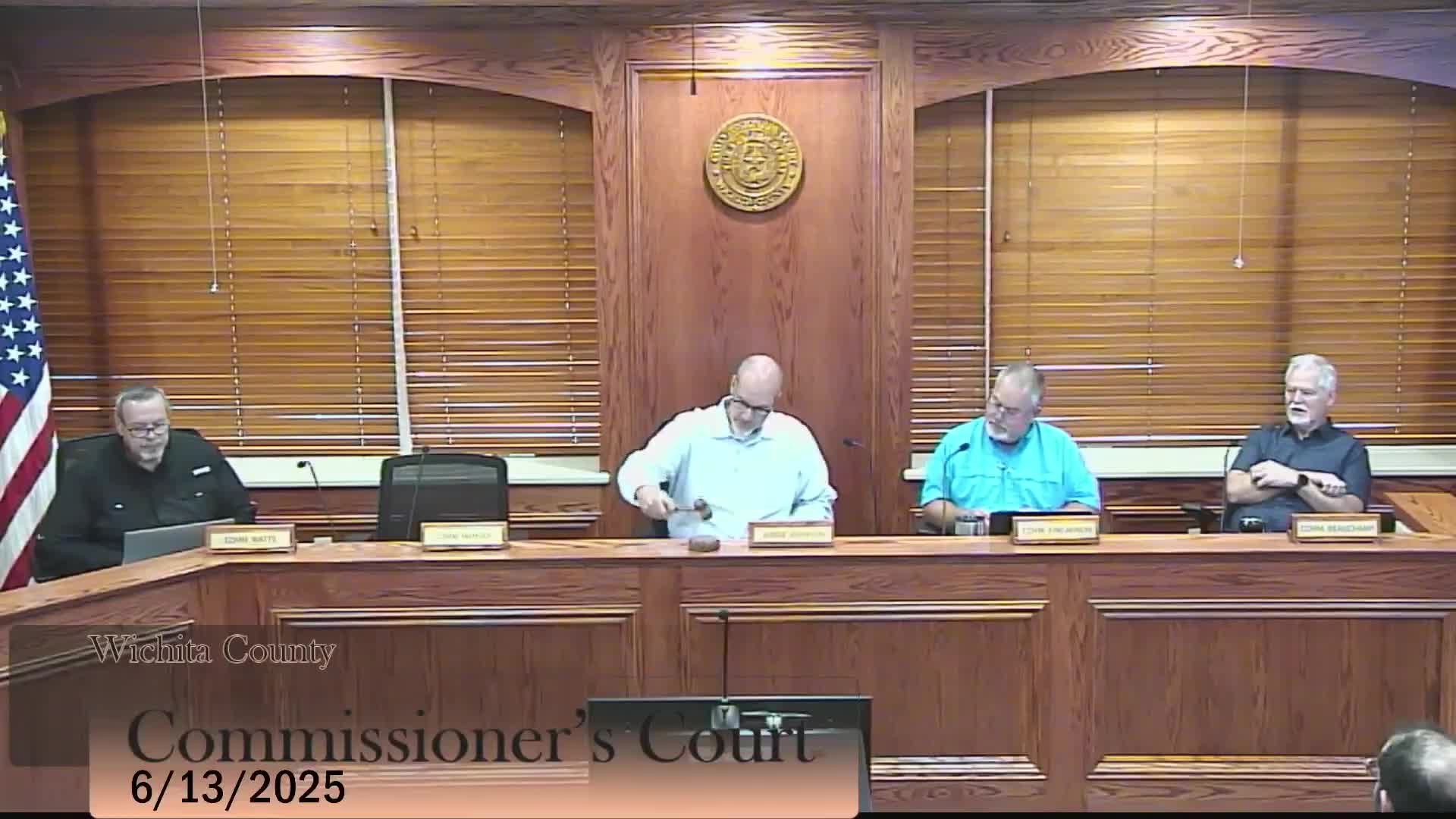
Summary
At its June 13 meeting, Wichita County Commissioners received a presentation from risk‑management contractor Steve Owens detailing five‑year auto claim payouts, department-level breakdowns, and workers' compensation results; county staff were asked to follow up with detailed reports on public‑works classifications and jail claims.
Wichita County Commissioners' Court on June 13 received a data review from Steve Owens of Attack Risk Management Services showing that auto physical‑damage claims have driven the county's loss exposure while workers' compensation results have stayed relatively low.
Owens told the court the pool has paid $528,508 in auto claims since October 2022, with the county's deductible share reported at $115,007.53, and that auto physical damage accounted for most of that total: the pool paid $351,005.62 for physical damage and $176,009.46 for auto liability. "This is where the money's going from the county," Owens said, describing the purpose of the report as a way "to show you the true cost of where the money is going every year, out of your claims."
The presentation broke costs down by department and year and showed deductibles declining after a peak in 2023. Owens pointed to a trend in deductible activity — "it went from 40 to 25 to 15" — and said that drop indicates fewer incidents: "That means you've had less incidents. So that's a good thing." He told commissioners the county's $5,000 deductible per incident must be accounted for in budgeting even when a claim is not filed for lower‑cost damage.
Owens also compared Wichita County to the pool and region on loss ratios. On auto physical damage he reported a four‑year loss ratio of about 2.82 for Wichita County versus roughly 1.17 for the pool and 1.36 for the region. The presenter warned that pool‑wide high loss ratios are a concern but explained the difference between private insurers and a membership risk pool: "We're not a for‑profit company, so we have that leeway… the pool is the pool. It's not the pool for auto, the pool for property, the pool for workers' comp."
On workers' compensation Owens said the pool paid $408,004.35 for 2021–25 claims (the presenter said he ran four years of data) and that Wichita County's workers'‑comp loss ratio was about 32.19, which he described as "really good" for a large county with a jail and many exposures. He noted that workers' comp is regulated by the Texas Department of Insurance (TDI) and that "there is no deductible on workers' comp by law," a point he raised when contrasting auto and workers'‑comp costs.
Commissioners asked for follow‑up details. Commissioner Watson asked about the county's annual premium contribution; Owens said the county's 2025 contribution (the pool premium terminology used in his slides) was about $45,002.67 for liability and $43,054.2 for physical damage and reiterated that the true cost to the county is the contribution plus deductible payments already incurred. Owens offered to provide more tailored comparisons to similarly sized counties (he said that analysis is manual and would be provided with lead time) and to send updated reports on demand. He also said he would work with Kenneth and with county staff to clarify why some losses were classified under "public works" and to pull a jail‑specific cause‑of‑loss report before the end of the meeting when asked: "I can actually do that before we leave today."
The court did not take formal action during the presentation. Commissioners and staff praised the county's safety and training programs, and Owens recommended continuing current programs that appear to be reducing incidents. He said the firm can deliver detailed loss runs and custom breakdowns by cause, department, and time period for county budgeting and training purposes.
Next steps identified during the meeting included Owens providing department‑level clarification on public‑works classifications in coordination with Kenneth, supplying a jail cause‑of‑loss breakdown on request, and producing a manual peer‑county comparison if the court requests it. No motions or votes were recorded on this item.