
MDOT officials outline Section 107 design-and-engineering structure, staffing and consulting mix
Get AI-powered insights, summaries, and transcripts
Subscribe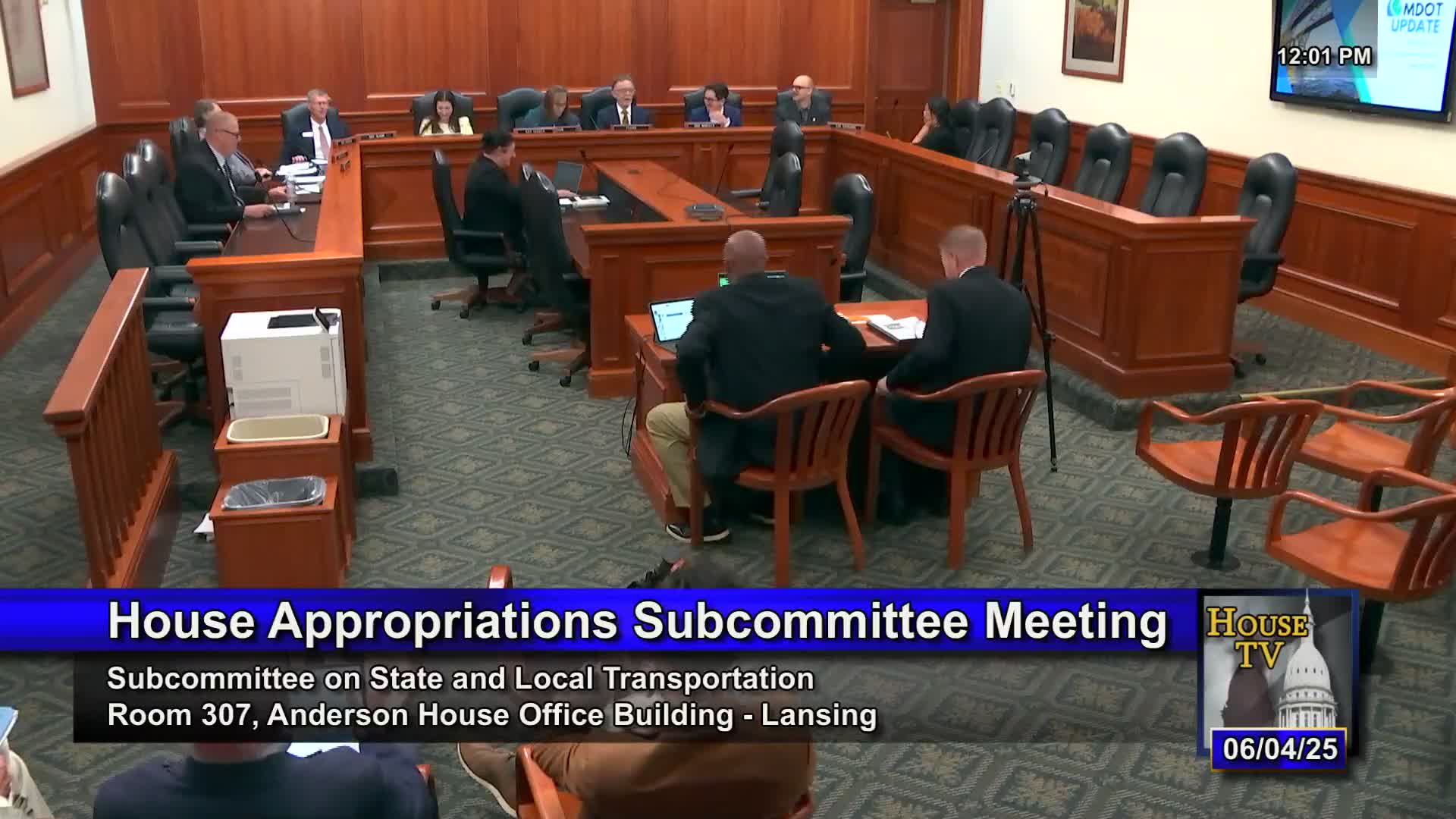
Summary
Michigan Department of Transportation officials told the House Appropriations Subcommittee on State and Local Transportation on May 21 that Section 107 of the state transportation budget covers the department’s design and engineering services and that most construction-related federal funds flow through capital outlay road and bridge appropriations.
Michigan Department of Transportation officials told the House Appropriations Subcommittee on State and Local Transportation on May 21 that Section 107 of the state transportation budget covers the department’s design and engineering services and that most construction-related federal funds flow through capital outlay road and bridge appropriations.
The briefing, led by Demetrius “Dee” Parker, bureau director of MDOT’s Bureau of Development, and Patrick McCarthy of MDOT’s Bureau of Finance and Administration, explained MDOT’s central-office and regional roles, staffing counts, consultant use and several current initiatives including digital 3-D modeling pilots and ongoing public-private partnership payments for I‑75.
MDOT’s Section 107 appropriation, Parker said, supports three broad “buckets” of work: program development and delivery (PDD), which includes region and Transportation Service Center (TSC) staff; system operations management (SAWM), which covers central-bureau functions such as permits and research; and business services, which include small-business support and legal services. “PDD” staff, Parker said, are the region- and TSC-based employees who manage projects and oversee construction in the field.
The nut graf: The committee sought specifics because Section 107 funds pay for personnel and services that support design, inspection and project delivery across Michigan. Lawmakers pressed MDOT for clearer dollar-level mappings of federal and state funds to TSCs, regions and central bureaus, and requested follow-up reports from MDOT on how appropriation lines map to actual expenditures.
Most important facts and supporting details
• Organization and scope: Parker described an MDOT structure led by Director Bradley Wefrick with a chief administrative officer and a chief operations officer; beneath operations are three bureaus, including Parker’s Bureau of Development, and seven regions that oversee 22 Transportation Service Centers. Parker said MDOT directly manages about 9,600 of Michigan’s roughly 122,000 road miles and about 4,800 of the state’s roughly 11,000–12,000 bridges; local road agencies and municipalities oversee the remainder.
• Staff and FTEs: Parker said the design-and-engineering section covers roughly 1,600 full-time positions across MDOT operations and cited example regional staffing (e.g., construction engineers, assistant engineers, construction technicians and development staff at TSCs). In committee questioning, a representative cited 138.5 PDD FTEs for a region as an example; Parker explained how TSC and region roles are distributed and acknowledged that head-count and budget documents can be complex.
• Consultants vs. in-house work: Parker and McCarthy said MDOT delivers a significant portion of design and construction engineering through consultants. Parker summarized the split as roughly 60 percent of design dollars contracted to consultants and 40 percent performed in-house, and about 55 percent of construction engineering dollars contracted out with the remainder handled by MDOT staff; MDOT decides to consult based on resource capacity and project complexity.
• Funding flow and accounting: Patrick McCarthy said the “majority of the federal funding” is expended through the capital outlay road-and-bridge appropriation, which covers construction and design costs. McCarthy said federal dollars in PDD/SAWM appropriations are typically for federal programs that participate in specific activities such as planning and research (for example, Surface Transportation Planning and Research programs). He told the committee MDOT can produce reports from the state accounting system (SIGMA) to show how charges map to appropriation line items.
• Digital design and pilots: Parker described an MDOT “digital vision” subteam and a recent 3-D project MDOT completed (a bridge job on I‑696) as a pilot toward digitized plans and cloud-based asset records; he said MDOT plans a larger 3-D modeling effort in the Bay Region in 2026–27.
• Local coordination and utilities: MDOT staff said TSCs exist to be close to local customers (city managers, county road commissions and utility companies) and that the department coordinates detours, paving and utility relocation with local agencies; Parker gave examples where MDOT agreed to pave local roads used as detour routes. On water mains and sewers, MDOT said local ownership determines whether replacements are included and that the department coordinates timing to avoid repaving immediately after utility work.
• Procurement and P3s: A committee member asked about I‑75, a public–private partnership. McCarthy said the private partner financed construction up front and MDOT makes scheduled availability payments over the contract term (about 25 years) that include repayment and the partner’s operations and maintenance obligations.
Committee requests and direction
Committee members requested that MDOT: • Provide a clearer, dollar-level mapping showing how federal and state funds are allocated across PDD, SAWM and business services and how those dollars are charged in SIGMA; McCarthy and Parker agreed to produce more detailed reports. • Share the five-year construction plan (the department’s published five-year schedule of projects) and links to public materials; staff said the plan is a public document and that the committee would be provided the link. • Return information on several specific items raised by members: cement specification decisions (1L vs. 1-2 cement types), pavement striping performance, cost ranges for replacing water mains during reconstruction projects, and outstanding payment obligations and structure for the I‑75 P3.
Distinguishing discussion, direction and action
Discussion: MDOT gave a descriptive briefing of organization, staffing, consultant usage and pilots; lawmakers asked technical and policy questions (cited examples include cement type preferences, TSC consolidation, striping reflectivity and coordination on detours). Direction/assignment: MDOT agreed to follow up with reports from SIGMA on appropriation-to-expenditure mapping, provide the five-year construction plan link, and return answers on cement procurement, striping contracts, and cost estimates for utility replacements. Formal action: Representative Borton moved to adopt the minutes of the May 21 meeting; the committee adopted the minutes by unanimous consent. No appropriation votes or amendments were taken at this hearing.
Context and next steps
MDOT emphasized the department’s hybrid delivery approach—regional TSCs for field implementation and central bureaus for policy and oversight—and the department said it will supply detailed accounting reports and project lists the committee requested. Committee members signaled interest in more detailed briefings or follow-up hearings to “get into the weeds” on how personnel costs and consultant contracts are funded and allocated across appropriation lines.
Ending
MDOT officials closed by saying they would provide the requested reports and that staff remain available for follow-up; the subcommittee adjourned after adopting meeting minutes by unanimous consent.