
Optimize project urges continued School Aid Act funding as it reports progress on special-education workforce
Get AI-powered insights, summaries, and transcripts
Subscribe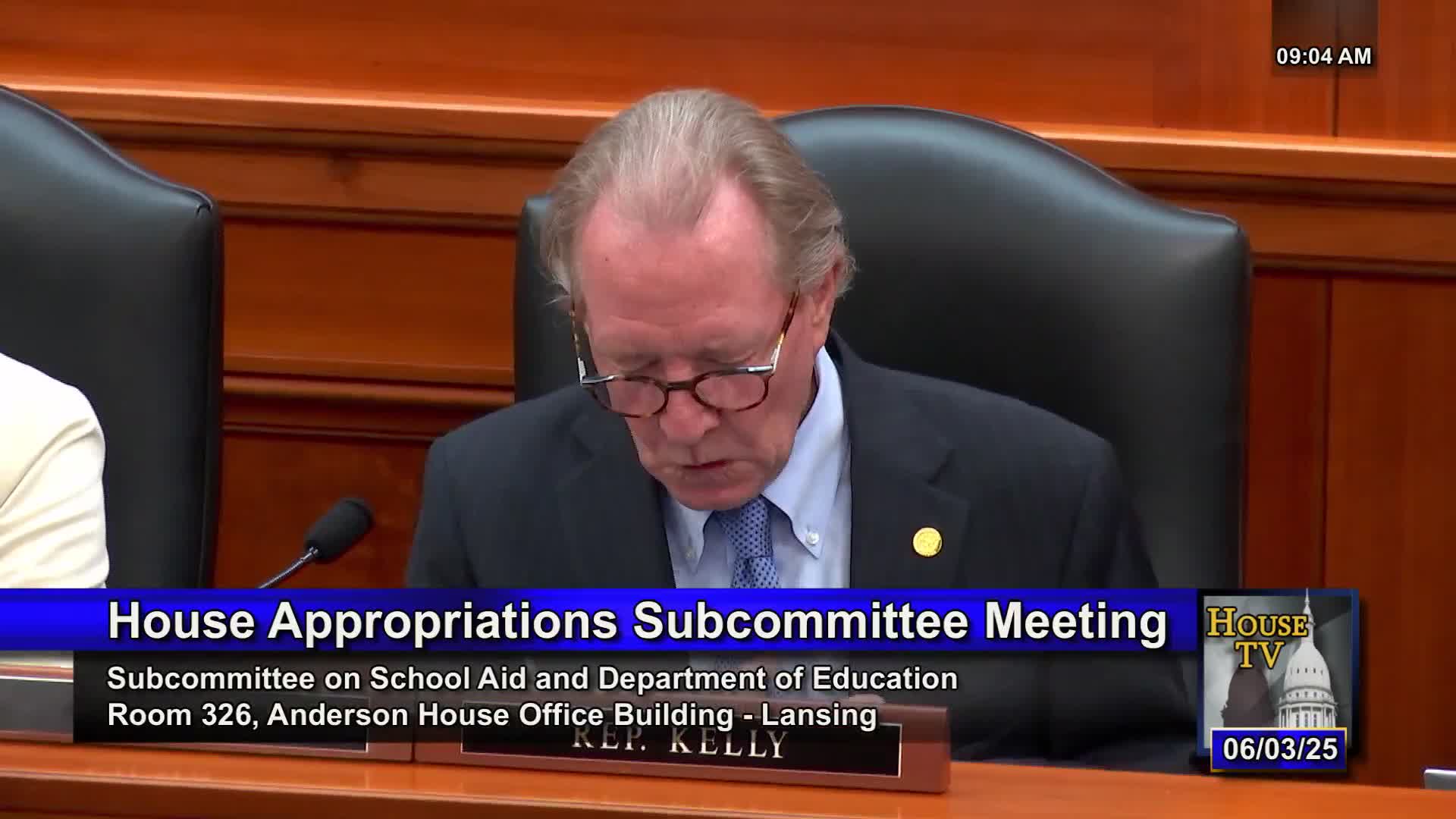
Summary
Optimize, the state-commissioned special-education capacity project, updated the House Appropriations Subcommittee on School Aid and the Department of Education on May 13, saying it has identified 127 barriers to Michigan’s special-education system and is pursuing targeted action teams, a statewide behavior-training plan and a recruiting campaign supported by a new job portal.
Optimize, the state-commissioned special-education capacity project, updated the House Appropriations Subcommittee on School Aid and the Department of Education on May 13, saying it has identified 127 barriers to Michigan’s special-education system and is pursuing targeted action teams, a statewide behavior-training plan and a recruiting campaign supported by a new job portal.
The presentation, given by Laurie Vander Ploeg, project consultant for Optimize, and Kathy Fortino, project manager for Optimize, reported that the initiative—created through line 94d of the School Aid Act—started work in 2022 and has received follow-up appropriations. Vander Ploeg told the committee “this is really a project that's intended to build statewide capacity.”
Why it matters: members of the committee pressed Optimize on how much longer state funding can sustain the effort and on how the project measures impact. Optimize said the most recent appropriation totaled $1 million and, accounting for carryover and current spending, “we have probably 2 years or so left” of funding and “may get through to 2027.” Committee members signaled support for continued funding if needed to preserve implementation gains.
Most important facts
- Scope and organization: Optimize convened a task force, a core team and multiple action teams to tackle the state’s special-education workforce and service challenges. The task force includes K–12 systems, institutes of higher education, professional associations and state agencies; Optimize said about 500 partners have participated across action teams.
- Barriers and priorities: The project reported identifying 127 barriers and then influence-mapping them to select the highest-leverage issues. Optimize said it focused on roughly five or six top barriers and created action teams around topics including credentialing, paperwork reduction, paraeducator training, building leadership for inclusive practices, school psychology and compensation.
- Credentialing and preparation: Optimize and its credentialing action team are working with the Michigan Department of Education and the Office of Educator Excellence (referred to in testimony as OEE) on a proposed new special-education credential. Vander Ploeg said the State Board of Education adopted new K–12 standards on May 13 that will require higher rigor in preparation programs and that the team is considering moving a five-year pathway to a four-year model with increased emphasis on literacy, numeracy and behavior.
- Workforce data and evaluation: Optimize is pursuing an 18-month workforce study with Michigan State University’s EPIC group to build a special-education–specific data picture. Presenters said current workforce data do not separate special education sufficiently to calculate attrition precisely; Optimize proposed paying Michigan State an additional amount to complete the scope of work.
- Recruiting and outreach: Optimize has launched a social-media campaign and a one-stop website and job portal. Fortino said the job portal contains “there's close to 3,000 positions that are posted,” and Optimize reported roughly 800,000 impressions on Snapchat since Jan. 1, 2025, with about 17,000 high-school users visiting the site and more than 265,000 video views. Optimize acknowledged the portal underrepresents openings from about 14 intermediate school districts that do not post externally; the project is offering to help those ISDs upload postings at no cost.
- Behavior supports and school psychology: A behavior action team with more than 70 participants recommended a statewide professional-development and coaching system that integrates school behavioral health, community mental health and other partners; Optimize said this work includes early-intervention (Part C) considerations. Optimize also reported it won Department of Labor funding to pilot a hybrid school-psychologist model and that an RFP has been issued in collaboration with MASP (the Michigan Association of School Psychologists).
Committee discussion and follow-up
Committee members asked for details on the 127 barriers and where to find them online; Optimize said the full list is posted on the project website. Representatives sought clarity on the 14 ISDs that do not post externally; Optimize said cost and local practice are likely factors and that CR Marketing (Optimize’s vendor) is helping the project reach those ISDs to offer free posting support.
Optimize said it has seen early signals of impact in higher-education enrollment: presenters reported that declines in special-education preparation program enrollment that once approached 66 percent (per an earlier comparison) have moderated and that some universities are reporting increases in specific endorsements. Northern Michigan University, Optimize said, has seen growth in learning-disabilities and early-childhood endorsements to the point of creating local faculty capacity pressures.
Formal committee actions
- Representative Glanville made a motion to approve minutes of May 13; with no objections the minutes were approved by unanimous consent.
- Representative Markkanen moved to excuse absent members; with no objections the motion prevailed by unanimous consent.
What was not decided
Optimize asked the subcommittee to consider continued funding beyond current carryover; the committee did not make a new appropriation at this meeting. Optimize also described a proposed paid study with Michigan State University and said an additional cost would be required; no committee vote on that study or its funding occurred.
Ending note
Optimize asked to return with more impact data as implementation expands. Presenters and committee members said they expect to review enrollment and program metrics, behavior-support plans and workforce-study results in future briefings.