Get Full Government Meeting Transcripts, Videos, & Alerts Forever!
Get email alerts on the Appropriations School Aid topic
No spam. Unsubscribe anytime.
House subcommittee backs House substitute for school-aid budget that rolls many categorical funds into larger per-pupil payments
Summary
The House Appropriations Subcommittee on School Aid adopted the H‑1 substitute for HB 45 77 and voted to report the bill to the full Appropriations Committee, advancing a $21.9 billion school‑aid plan that rolls numerous categorical grants into larger per‑pupil payments.
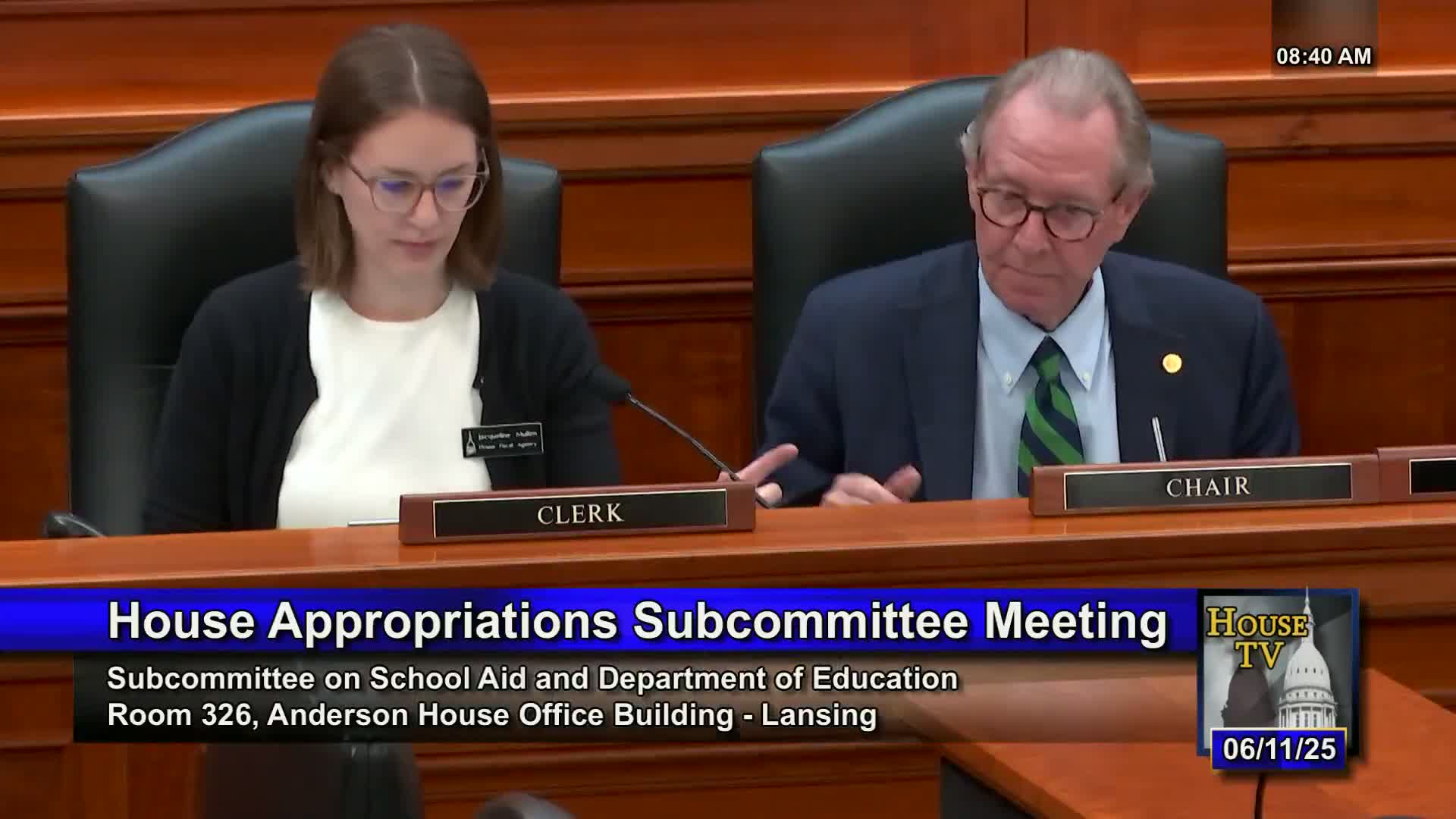
The House Appropriations Subcommittee on School Aid and the Michigan Department of Education adopted the H-1 substitute for HB 45 77 on a voice/roll-call vote and voted to report the substitute to the full Appropriations Committee.
The substitute would set total House school-aid appropriations at about $21.9 billion — an increase the House fiscal staff described as roughly $1.1 billion, or about 5.5% above the year-to-date level — while rolling multiple categorical appropriations into a larger per-pupil foundation payment. "The chair's recommendation proposes a total of 21.9 billion dollars," Jacqueline Mullins, senior fiscal analyst for the House Fiscal Agency, told the subcommittee.
Why it matters: The roll-up changes how money is allocated to districts, consolidating many categorical grants into a single per-pupil payment and adding new statewide requirements tied to that payment. Supporters said the change simplifies funding and raises the per-pupil foundation; critics warned it may shift money away from districts or programs with above-average costs.
What the substitute does: House fiscal staff said the substitute would raise the foundation allowance from $9,608 per pupil to $10,025 per pupil and includes cyber schools in that calculation. The plan also proposes an additional per-pupil payment that could increase effective per-pupil funding toward $12,000 in some cases; the staff noted the roll-up would also provide an estimated $228 per pupil to intermediate school districts (ISDs) and about $40.8 million in general-fund support to nonpublic schools. Jacqueline Mullins summarized the foundation change as an increase that "would bring it up from $9,608 per pupil to 10,025."
School safety and mental health: The substitute creates a new Section 22f that, according to the fiscal summary, would require districts to support at least one school resource officer (SRO) and one mental-health support staff member; nonpublic schools would also be required to support an SRO (which they may share). Fiscal staff described Section 31DDA in the current-year funding as being rolled into Section 22f and noted that the subcommittee added roughly $370 million in total for mental-health and safety supports in the roll-up, with $350 million from the School Aid Fund directed to district per-pupil payments and $20 million to nonpublics.
Reserve funds and deposits: The House plan would lapse and deposit balances from multiple reserve funds into the School Aid Fund, according to fiscal staff. Examples cited include a $147.4 million lapsing from the MPSERS reserve, $235.2 million from an educator fellowship public-provider fund, $193.6 million from the enrollment stabilization fund, and a $265.8 million deposit from the school-aid rainy-day fund (leaving an estimated $209 million in rainy-day). Fiscal staff identified the total of rolled funds and listed the deposits in the summary table.
Penalties and boilerplate changes: The substitute adds boilerplate provisions. One new boilerplate section described in the summary would impose a 20% penalty on a district's discretionary portion of the foundation allowance if the district is found to engage in specified curriculum or facility practices; fiscal staff described that provision as listing examples such as use of materials the bill labels as "race or gender stereotyping," funding for diversity/equity/inclusion initiatives, allowing transgender girls to participate in girls' sports, or providing multi-stall unisex bathrooms. The bill also contains a new hold-harmless payment (Section 22h) intended to offset reductions caused by the roll-up and an estimated $138.8 million total for that purpose.
Discussion highlights: Representative Glanville and others questioned whether rolling targeted funds into a general per-pupil payment would leave districts with higher, unavoidable costs (for example, transport or localized emergency needs) without dedicated funding. Representative Glanville asked for an example using Flint's declaration of emergency funding; fiscal staff explained the $8.1 million for the Flint emergency (split $5 million School Aid Fund, $3.1 million general fund) has been rolled into Section 22 so the dollars are included in the per-pupil buckets rather than as a separate, district-specific line item. Representative Glanville said that approach could leave districts with unique costs to decide how to spend their per-pupil allotment.
What was decided: The subcommittee adopted the H-1 substitute for HB 45 77 (motion by Representative Jenkins Arnold) and then voted to report the substitute to the full Appropriations Committee with recommendations that it pass. The substitute was adopted on a roll call in which five members voted yes and two members registered passes/abstentions; the motion to report was adopted on a roll call that recorded five yes votes and two no votes.
Next steps: The subcommittee reported HB 45 77 H-1 to the full Appropriations Committee for further action and negotiation with the Senate and governor's office, as committee members noted during the hearing.