Get Full Government Meeting Transcripts, Videos, & Alerts Forever!
Get email alerts on the Higher Education Appropriations Universities topic
No spam. Unsubscribe anytime.
Committee approves university funding plan that shifts funds into scholarships and campus investment funds, adds tuition caps and restricts some spending
Summary
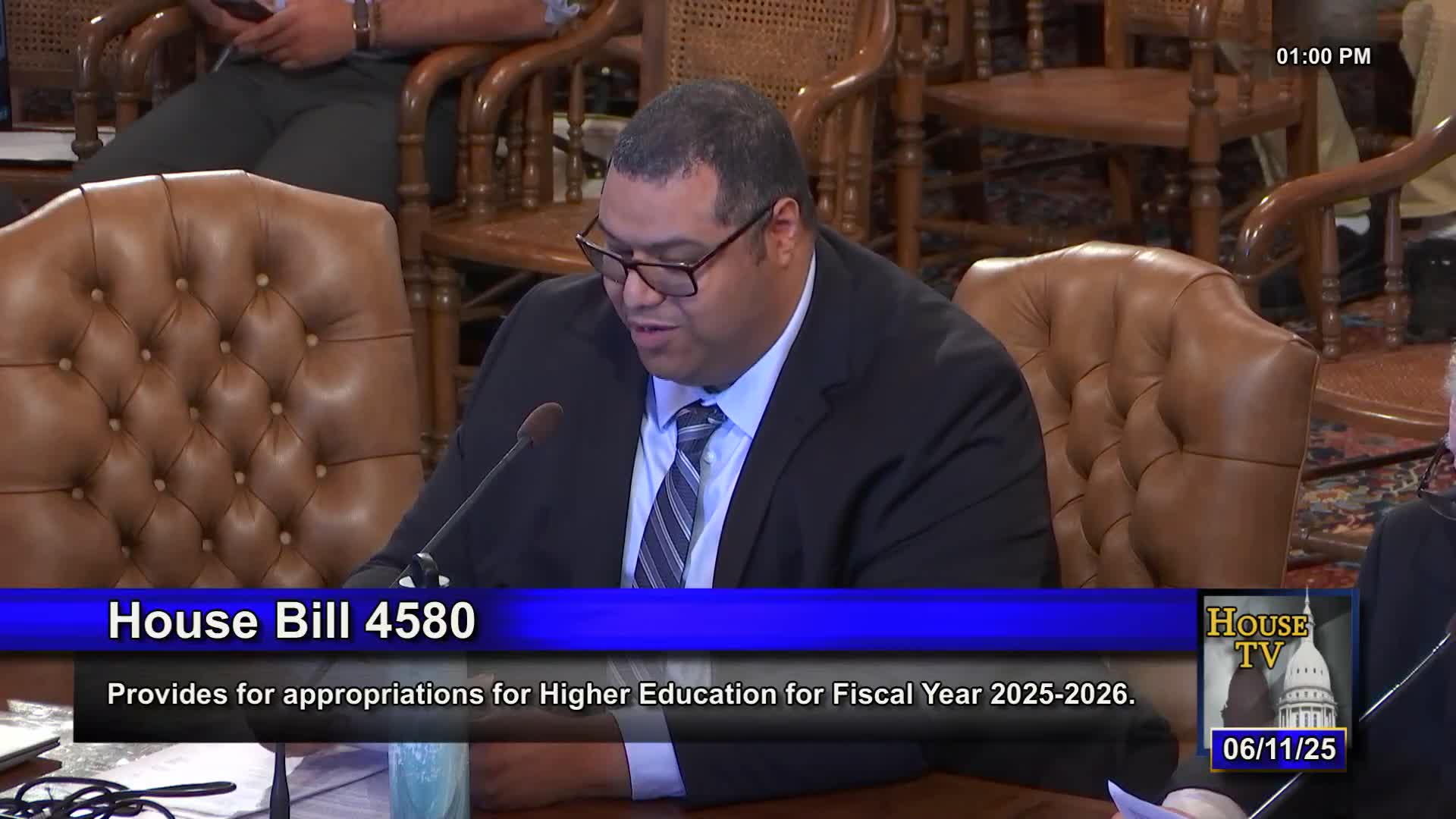
The House Appropriations Committee adopted the H‑1 substitute to House Bill 45 80, restructuring university funding by shifting significant dollars into a retooled Michigan Achievement Scholarship and campus investment funds while imposing tuition restraints and program restrictions.
The House Appropriations Committee adopted the H‑1 substitute to House Bill 45 80, the higher education appropriation, in a session that focused on a large restructuring of university support and a major expansion of the Michigan Achievement Scholarship (MAS).
House Fiscal Agency staff described the bill as moving substantial ongoing general‑fund operations appropriations for universities into a combination of smaller direct appropriations and new campus investment funds, while adding one‑time deposits to a post‑secondary scholarship fund. The H‑1 shows a gross appropriation framework that includes a large SAF (School Aid Fund) one‑time deposit of $1.1 billion to the post‑secondary scholarship fund, paired with a transfer of various university operation grants away from the general fund. House Fiscal summarized the net result as a direct appropriation to universities of $855.7 million gross (about $41.6 million general fund) for FY26, with an estimated additional $828.1 million in campus investment/MMAS‑related funding included in projections; combined, the total estimate with MAS would approximate current operations funding but shift the composition of appropriation sources.
Under the H‑1 the Michigan Achievement Scholarship program would be restructured to make awards more broadly available: the scholarship eligibility would be revised to allow awards up to $5,500 for residents attending 4‑year public or private institutions and up to $2,750 for residents at community colleges or tribal institutions, regardless of family income or high‑school graduation year. House Fiscal said the House would cap payments at $828.1 million for students at public universities, $170.6 million for private institutions, and $276.4 million for community colleges; the bill then deposits one‑time amounts into the scholarship funds to cover the program's expansion.
Campus investment funds are limited by statute language in the bill to infrastructure, technology, equipment, maintenance, safety and capital debt reduction; the bill ties distribution to FY24 resident full‑time equated students and applies reductions for institutions with larger endowments (50% reduction for endowments $1B–$5B, 65% for $5B–$10B, 75% above $10B). The bill conditions an institution's full campus investment allocation on a tuition restraint to the greater of 3% or $489.
Representatives and university advocates questioned the scholarship math and full‑time definitions. Representative Steckloff asked about differences between the bill's definition of full‑time (15 credit hours) and institutions' reporting measures; House Fiscal said the FY24 FYES (full‑time equated students) measure uses 15 credits and that estimates in the fiscal summary are based on FY24 numbers; the committee acknowledged the numbers were an estimate and that actual payouts will depend on enrollments and final award counts.
The H‑1 also removes general fund support for prior tuition grant and competitive scholarship programs, consolidating assistance under the revised MAS. The bill adds multiple boilerplate restrictions similar to those in K‑12 and community colleges: limits on DEI spending, restrictions tied to Students for Fair Admissions v. Harvard, salary spending limits and language restricting race‑ or sex‑based common area ceremonies. The bill also includes a $13 million general fund appropriation to participating universities that are part of the MPSERS support payment group.
Representative Markkanen, sponsor for the higher‑education slate, said the approach is intended to encourage student retention in Michigan and provide capital support to campus infrastructure while expanding scholarships to make college more affordable for Michigan residents. Representative Steckloff and others, including committee members, pushed back on estimates and urged clarity on full‑time definitions and MAS award modeling.
Several member amendments were offered and failed, including an amendment by Representative Farhat to delay the act until passage of a joint resolution limiting use of school aid funds (not adopted); an amendment by Representative Longjohn to protect a small amount of AgBio funding (not adopted); and an amendment by Representative Rogers to add veteran supports (not adopted). The H‑1 substitute was adopted on a recorded roll call and reported with recommendation to the full House.
Committee discussion emphasized the structural shift of university funding sources, tradeoffs between one‑time scholarship deposits and ongoing support, and the operational impacts of tuition restraints and new campus investment restrictions. House Fiscal and the sponsor said the total estimated allocations with MAS are intended to approximate current operations funding, although distribution and institutional impact will vary by campus based on enrollment, endowment and the final award mix.