
Lawmakers ask for clearer breakdown of Supreme Court and SCAO spending amid audit requests
Get AI-powered insights, summaries, and transcripts
Subscribe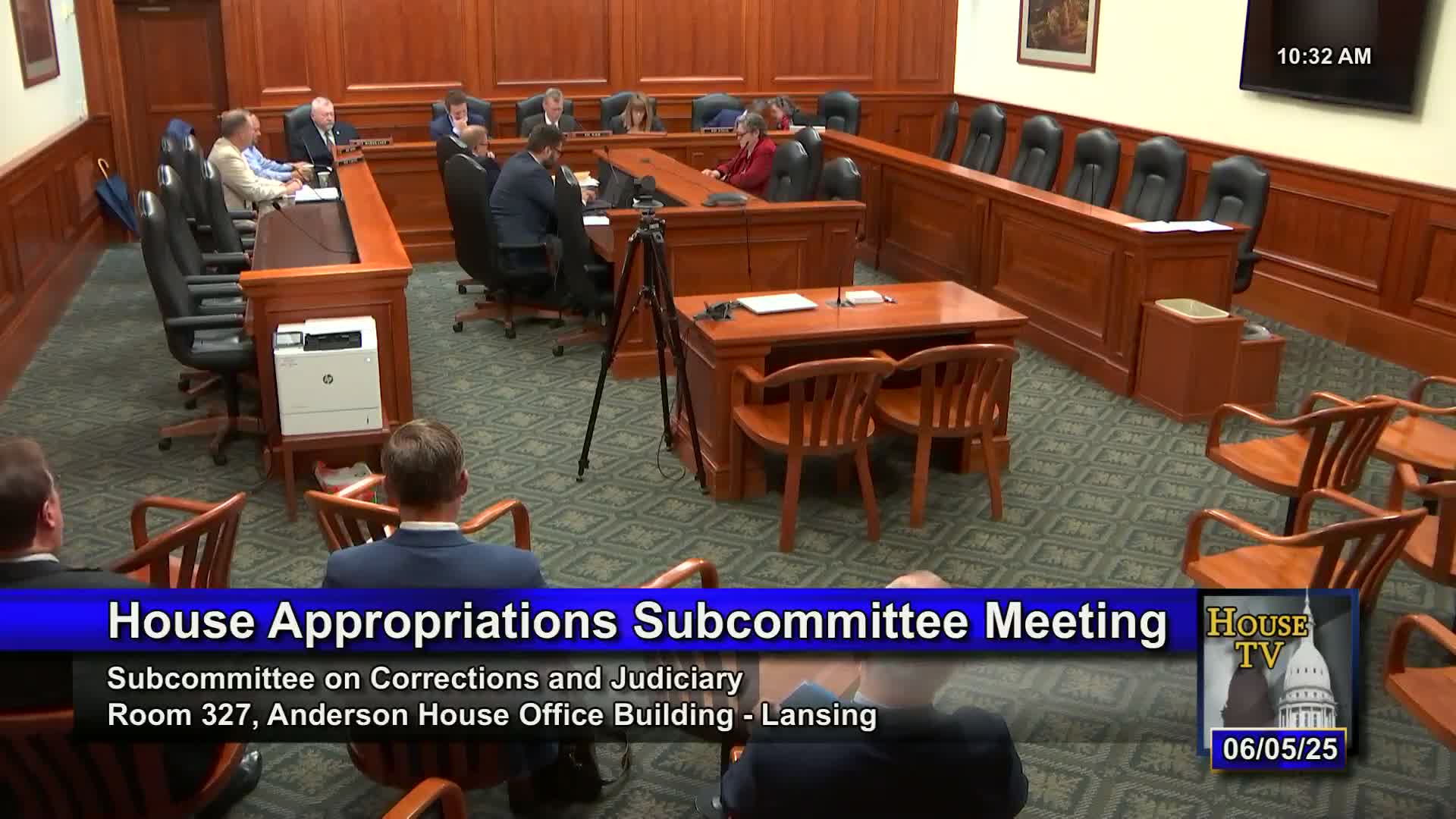
Summary
State Court Administrator Tom Boyd told members of the House Appropriations Subcommittee on Corrections and Judiciary that the Michigan Supreme Court controls how funds in the State Court Administrative Office (SCAO) and Supreme Court administration line items are spent and offered to provide detailed retrospective accounting to address lawmakers’ transparency concerns.
State Court Administrator Tom Boyd told members of the House Appropriations Subcommittee on Corrections and Judiciary that the Michigan Supreme Court controls how funds in the State Court Administrative Office (SCAO) and Supreme Court administration line items are spent and offered to provide detailed retrospective accounting to address lawmakers’ transparency concerns.
The request came during a committee meeting called to review roughly $14,500,000 appropriated to the SCAO line and about $16,500,000 in the Supreme Court administration line. Boyd said the constitutional authority to allocate those dollars rests with the Supreme Court and that much of the funding pays staff who provide statewide services to courts.
"The Supreme Court, through the chief, is responsible for how this gets laid out," Tom Boyd, State Court Administrator, said during the hearing. "We can tell you in the fiscal year 24 where we spent every dime for those two lines."
Why this matters
The two line items are part of broader judicial-branch appropriations that support court administration across Michigan. Lawmakers pressing for line-item clarity said the public and the Legislature should be able to see how appropriated funds flow through court functions such as clerks and legal staff, statewide human resources, and operations. The exchange underscored recurring tensions about how to balance judicial-branch autonomy under the Michigan Constitution with legislative oversight of public spending.
Most important details
Boyd explained that many administrative functions — human resources, finance, the public information office, and court analysts who help trial courts implement statutory changes — serve the entire judicial branch rather than only the SCAO. He said organizational changes ordered by successive chief justices can reassign the internal structure and that spending therefore is best described retrospectively.
He offered a practical response to the committee’s request for transparency: the SCAO can report past expenditures by Sigma spending units, the Department of Technology, Management & Budget payment system used for state accounting. "The easiest way for us is to tell you within Sigma," Boyd said. "We can tell you how much money we spent in FY24 in every one of those units."
Committee members pressed for that retrospective report during the hearing. Boyd said staff would compile and deliver expenditure details for the committee's review within weeks.
Discussion versus decision
The committee received Boyd’s explanation and requested follow-up. There was no formal vote on policy changes or reallocation of funds at the meeting. A procedural motion to approve the subcommittee minutes from the prior meeting was made and carried without objection.
Context and background
Boyd framed several legal and organizational points for members: the Michigan Constitution (Article 6) vests the Supreme Court with supervisory authority over court administration; it also authorizes the court to appoint a State Court Administrator and to employ "other assistance" to carry out administrative duties. He said those constitutional provisions underlie why some budget lines appear labeled as administration even though the funded staff perform operational and judicial-support roles.
What comes next
Committee members requested an itemized report showing where fiscal 2024 appropriations for the two lines were spent (Sigma spending units), and Boyd committed to producing that retrospective accounting. He said predicting future allocations is harder because the chief justice may reorganize internal functions.
Ending
Boyd stressed the courts’ intent to increase public transparency, citing new dashboards and a planned data analytics platform. The committee did not take formal action on the appropriation lines at the hearing but directed staff to supply the Sigma-based breakdown requested by members.