Get Full Government Meeting Transcripts, Videos, & Alerts Forever!
Get email alerts on the School Aid Appropriations topic
No spam. Unsubscribe anytime.
House plan raises per‑pupil foundation, rolls many categoricals into one payment and tightens school reporting
Summary
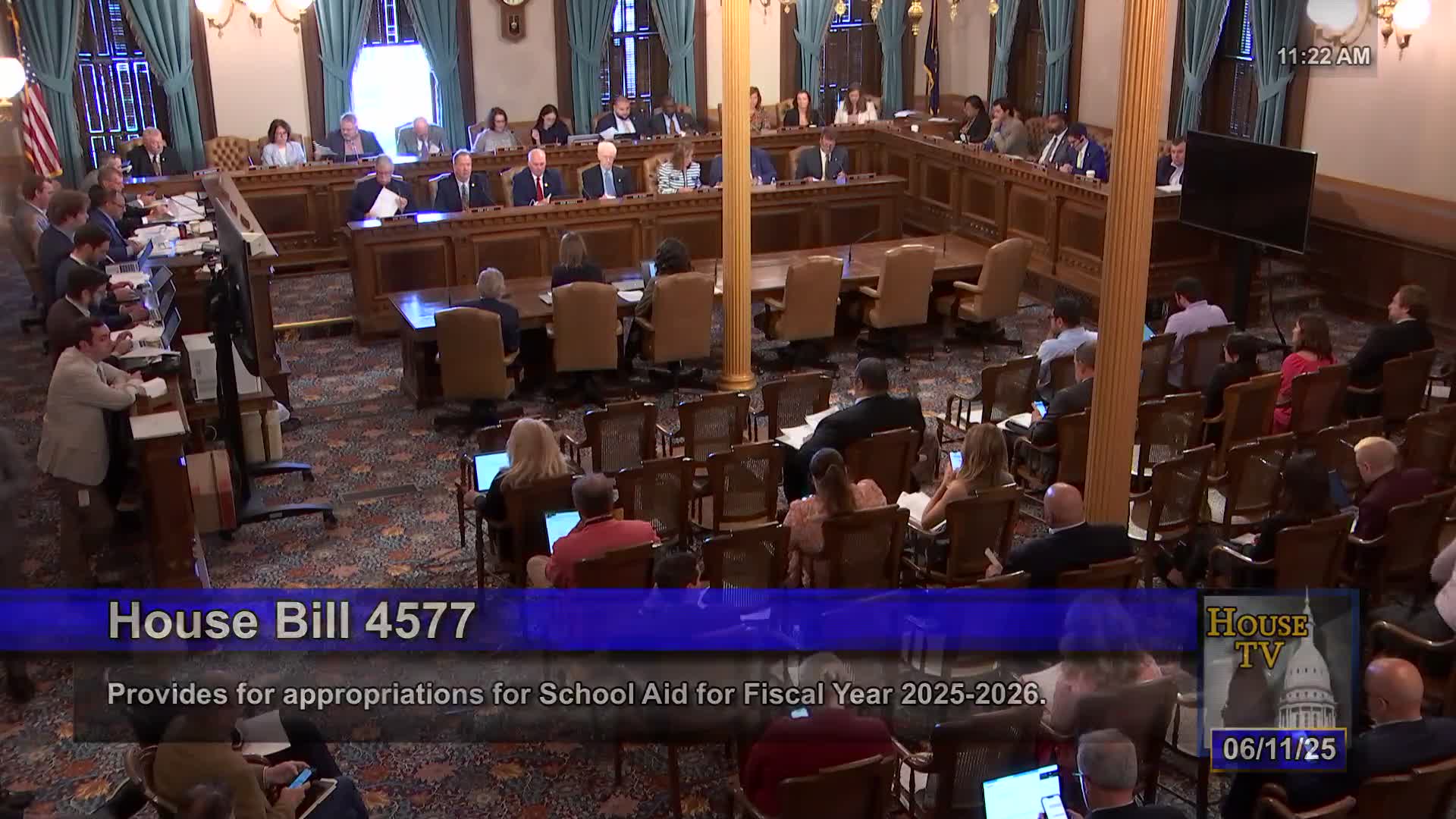
The committee advanced the H‑1 substitute for the school aid bill (House Bill 45‑77), increasing the foundation allowance per pupil and consolidating multiple categorical grants into a single per‑pupil payment while adding new reporting and compliance language.
The House Appropriations Committee voted to adopt the H‑1 substitute to House Bill 45‑77, the state school aid appropriation, advancing the funding plan that raises the foundation allowance and repurposes many ongoing categorical grants into a single per‑pupil payment.
House Fiscal analyst Jacqueline Mullen summarized the proposal and told members the House would increase the foundation allowance by $417 per pupil (a 4.3% increase) to $10,025 and create a new per‑pupil payment (section 22f) funded largely by rolling up existing categorical line items. Mullen said the House provides $3.1 billion in roll‑up funding that, when combined with other per‑pupil payments, is intended to simplify the formula while adding hold‑harmless language (section 22h) so districts and ISDs are protected from reductions caused by the reallocation.
Why it matters: The change alters how districts receive state support by converting many categorized grants into general per‑pupil funding. That affects program reporting, local choices about services, and how districts prioritize safety, mental health and literacy investments.
Key details
- Foundation allowance and supplemental payment: The House increases the foundation allowance by $417 (from a baseline cited at $9,608 to $10,025). It also creates a new per‑pupil payment (section 22f) and a hold‑harmless section (22h) to prevent unintended funding losses from the roll‑up.
- Roll‑up of categoricals: House Fiscal provided a table listing ongoing sections that would be eliminated and consolidated into the per‑pupil payment; items include transportation, school safety and other categorical programs. The House proposes transferring remaining balances from multiple reserve funds into the school aid fund to finance the roll‑up.
- Conditions on use: The House tied portions of the new per‑pupil payments to local commitments. For example, the school safety and mental health portion requires districts to support at least one school resource officer and one mental health staff member to receive parts of the new payment; nonpublic schools receiving funds would be permitted to share an SRO with districts.
- Boilerplate changes and compliance: The bill adds new reporting requirements (for example, districts must report which have been determined to need MTSS and reading interventions under section 7‑01) and imposes penalties for specified noncompliance. Section 1‑64k would allow MDE to withhold state aid payments for noncompliance on items such as school meal ingredient lists, FAFSA‑related incentives and survey transparency. The House also struck implicit bias training from eligible expenses for school board member training (section 6‑02).
Debate and amendments
- Meals: Representative Price questioned the removal of universal school meals from the state program; proponents said districts would have flexibility with the larger foundation allowance and federal food programs remain available.
- Charter and nonpublic funding: The House keeps cyber school funding at the same target foundation and includes nonpublic schools in the per‑pupil payment, prompting questions about parity and differences in obligations (such as special education and transportation responsibilities).
- Amendments: Representative Farhat’s amendment requiring school districts to report CTE participation was adopted. Representative Steckloff’s amendment to fund dual enrollment with $50 million was not adopted.
What the record shows: The committee adopted the H‑1 substitute (17 yeas, 12 nays) and recorded multiple roll calls and amendments; committee members asked fiscal staff for tables and follow‑up detail on the roll‑up list and the hold‑harmless calculations.