Get Full Government Meeting Transcripts, Videos, & Alerts Forever!
Get email alerts on the Education Appropriations School Aid topic
No spam. Unsubscribe anytime.
House approves school‑aid plan that increases foundation allowance, rolls up categoricals and adds penalties for certain district practices
Summary
The committee approved the H‑1 substitute of House Bill 45 77, the K‑12 school aid appropriation, raising the foundation allowance, creating a consolidated per‑pupil payment funded by rolled‑up categorical line items, and adding boilerplate penalties for specified district policies and practices.
The House Appropriations Committee on a 17‑12 recorded vote adopted the H‑1 substitute to House Bill 45 77, the school aid bill, a broad package that raises the foundation allowance, consolidates multiple categorical line items into a per‑pupil payment, and adds new boilerplate conditioning funding on several district policies.
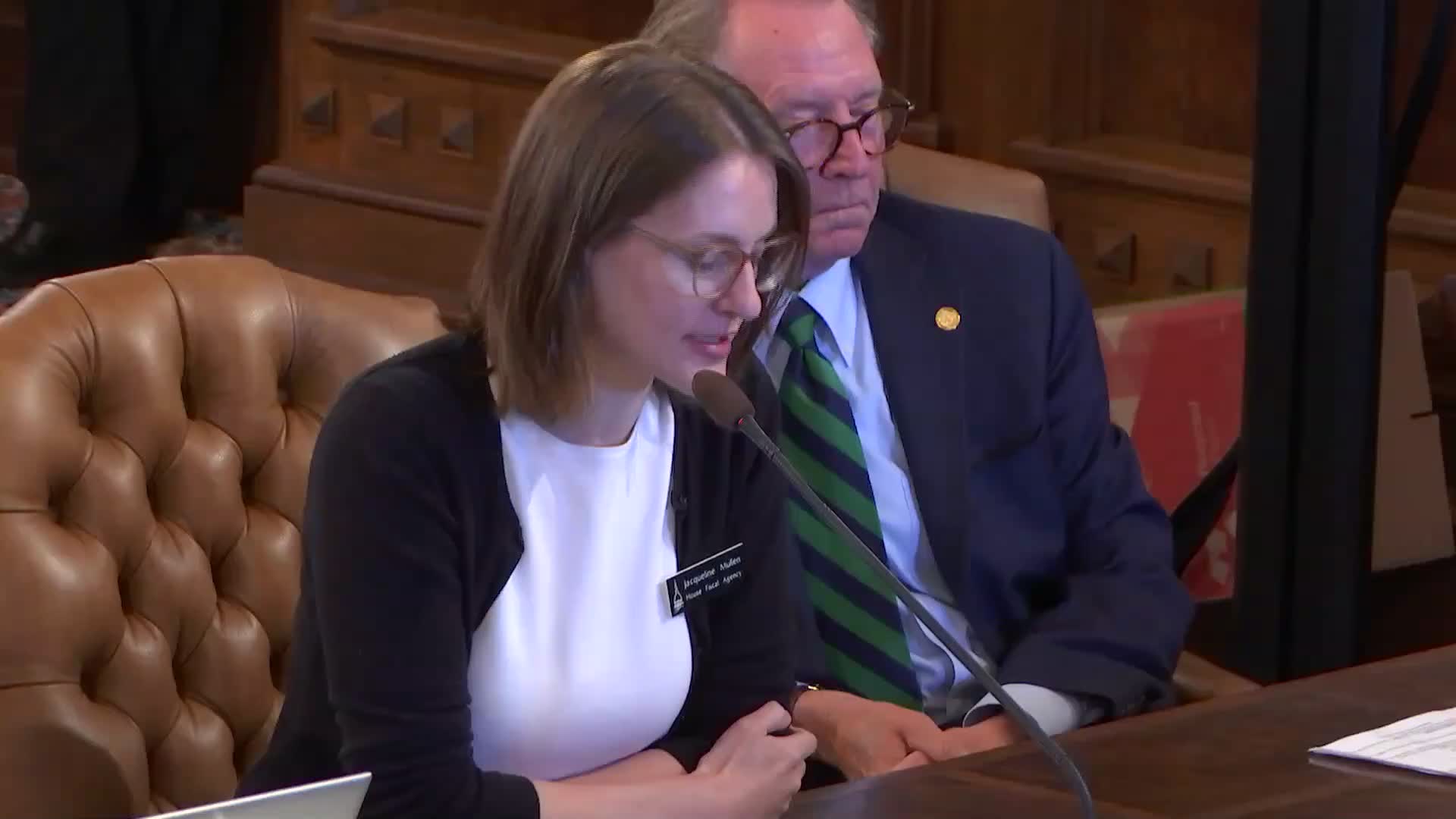
Jacqueline Mullen, Senior Fiscal Analyst for House Fiscal, presented the summary. The House proposal increases the foundation allowance by $417 per pupil — from $9,608 to $10,025 per pupil — and does not adopt the executive and senate's smaller cyber school target; cyber schools would also receive the increase to $10,025, Mullen said. The bill creates a new per‑pupil payment (drafted as section 22f) and funds that payment primarily by "rolling up" existing categorical line items into the per‑pupil payment; the roll‑up is intended to simplify and move more funding into an undifferentiated per‑pupil payment, staff said.
The H‑1 contains a new section (22f) that House Fiscal described as providing a per‑pupil payment to districts, intermediate school districts and nonpublic schools. The bill includes $40,800,000 of general fund directed at nonpublic schools with reporting requirements and an SRO (school resource officer) staffing requirement that allows sharing of an SRO with a district, according to the fiscal summary.
To protect programs that might lose funding as the roll‑up reallocates line items, the bill includes section 22h, intended to "hold harmless" districts and ISDs if the reallocation caused reductions. The House also proposes closing and transferring balances from several reserve and specialized funds into the school aid fund to finance the consolidated payment.
The bill makes numerous boilerplate changes, both operational and programmatic. Among the most consequential is a new penalty provision (cited as section 16 16 in the summary) that would impose a 20% penalty on a district's discretionary portion of its foundation allowance for noncompliance with listed items, including use of curriculum that "includes race or gender stereotyping," state funding for DEI initiatives, permitting transgender girls to play on girls'sports teams, or providing multi‑stall unisex bathrooms. Another new provision (section 164k) would allow MDE to withhold state aid for certain noncompliance items such as prohibiting particular ingredients in school meals, requiring completion of the federal free/reduced lunch application, or prohibiting surveys that include questions related to certain topics.
Representative Kelly, sponsor of the package, framed the approach as shifting money to a larger per‑pupil allotment and giving local officials more discretion: "a child is a child is a child and deserves the same amount of money regardless of where they choose to go to school," he told the committee. Representative Tammy Price and others raised concerns about elimination of the universal school‑meal program in the House proposal and the consequences for students in high‑poverty districts; Kelly replied that districts would have local options and federal programs (SNAP) could be used to meet needs.
During committee consideration Representative Kelly offered an amendment to restore dissemination of student performance data through EBAS; that amendment was adopted on a roll call. Representative Glanville moved a Democratic substitute (H‑2) that would have kept explicit funding for transportation, CTE, ELL, special education and other categorical supports while raising a per‑pupil target; the H‑2 substitute failed on a recorded vote. Representative Weiss, a former teacher appearing for public comment, testified the proposed roll‑up would shift about $2.5 billion out of school aid into the general fund and warned of risk to guaranteed funding for equity positions and categorical programs; committee members disputed some of those characterizations and noted the House's recommended school aid total was higher than other proposals.
The adoption vote on H‑1 was 17 yeas to 12 nays; the bill was reported with recommendation as amended for further House consideration.
Committee discussion focused on tradeoffs between simplifying funding into one per‑pupil line and preserving guaranteed categorical supports for districts that face higher costs because of geography, transportation, ELL students or special education needs. The committee record shows partisan disagreement over the policy boilerplate tied to funding and over whether the roll‑up adequately protects high‑need districts.