Get Full Government Meeting Transcripts, Videos, & Alerts Forever!
Get email alerts on the Education Appropriations Mde topic
No spam. Unsubscribe anytime.
House panel adopts MDE budget that trims staff, changes grant rules and limits some programs
Summary
The Michigan House Appropriations Committee approved the H‑1 substitute for House Bill 45 76, the appropriations bill for the Michigan Department of Education, reducing the department's gross budget and FTEs, adding new reporting and grant conditions, and adopting amendments that require additional CTE reporting.
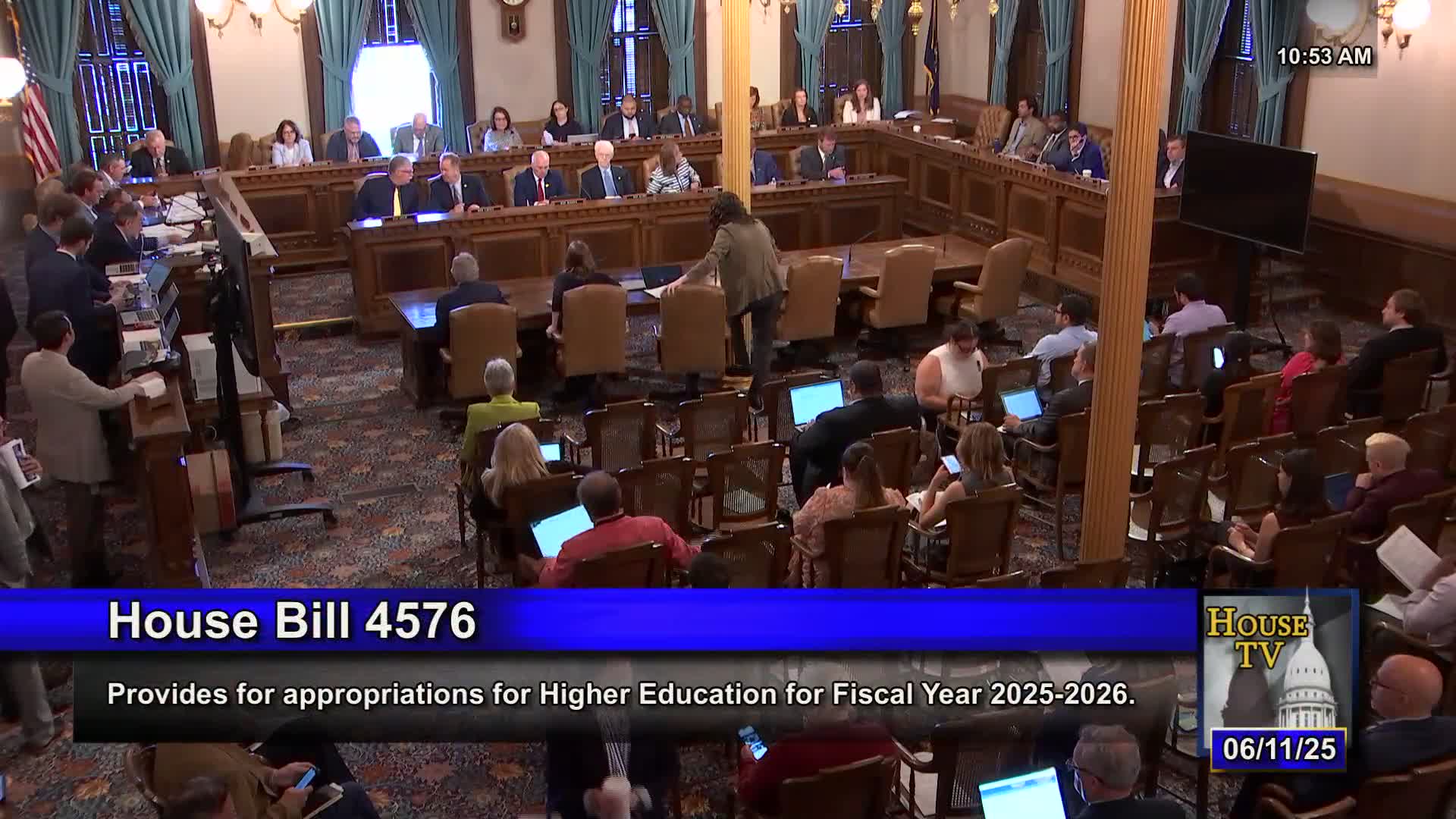
The House Appropriations Committee on a 17‑12 vote adopted the H‑1 substitute to House Bill 45 76, the Michigan Department of Education appropriation, after a morning of testimony and questioning about staff reductions, grant conditions and programmatic restrictions.
The H‑1 proposal sets the Michigan Department of Education (MDE) gross budget at $133,200,000, a gross decrease of $31,700,000 (19.2%), and reduces department full‑time equivalent positions by 118 to 456.5 FTEs, a 20.5% cut, officials from the House Fiscal Agency said. Jacqueline Mullen, Senior Fiscal Analyst for House Fiscal, and Noel Benson of the House Fiscal Agency summarized the changes for the committee.
The budget eliminates $8 million tied to teacher certification fees based on a separate House bill (House Bill 45 4,150) that would remove those fees, and removes authorization for about 65 vacant FTEs and other vacant positions, Benson said. The bill also eliminates several programs and administrative offices on the department side, including federal library services funding and the Office of Strategic Planning and Implementation, and reduces information technology appropriations.
The measure contains new and revised boilerplate directing how MDE may operate and report. Committee analysts highlighted sections that (using the bill's numbering) require quarterly department performance scorecards; cap court judgment payments at $200,000; reinstate severance reporting; condition grant awards and require quarterly grant reporting; and require contractors to use the federal E‑Verify system. The bill also adds language that "requires MDE to prioritize in‑person work, including the requirement for all employees to work in person 5 days per week," Benson said.
The H‑1 also includes programmatic restrictions and reporting requirements. Among other items it: removes funding for partnership district support (tied to the School Aid Act); strikes implicit bias as an eligible expense for school board member training; requires reporting on which districts the department determines need to implement multi‑tiered systems of supports (MTSS) and reading intervention; and adds limits on use of funds for certain DEI programs, according to Benson's presentation.
Committee members pressed staff and the bill sponsor on the in‑person work requirement, the effect of the FTE reductions on service delivery, whether foster care oversight language was included, and whether dyslexia screening implementation received funding. Representative Tim Kelly, the bill sponsor, told the committee the bills aim to shift more funding directly to per‑pupil support and local decision‑making; "a child is a child is a child and deserves the same amount of money regardless of where they choose to go to school," he said.
Representative Matt Maddock moved adoption of the H‑1 substitute. The clerk recorded 17 yeas and 12 nays; the H‑1 was adopted and the bill was reported with recommendation as amended.
After adoption the committee considered member amendments. Representative Christine Farhat offered and won an amendment to require districts to report counts of students participating in career and technical education at or before graduation and while still in high school; the clerk recorded 29 yeas, 0 nays and the amendment was adopted. Representative Mariam Steckloff proposed an amendment to place $50 million into a dual‑enrollment program; that amendment failed on a 12 yeas to 16 nays vote.
Discussion during the hearing included repeated concerns about reductions in department staff and whether the department can meet reporting and oversight expectations with the lower FTE authorization. Representative Edwards asked whether the in‑person work language considered field workers with non‑office schedules; Benson and the sponsor said the intent is to prioritize in‑person work after the COVID period. Representative Snyder raised questions about funding for dyslexia screening implementation and whether the increased foundation allowance would cover local costs. Representative Glanville pressed the sponsor on the committee's requirement that MDE report which districts "need" MTSS, noting most districts already use MTSS.
The committee transcript and roll calls show the bill passed committee as amended and is recommended for further action by the House. The committee record shows deliberations focused on fiscal tradeoffs, staff reductions, and new reporting/contracting conditions placed on MDE. The measure moves forward with MDE funding reduced from current levels but with new reporting and oversight provisions and statutory cross‑references in the bill text.