Get Full Government Meeting Transcripts, Videos, & Alerts Forever!
Get email alerts on the Private Adoption Licensing topic
No spam. Unsubscribe anytime.
Attorneys, agencies and parents press Georgia on private-adoption delays and enforcement of unlicensed placement activity
Summary
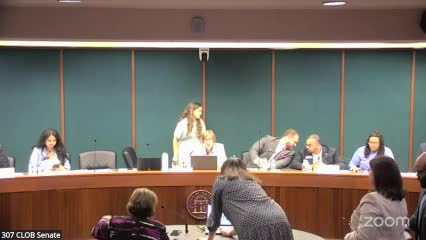
Private adoption attorneys, agency directors, adoptive parents and birth mothers testified to the Senate special committee about evolving Georgia ICPC checklist requirements, delays in approvals, and enforcement actions against out-of-state operators; state licensing officials described recent interagency-agreement reviews and citations.
A second panel focused on private adoptions, advertising, unlicensed actors and how Georgia enforces child-placing rules. Senators heard competing accounts: DHS and the Office of Inspector General’s Residential Child Care Licensing (RCCL) unit described stepped-up enforcement of interagency agreements (IAAs) with out-of-state child-placing agencies, while private attorneys and adoptive families described repeated checklist changes, long delays for interstate approval and cases in which children were removed from private placements during investigations.
Why it matters: Attorneys and adoptive parents said recent administrative changes to ICPC practice and Georgia checklists have made interstate private adoptions longer and more uncertain—delaying families’ returns home with newborns and, in some accounts, leaving babies in foster care for months. RCCL and the inspector general’s office said the changes were necessary to curb unlawful advertising and unlicensed placement activity and to protect birth parents from exploitation.
State enforcement steps: Beth Vineyard, director of RCCL, and Inspector General Maurice Ingram described an enforcement focus that began after adoption attorneys and other stakeholders raised concerns about out-of-state entities doing placement activity in Georgia without an IAA or Georgia license. Vineyard said Georgia law requires that "no person can advertise that they will adopt or arrange for or cause a child to be adopted or placed for adoption unless they're in one of three categories: a child placing agency, a prospective adoptive parent with an approved home study, or a Georgia attorney representing a prospective adoptive parent with a valid approved home study." She added that unlawful advertising and offering inducements are felonies under Georgia law.
Since RCCL put an emphasis on interagency agreements on July 15, 2024, Vineyard reported the office had received 130 IAA submissions, approved 76, had two withdrawn and reported 51 as "no jurisdiction" cases; RCCL had denied none (data reported as of the week before the hearing and updated in-session). RCCL also described 21 investigations that led to citations: 17 at the "substantial compliance" level (an educational-level finding) and four at a higher initial category 3 level, which RCCL said reflected intentional or deceptive violations. Vineyard said the number of citations has trended downward as outreach and education increased, and that RCCL now processes IAAs in roughly five business days.
Practitioner and family concerns: Private-adoption attorneys and agency directors testified that starting in late 2023 Georgia’s ICPC checklist and packet expectations changed repeatedly, causing uncertainty. Multiple attorneys said the state’s revised checklist had at times required material not demanded by other states—most prominently, a certified copy of the birth mother’s full medical record and a certification that the packet contained the mother’s entire record. Several speakers said Georgia appeared to be the only state requiring the mother’s entire medical chart and that obtaining certified medical records can be costly and slow.
Attorneys and adoptive parents described multiple cases where approvals were delayed or where ICPC-initiated investigations interrupted private placements. Counsel cited one high-profile Cherokee County case where an infant placed with adoptive parents was removed, placed in foster care and later returned after court proceedings; attorneys described that episode as an example of what they called "weaponization" of ICPC screening. Several family witnesses said administrative delay forced adoptive couples to remain in hotels or Airbnbs with newborns for weeks and months, missing early-family milestones.
Birth-parent and agency testimony: Several birth mothers and agency executives told senators that unchecked out-of-state intermediaries and unregulated facilitators have, in some circumstances, arranged placements that skirt Georgia licensing rules and that quick, on‑the‑ground support for expectant mothers is often missing when an out-of-state virtual operator handles a case. Agency directors described a range of agency fees and the cost of adequate oversight: one agency director said a full-service, licensed-agency placement for a private adoption (including placement support, a birth-parent attorney and counseling) typically has a multi-thousand-dollar fee, and that agency audits and malpractice/agency insurance are material cost drivers.
Suggested fixes and next steps: Witnesses disagreed about the appropriate balance between speed and safeguards. Several attorneys and agency directors urged DHS to publish a stable checklist and engage practitioners in rule design; DHS officials said they had published an updated, streamlined checklist the Monday before the hearing and that agency staff were working on additional improvements to tracking and technology. RCCL said it would begin annual reports on unlawful placement activity to the attorney general and law enforcement and stressed that a portion of the citations issued reflected lack of knowledge by out-of-state CPAs rather than willful misconduct; RCCL said it had shortened investigations in many cases to a one-business-day administrative review to avoid delaying families.
Committee response: Several senators asked DHS and RCCL to supply the committee with numbers the department did not have at the hearing—most prominently, an exact percentage of incoming packets that were incomplete and the nature of the missing items—so the legislature can assess whether administrative action, model rulemaking or statutory change is required. Some committee members suggested exploring statutory options to require independent counsel for birth parents in certain circumstances and to consider adoption-related reforms discussed in the Uniform Unregulated Child Custody Transfer Act.
The hearing closed with DHS and other officials offering to continue working with practitioners, providing more data and considering administrative and (where appropriate) statutory steps to both protect birth parents and prevent unnecessary delay for adoptive families.