Get Full Government Meeting Transcripts, Videos, & Alerts Forever!
Get email alerts on the Interstate Compact Children topic
No spam. Unsubscribe anytime.
Senate committee hears federal, state overview of interstate child-placement compact and Georgia timelines
Summary
A Senate special committee on Children and Families heard an overview of the Interstate Compact for the Placement of Children (ICPC) from a national expert and Georgia Department of Human Services officials, who described how the compact works, the state’s caseload and regulatory timelines while saying the committee will not vote today.
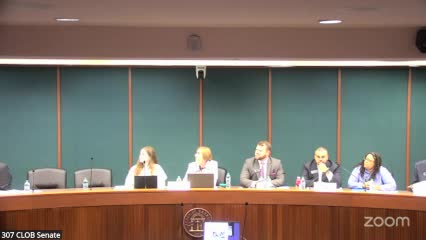
Senate Chairwoman Kay Kirkpatrick convened a special meeting of the Senate Special Committee on Children and Families to examine the interstate compact for placement of children (ICPC), saying the hearing was called to "understand the process and to give all parties a chance to be heard." The committee said it would not take votes at the session.
The session opened with a remote briefing from Rick Masters, general counsel to the Interstate Commission for Juveniles, who summarized the compact’s purpose and recent updates. Masters said ICPC “is one of those compacts, which was enacted back in the 1950s,” and described the compact as a contract between member states that sets enforceable procedures for placing children across state lines.
Why it matters: Committee members and DHS officials said the recently revised ICPC and its implementing rules aim to reduce inconsistent enforcement and court challenges that have complicated interstate placements, and to provide clearer rulemaking for member states. Senators asked whether neighboring states had enacted the revised compact and how Georgia’s implementation would affect cross-border placements.
State officials described how ICPC cases move through Georgia’s system. Bridal Pedersen, deputy commissioner for health law and policy at the Georgia Department of Human Services (DHS/OHLP), told the committee DHS has consolidated ICPC work under OHLP and has revised public materials and checklists to speed processing. Pedersen said DHS moved its ICPC team under OHLP in February 2025 and is “just getting started” on broader operational changes.
Aletta DeJola Adegen, identified as the state compact administrator, outlined regulation types and statutory processing windows used in Georgia. He told senators that the state classifies placements under numbered ICPC regulations: relocation of an already-approved relative or foster family (Regulation 1), incoming placements that have not yet been approved (Regulation 2), licensed residential facility placements (Regulation 4) and expedited/priority emergency placements (Regulation 7). He summarized Georgia’s internal timelines:
- Regulation 1/2: up to 3 days to request a home study; up to 45 days to complete a home study; up to 3 days to transmit an approval or denial; if approved, up to 180 days for the sending state to effect placement. Georgia officials said 60 days is a more typical placement interval under normal circumstances. - Regulation 4 (residential facilities): up to 3 days for an approval/denial and up to 30 days to place the child. - Regulation 7 (expedited/priority): case initiation to assignment in 1 day, home-study completion in up to 15 days, decision transmission in 3 days, and the same up-to-180-day placement window if approved.
Dina Krim, a special assistant attorney general assigned to juvenile and ICPC matters, explained Regulation 12, which governs private (agency and independent) adoptions that cross state lines. She noted Regulation 12 gives receiving states three business days to review a packet and called the typical ICPC packet “at least a 100 pages long,” often much larger. Krim said Georgia strives to meet that 3-business-day standard for Reg 12 review but that delays most commonly result from incomplete packets.
Key figures and caseload: Pedersen provided fiscal-year-to-date figures for FY25. Georgia’s ICPC unit had processed just over 1,600 receiving-state cases (the state was the receiving jurisdiction) so far in the year; staff reported about 77% of those were public (parent/relative/foster/public-adoption) matters, 17.5% were residential placements and about 5.6% were private-adoption matters. As a sending state, Georgia had handled roughly 863 outgoing cases (71% public, 22% residential, 6.4% private adoptions). Pedersen said combined sending and receiving cases totaled nearly 2,500 in FY25 to date.
Officials emphasized that the sending state retains jurisdiction after placement for supervision and reporting, and that the receiving state may decline placements that would be contrary to the child’s interests. Pedersen and Adegen told senators that Georgia’s ICPC office uses a national case-tracking tool (referred to as the "NICE"/NEICE system in testimony) to communicate packets between states and to monitor status.
Committee questions and next steps: Senators pressed DHS on average processing times, causes of delay and whether neighboring states had enacted the revised compact; Adegen said only Florida among Georgia’s immediate neighbors had statutorily enacted the revised compact as of the briefing, and he offered to provide a list of other states offline. Pedersen and Adegen said missing or incomplete documentation—especially in Regulation 12 packets for private adoptions—was the single largest driver of delay. Krim and DHS staff also said they were updating checklists and public guidance to reduce preventable omissions and encouraged continued dialogue with practitioners.
The session’s presenters repeatedly framed the hearing as informational and said the committee would not vote; officials offered to provide supplemental case counts, the percentage of deficient packets, and revised checklists and tracking metrics for the committee’s follow-up. The committee paused for additional witnesses after the DHS presentations.